Dolphin Sleep Chronotype: Light Sleepers Are Wired Differently

“This post contains affiliate links. I may earn a commission if you buy through these links, at no extra cost to you. Read my Disclaimer for more details.”
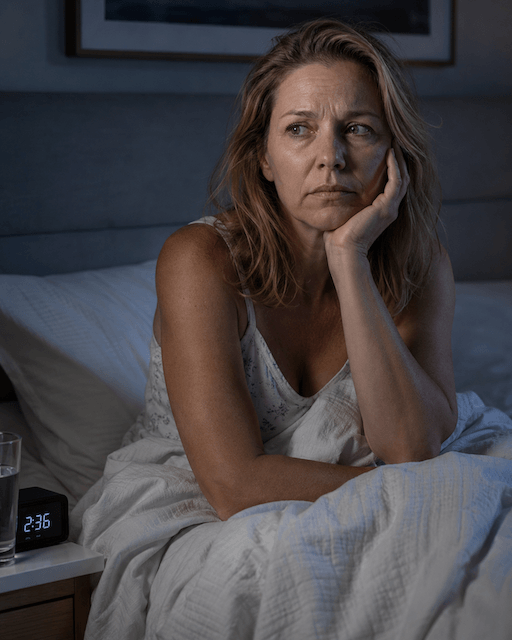
Most people who come to this site arrive because they’ve been diagnosed with sleep apnea, or they suspect they might have it. But over the years, I’ve heard from a broader group — people who struggle with sleep in ways that don’t fit the classic sleep apnea picture. They’re not necessarily snoring loudly or stopping breathing. They’re just… light sleepers. Easily woken. Tired despite spending enough hours in bed. Unable to switch off at night, no matter how exhausted they feel.
If that pattern sounds familiar, you may have encountered the term dolphin sleep chronotype. It’s been floating around wellness circles for a while now and I’ve had enough questions about it to think it deserves a proper explanation — what it actually means, what the research says, and what you can realistically do about it.
What a Sleep Chronotype Actually Is
A chronotype is your biological predisposition toward a particular sleep timing and pattern. It’s not a lifestyle choice or a habit — it’s driven by your circadian rhythm, which is the internal body clock that regulates when you feel alert, when you feel sleepy, and when your body performs various restorative functions. Chronotypes are largely genetic, though they shift across the lifespan — teenagers tend toward later chronotypes, older adults toward earlier ones.
The chronotype framework most people are familiar with divides people into morning types and evening types, sometimes called larks and owls. The more detailed four-type model popularised by sleep psychologist Michael Breus adds two further categories — the lion, the bear, the wolf, and the dolphin — each named for an animal whose sleep patterns loosely resemble the human type.
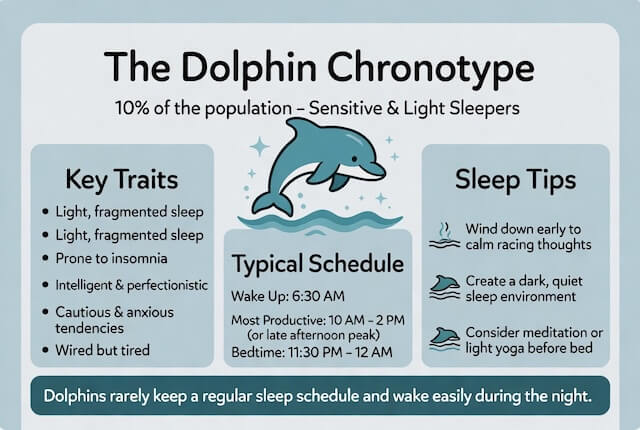
The dolphin is the outlier in this framework. Where lions, bears, and wolves differ mainly in timing — when they feel most alert and when they naturally want to sleep — the dolphin chronotype is defined less by timing and more by quality. Dolphins are light sleepers. They’re easily roused by noise, temperature changes, or even just the subtle physiological arousal that comes with stress or an active mind. They tend toward hypervigilance at night, with a nervous system that doesn’t fully downregulate the way it needs to for consolidated, restorative sleep. The name comes from the fact that actual dolphins sleep with one brain hemisphere active at a time, maintaining enough awareness to surface and breathe, which is a reasonable metaphor for a human who never quite fully lets go.
The Dolphin Pattern in Practice
If you’re a dolphin chronotype, the experience is probably familiar even if you’ve never had a name for it. You get into bed tired. You lie there while your mind runs through the day, or tomorrow’s tasks, or something that happened three weeks ago that you can’t quite let go of. Eventually, you fall asleep, but it’s light — any sound in the house can pull you back to the surface. You might wake at two or three in the morning for no apparent reason and then spend an hour trying to get back under. By morning, you’ve been in bed for seven or eight hours, but you don’t feel like you’ve properly slept.
The frustrating thing about this pattern is that it doesn’t show up on a standard sleep tracker as obviously broken. You’re clocking the hours. You’re not snoring dramatically or being kicked awake by a partner. You just feel, persistently, like your sleep isn’t doing what sleep is supposed to do.
Research into hyperarousal and insomnia consistently shows that the nervous system plays a central role in this pattern. People who sleep lightly and wake frequently tend to have elevated physiological arousal at night — higher core body temperatures, higher heart rate variability, more cortisol — than people who sleep deeply. The brain isn’t fully transitioning into the lower-arousal states that deep and REM sleep require. It’s maintaining a kind of background alertness that makes sleep fragile.
This isn’t a character flaw or a sign that you’re doing something wrong. It’s a genuine neurological tendency, and for some people it’s strongly heritable. Understanding that is actually useful because it shifts the question from “why can’t I just sleep normally” to “what does my particular nervous system need in order to settle.”
Why the Environment Matters More for Light Sleepers
Here’s something that research makes clear and that I think is underappreciated in most sleep advice: the sleep environment has a disproportionate effect on people who sleep lightly. For a deep sleeper, a slightly dry room, a pillow that’s not quite right, or a minor temperature fluctuation might produce no response at all — they sleep straight through it. For a dolphin chronotype, the same conditions can trigger a full awakening.
This means that environmental optimisation isn’t optional for light sleepers the way it might be for others. It’s one of the highest-leverage interventions available, and it works independently of whatever else you might be doing for your sleep. If your room is too warm, too dry, too noisy, or your bedding is creating physical discomfort, those factors are working directly against your sleep architecture in ways that are harder to compensate for than they would be for someone with a more robust sleep system.
The American Academy of Sleep Medicine recommends a cool, dark, and quiet sleep environment as a foundation for healthy sleep — guidance that applies to everyone but matters most for people whose sleep is easily disrupted. Temperature in particular has a strong mechanistic relationship with sleep depth: the body needs to drop its core temperature by one to two degrees Celsius to initiate and maintain deep sleep, and anything that impedes that process — warm bedding, a warm room, a pillow that traps heat — directly interferes with the sleep stages that leave you feeling rested.
Humidity is another factor that gets overlooked. Dry air irritates the airways and promotes mouth breathing during sleep, which produces dry mouth, throat discomfort, and more frequent microarousals — brief neurological awakenings that you may not remember but that fragment your sleep architecture over the course of a night. This matters for everyone but it’s especially relevant if you sleep lightly, because those microarousals are more likely to become full awakenings.
The Role of Magnesium and Nervous System Support
Beyond the physical environment, there’s reasonable evidence for targeted nutritional support in people whose sleep problems are rooted in nervous system hyperarousal rather than circadian timing issues.
Magnesium is the most well-studied here. It plays a role in the regulation of GABA, the primary inhibitory neurotransmitter — essentially the brain’s brake pedal. Adequate magnesium supports the nervous system’s ability to downregulate, and deficiency is associated with increased anxiety, muscle tension, and sleep disturbance. Most adults in Western populations don’t get enough magnesium from diet alone.
Magnesium L-threonate is a particular form that has attracted research interest because of its ability to cross the blood-brain barrier more effectively than other forms, making it more relevant specifically to cognitive calm and sleep quality rather than just general magnesium sufficiency. The research is still developing but the early evidence is promising for people whose sleep problems are primarily arousal-driven rather than driven by circadian misalignment.
For a dolphin chronotype whose core problem is a nervous system that won’t switch off, this kind of targeted support makes more mechanistic sense than many of the generic sleep hygiene recommendations that get offered to everyone regardless of the underlying pattern.
What Actually Helps: A Realistic Picture
I want to be honest about what works and what doesn’t for this particular sleep pattern, because a lot of what gets marketed at light sleepers is either generic or irrelevant to the actual problem.
Sleep timing adjustments — the usual chronotype advice about aligning your schedule to your natural preferences — matter less for dolphins than for lions and wolves, because the dolphin’s problem isn’t primarily about timing. Going to bed at the “right” time doesn’t help much if the nervous system is still running at too high an idle when you get there.
The things that do move the needle are the ones that directly address fragmentation and arousal. A sleep environment that removes the small disturbances that trigger wake-ups. Physical comfort that doesn’t create its own arousals — a pillow that supports proper alignment, bedding that doesn’t trap heat, a mattress that doesn’t transmit partner movement. Genuine nervous system wind-down in the hour before bed, which means reducing screen exposure, lowering stimulation, and if appropriate, supporting GABA function with magnesium. A consistent wake time, which is probably the single most well-evidenced behavioural intervention for sleep quality across all chronotypes.
The Dolphin Cool Drift Bundle
For people who want to address several of these factors at once rather than buying and testing products individually, the Dolphin Cool Drift Bundle at SleepDoctor is worth knowing about.
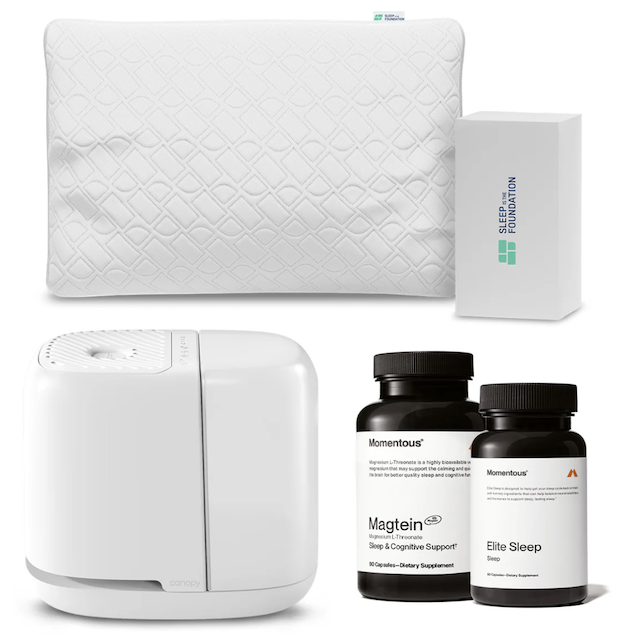
It’s designed specifically with the light sleeper’s profile in mind and brings together four components that address different dimensions of the fragmentation problem.
The Canopy Bedside Humidifier 2.0 keeps overnight air humidity at a level that reduces airway irritation and dry mouth, which disrupts light sleep. If you regularly wake with a dry throat or find that air-conditioned rooms make your sleep worse, this addresses that directly. It’s also particularly useful for CPAP users, where dry air is a known driver of mask discomfort and compliance issues.
The Gel Memory Foam Pillow provides the temperature-neutral, alignment-supporting sleep surface that matters more for dolphin sleepers than most people realise. Gel memory foam dissipates heat rather than trapping it, which helps maintain the core temperature drop that deep sleep requires. It also supports neutral head and neck alignment, which reduces the tossing and turning that comes from physical discomfort during the night.
The Momentous Magnesium L-Threonate and Elite Sleep capsules address the nervous system side of the equation — supporting cognitive calm and natural sleep cycle regulation in ways that are relevant to arousal-driven sleep fragmentation rather than just general relaxation.
The bundle is currently available at $328, down from $386, which represents reasonable value given that the humidifier and pillow alone account for most of that price and each would cost comparably purchased separately. It’s available through SleepDoctor, ships in one to two business days, and is HSA/FSA eligible — worth knowing if you have funds in either account that you’re looking to put toward sleep health.
It won’t suit everyone. If your sleep problems are driven by undiagnosed sleep apnea rather than the hyperarousal pattern, environmental improvements will help at the margins but won’t address the underlying issue. And if you’re already sleeping deeply and just want to optimise, the investment is probably not necessary. But for someone who genuinely fits the dolphin profile — light, fragmented, arousal-driven sleep that hasn’t responded to basic sleep hygiene — addressing multiple disruption sources simultaneously tends to produce better results than fixing them one at a time.
A Note on Getting the Diagnosis Right
Before investing in sleep environment improvements, it’s worth being reasonably confident that what you’re dealing with is actually a chronotype and arousal issue rather than something that needs medical investigation. The dolphin pattern — light sleep, frequent awakenings, unrefreshing rest — overlaps with several conditions that have specific treatments, including insomnia disorder, anxiety-related sleep disruption, and sleep-disordered breathing.
If you wake frequently and feel exhausted despite adequate time in bed, and particularly if anyone has ever mentioned that you snore or stop breathing during sleep, it’s worth getting properly assessed before concluding that your sleep architecture is simply the way you’re built. A proper evaluation gives you a baseline — and if it comes back normal, you can invest in environmental optimisation with confidence that you’re addressing the right problem.
The dolphin chronotype is real, it’s well described in the sleep science literature, and the people who fit the profile genuinely benefit from approaches tailored to their particular sleep pattern. But the label is a starting point for understanding, not a reason to skip the investigation that tells you what you’re actually dealing with.
⚠️ MEDICAL DISCLAIMER This blog provides general information only and is not a substitute for professional medical advice, diagnosis, or treatment. Sleep apnea is a serious condition, and CPAP equipment should be used under proper medical supervision. Always consult your doctor or sleep specialist before starting, stopping, or changing any therapy. I share personal experiences as a CPAP user, not as a medical professional. Individual results vary. For medical guidance, please consult a qualified clinician or the American Academy of Sleep Medicine (aasm.org).