Teeth Grinding and Sleep Apnea: Dude, Your Teeth Fit Together Like a Jigsaw!


A while back I tried to take this blog onto TikTok. Short videos, big reach, and there was already a lot of sleep apnea content getting traction. I figured I could help people who were never going to find a written blog about obstructive sleep apnea, but who might watch a short video on the topic.
I filmed what I thought was a useful video about teeth grinding and sleep apnea. The next morning, a comment had landed underneath it.
Dude, your upper and lower teeth fit together like a jigsaw puzzle. That’s wild.
I went to the bathroom and actually looked. The commenter was right. Years of grinding in my sleep had worn the cusps and ridges off my back teeth so smoothly that the upper and lower set fit together like two halves of the same shape. I had not properly noticed. Or, more honestly, I had noticed and not wanted to look.
I never posted to TikTok again. The comment was not cruel, but it landed hard, and it knocked the energy out of the channel for me. What it did do, though, was force me to take the dental side of sleep apnea seriously. This post is about that part of the story, and about a tradeoff I am still sitting in.
A disclosure before I go further. My background is in computer science, not medicine. Nothing here is medical advice. I am writing as someone who has lived with severe obstructive sleep apnea for more than a decade, not as a clinician.
What my situation actually looks like
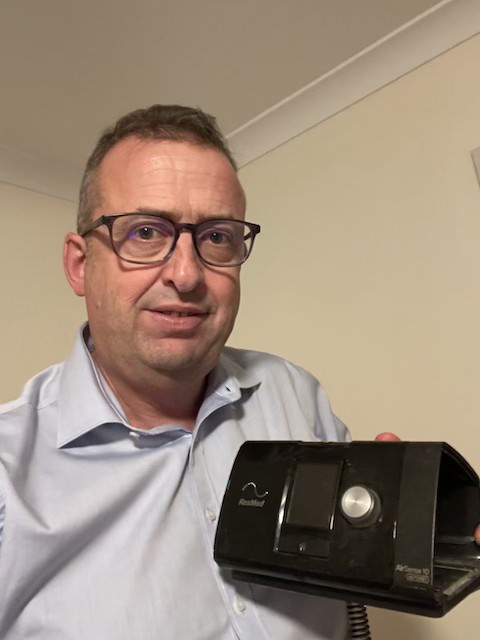
I was diagnosed with severe obstructive sleep apnea more than a decade ago. My AHI was 51 at diagnosis, which is firmly in the severe range. Anything over 30 counts as severe. I have been on CPAP therapy since the diagnosis, using a ResMed AirSense 10 and a full face mask. I am a chronic mouth breather, which is part of why a full face mask is the right fit for me rather than a nasal mask.
CPAP works for me. It treats the breathing problem. What it does not do, at least not as far as I can tell, is stop the grinding.
My dentist is the one who confirmed the bruxism damage. She walked me through the wear pattern across my back teeth, the flattened biting surfaces, the places where the enamel had been ground thin. Then she said something that I want to pass on, because it is sensible advice rather than a sales pitch. She said I needed a night guard, but I should buy an over the counter one first and see how it felt before I committed to an expensive custom guard. Custom dental appliances are not cheap, and you do not really know whether you can sleep with one in your mouth until you try.
I have not done it yet. I will get to why.
Why obstructive sleep apnea and teeth grinding are tangled together
The link between bruxism, the medical word for teeth grinding, and obstructive sleep apnea is well documented in the sleep medicine literature, although the direction of the relationship is not fully settled. The Cleveland Clinic puts it carefully: research has confirmed a correlation between sleep apnea and teeth grinding, but it is not entirely clear whether the apnea causes the bruxism or the other way around.
The mechanism that gets discussed most often goes like this. When your airway collapses or partially closes during sleep, your brain registers the drop in oxygen and triggers a brief arousal to restart breathing. These arousals are short and you usually do not remember them. Along with the arousal comes a burst of muscle activity, including in the jaw. The theory is that the jaw clenching and grinding is part of the body’s attempt to reposition the tongue and pull the airway back open.
If that is the right picture, then a person with severe sleep apnea and an AHI in the fifties is having those events around fifty times an hour, all night. That is fifty opportunities for the jaw to clench. Multiply that by years of untreated apnea and the dental damage adds up.
The peer-reviewed literature on this is summarized in the StatPearls bruxism management chapter on the NIH bookshelf, which notes that sleep related microarousals correlate with sleep bruxism, and that sleep apnea is one of the recognized risk factors. I find that resource useful because it cites the underlying studies rather than just summarizing them.
A couple of caveats are worth holding onto. First, not everyone with sleep apnea grinds their teeth, and not everyone who grinds their teeth has sleep apnea. Second, plain stress related grinding is also a real thing, and you can have both at once. The honest version is that if you grind your teeth at night, sleep apnea is one of the things worth ruling in or out, but it is not the only possible cause.
For me, the timing fits. The worst of the visible damage was done in the years before my diagnosis, when my apnea was untreated and I was having dozens of breathing events per hour, every hour, all night.
Why a night guard and a full face CPAP mask do not happily share a face
This is the part I wish someone had warned me about earlier, because it changes the available options.
For most people with bruxism, the standard recommendation is a night guard. A barrier of acrylic or plastic between your upper and lower teeth, so that the grinding wears down the guard instead of the enamel. Simple, effective, broadly recommended.
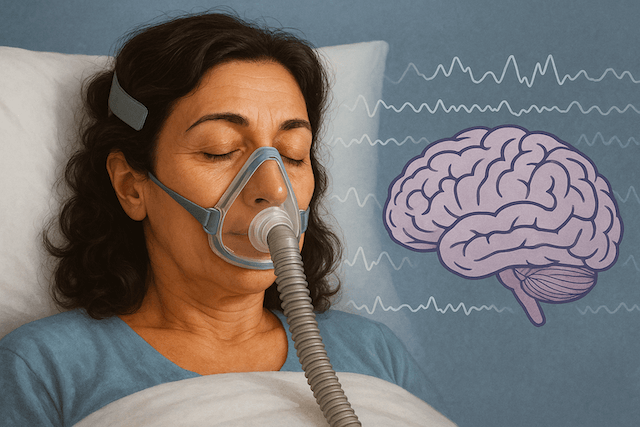
When you also wear a full face CPAP mask, the picture gets more complicated. A full face mask seals over both your nose and your mouth. It needs an even seal against the skin to deliver pressurized air without leaks. Adding a bulky guard inside your mouth changes the shape of your jaw and lips in subtle ways. For some people, that does not matter. For others, it shifts the seal just enough that the mask starts leaking air, which makes the therapy less effective.
There are also practical concerns. A guard plus a mask is more equipment in your face than most people want to wear to sleep. If you are already struggling to tolerate CPAP, especially in the early months, stacking a night guard on top is a real ask.
If you wear a nasal mask or nasal pillows instead, the picture is easier. The mask only covers your nose, your mouth is free, and a night guard fits in roughly the same way it would for someone without sleep apnea. The trouble is that nasal masks only work if you can keep your mouth closed during sleep, which mouth breathers like me cannot reliably do.
So the people most likely to need a night guard, those with severe long term apnea grinding through their teeth, are also the people most likely to be wearing the mask that least likes a night guard underneath it. That is not great.
The honest tradeoff I am sitting in
Here is where I have to be straight, rather than write the version of this article that pretends I am doing everything right.
My dentist told me I need a night guard. She gave me sensible advice for how to start, by trying an over the counter one before committing to a custom one. I have not done it. The reason is simple. Sleeping with CPAP every night is already enough work. The mask, the hose, the cleaning, the seal, the small daily admin of the therapy. Adding another piece of equipment into my mouth, on top of the mask sealed over my mouth, is something I have not yet been willing to take on.
I am aware that this is a choice with consequences. Every night I sleep without a guard, I am letting more enamel get worn down. I cannot grow it back. The damage I already have is permanent, and any new damage on top will also be permanent. I am not pretending otherwise.
What I have decided, for now, is that the CPAP therapy itself is the priority. Untreated severe sleep apnea is a serious condition, with cardiovascular and cognitive consequences that go well beyond dental wear. If I add a night guard and find that I cannot sleep with it, and the mask seal degrades, and my therapy adherence drops, I have made things worse, not better. So I have not added it.
That might change. The honest answer is that the right thing to do is probably to take my dentist’s advice and try the cheap over the counter version, see how I sleep with it, and find out whether my reluctance is real or just inertia. I am writing this post partly because saying it in public makes it harder to keep putting off.
If you are in a similar spot, I am not going to tell you what to do. I will tell you that the conversation to have is with your dentist and your sleep specialist together, not separately. They each see one half of the picture.
What people in this situation could think about
A few things are worth raising with your clinicians if you are dealing with both sleep apnea and grinding.
The first is whether your sleep apnea is being treated as effectively as it could be. Untreated apnea is associated with bruxism in the literature, and there is reasonable evidence that good CPAP therapy reduces grinding for a meaningful number of patients. So the first question is not really about the grinding. It is whether your sleep study, your equipment, your pressures, and your adherence are all where they should be. A useful starting point if you have not been formally tested is a home sleep study or a lab based study ordered by your doctor.
The second is the mask question. If you are mostly a nose breather and your apnea is not severe, you may be able to use a nasal mask and a night guard together without much fuss. That option is worth raising with your sleep specialist before you assume you are stuck with a full face mask.
The third is whether a custom guard might be designed with your CPAP mask in mind. A dentist with experience in dental sleep medicine can sometimes make a guard that is thinner, or shaped differently from a standard one, in a way that plays better with a mask. This is not something a general dentist will necessarily think about unprompted. If you are going to spend the money on a custom guard, it is worth finding someone who understands what is sealing against your face every night.
The fourth is the obvious one, which is that there are alternative sleep apnea treatments for people with mild or moderate. Mandibular advancement devices, which reposition your lower jaw forward to keep the airway open, can sometimes do double duty as a guard and an apnea treatment. They are not appropriate for severe cases like mine, but for someone with mild apnea and grinding, that is a real conversation to have.
The fifth thing, and the one that applies to everyone in this situation, is to keep your dentist in the loop on your sleep apnea. Most dentists are not sleep specialists, but a dentist who knows you have OSA will look at your teeth differently than one who does not. They will be more alert to the wear patterns, more careful about how they document the damage over time, and more likely to flag changes early.
When to actually see a doctor
If you are reading this and any of the following sounds familiar, the honest answer is to get evaluated rather than self diagnose from a blog post.
Loud, persistent snoring. Waking up gasping or choking. A partner who has watched you stop breathing in your sleep. Morning headaches or a sore jaw most mornings. Visible wear on your teeth, or a dentist flagging the wear pattern. Daytime sleepiness that is not explained by your schedule. Trouble concentrating that has crept in over months or years.
The damage from untreated sleep apnea, dental or otherwise, builds up quietly. It is the kind of problem where each individual night seems unremarkable, until enough of them stack up that you find yourself looking in the mirror at teeth that fit together like a jigsaw.
That comment under my TikTok video was the most useful thing a stranger has ever said to me. I would rather not have needed the lesson. But if you are grinding your teeth and you have not been tested for sleep apnea, please go and get tested.
You can find an accredited sleep center through the patient education site of the American Academy of Sleep Medicine. Talk to your doctor first, take the referral, and get the study done. Whatever the result is, you will know more than you do now, and that is worth a lot.
⚠️ MEDICAL DISCLAIMER This blog provides general information only and is not a substitute for professional medical advice, diagnosis, or treatment. Sleep apnea is a serious condition, and CPAP equipment should be used under proper medical supervision. Always consult your doctor or sleep specialist before starting, stopping, or changing any therapy. I share personal experiences as a CPAP user, not as a medical professional. Individual results vary. For medical guidance, please consult a qualified clinician or the American Academy of Sleep Medicine (aasm.org).