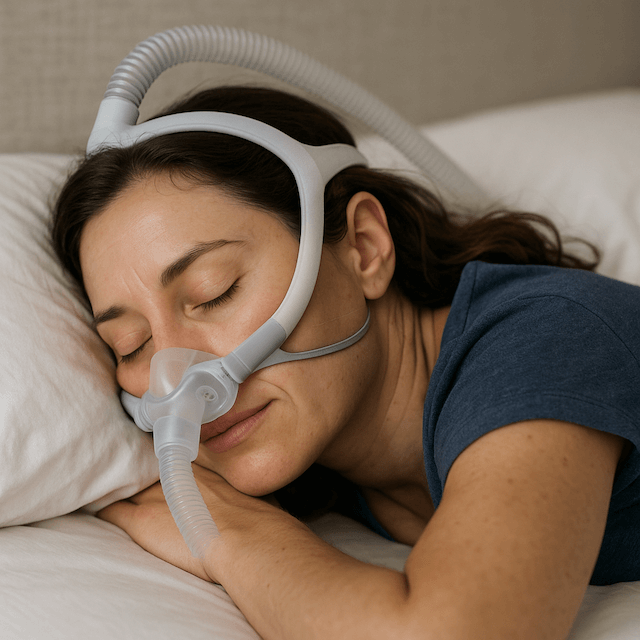
Best CPAP Masks for Side Sleepers: What Actually Works

“This post contains affiliate links. I may earn a commission if you buy through these links at no extra cost to you. Read my Disclaimer for more details.”
Side sleeping is the recommended position for sleep apnea. Your airway sits more favourably, gravity is working with you rather than against you, and for a lot of people it’s simply the position their body defaults to. The problem is that it’s also the position most likely to cause mask problems — and if you’re new to CPAP, having your mask leak, shift, or dig into your face every time you roll over is one of the fastest routes to giving up on therapy entirely.
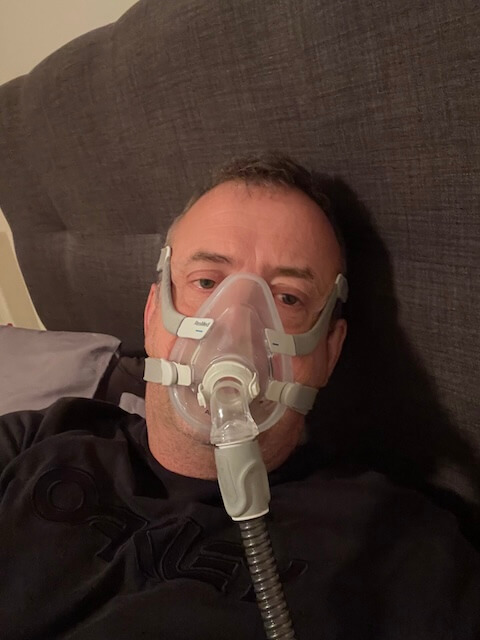
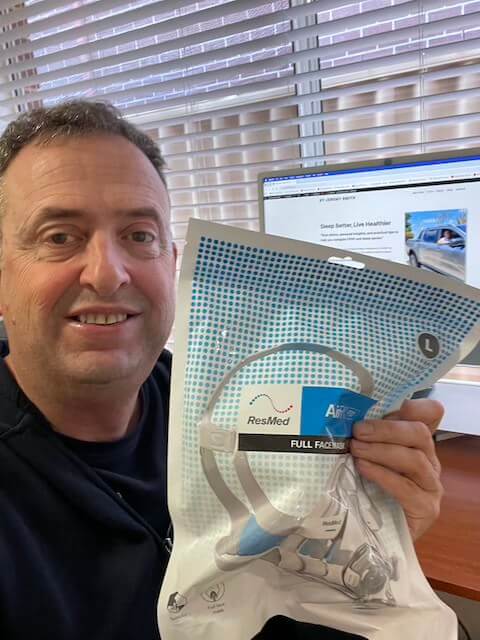
I’m a side sleeper. I’ve been using a full face mask — the ResMed AirFit F20 — for over ten years. I know exactly what the pillow-meets-mask problem feels like, and I know what separates a mask that handles side sleeping from one that fights against it all night. The issues are specific: the mask frame pressing against the pillow and breaking the seal, the hose pulling when you shift position, and the cushion losing contact when your face is compressed from the side. Solving them requires either minimal facial contact, a top-of-head hose connection, or enough structural stability to maintain the seal under lateral pressure — ideally, more than one of those.
According to the American Academy of Sleep Medicine, CPAP mask fit and comfort are among the primary drivers of therapy adherence — and for side sleepers in particular, the wrong mask makes every night a negotiation rather than a routine.
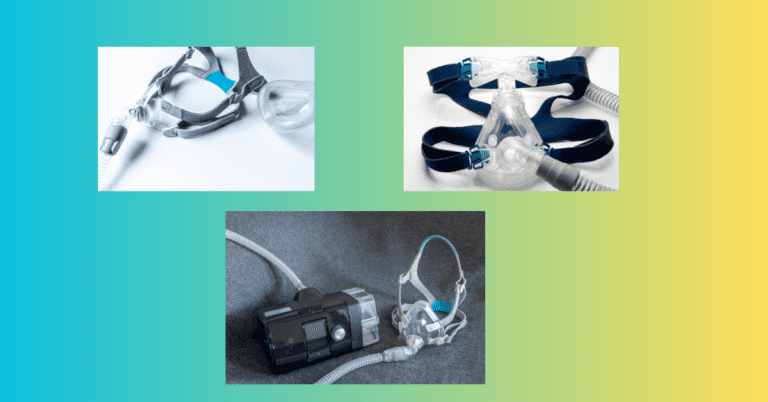
Quick picks:
| Your situation | My recommendation |
|---|---|
| Best overall for side sleepers | ResMed AirFit P10 |
| Best top-of-head hose design | Philips DreamWear Nasal |
| Best minimal contact nasal | ResMed AirFit N30i |
| Best nasal pillow alternative | Fisher & Paykel Brevida |
| Best full face for side sleepers | ResMed AirFit F20 |
ResMed AirFit P10 — Best Overall for Side Sleepers
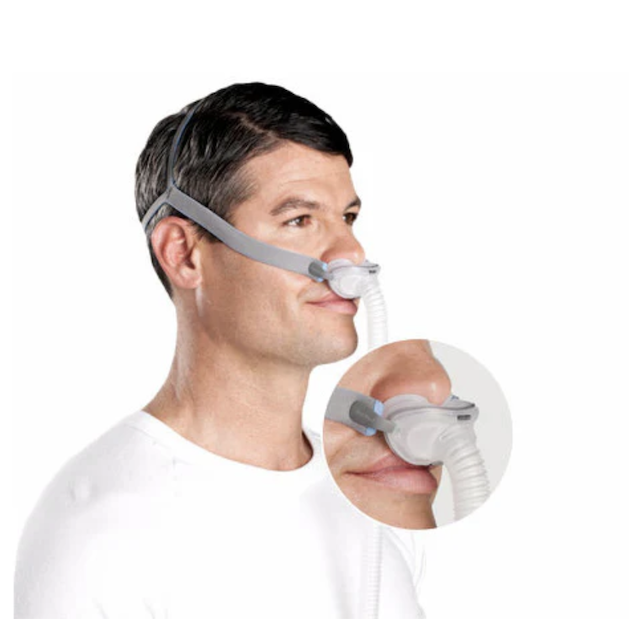
The P10 is the easiest recommendation for side sleepers who are confirmed nose breathers, and the reason is straightforward: there’s almost nothing there. The nasal pillows insert lightly at the nostrils with minimal headgear — no frame pressing against a pillow, no cushion surface for the pillow to displace, barely anything between your face and the bedding. When you roll onto your side, there’s nothing to fight.
It’s also one of the quietest CPAP masks available, which matters in a shared bedroom. The low-friction headgear stays put through position changes without needing to be strapped so tightly it causes discomfort. Compatible with virtually every CPAP machine on the market.
The limitation is the same as every nasal pillow mask: mouth breathers need either a chin strap to keep the mouth closed or a different mask type altogether. If you know you breathe through your mouth during sleep, skip to the F20 at the bottom of this list. If you’re a nose breather, the P10 is genuinely hard to beat for side sleeping comfort.
Philips DreamWear Nasal — Best Top-of-Head Hose Design
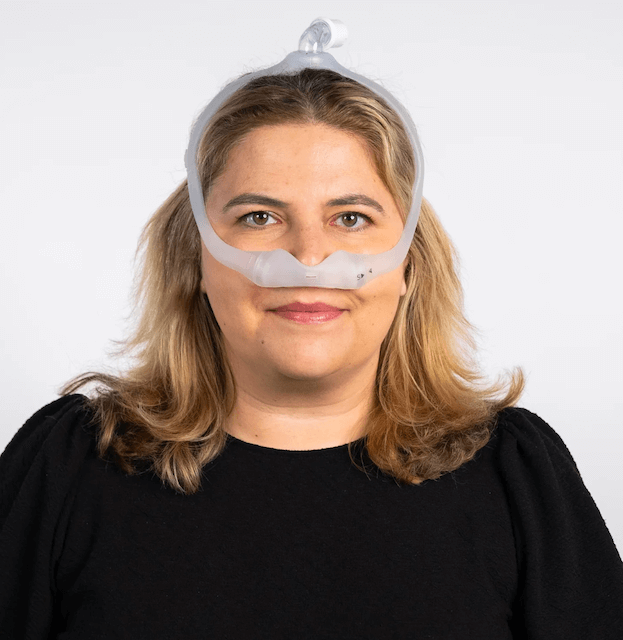
The DreamWear’s distinguishing feature for side sleepers is the hose connection point — it attaches at the top of the head rather than at the front of the mask. This matters because the hose is almost always the thing that gets pulled and tugged when you shift position during the night. A front-connection hose runs across the pillow, catches on the bedding, and drags on the mask. A top-of-head connection hangs clear of everything and moves freely with you.
The cushion design is also side-sleeper friendly — it sits under the nose rather than pressing against it from outside, which means it’s not being compressed against a pillow surface when you’re lying on your side. The under-nose seal takes a little longer to dial in than a traditional nasal cushion but holds well once fitted correctly.
For active sleepers who change position frequently during the night, the top-of-head hose connection alone makes the DreamWear worth serious consideration.
ResMed AirFit N30i — Best Minimal Contact Nasal
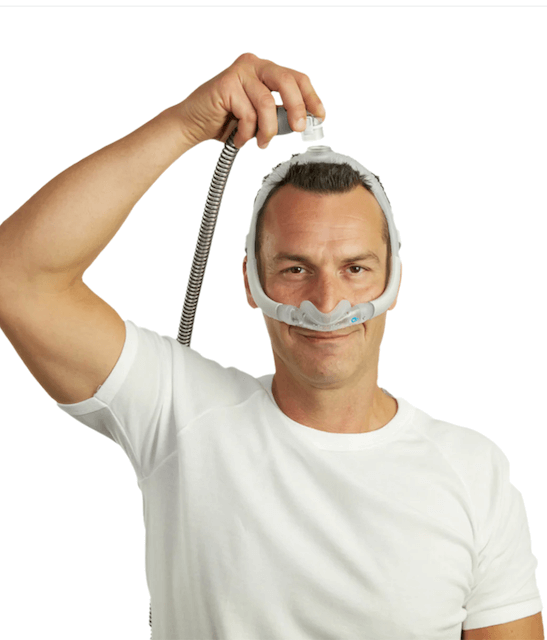
The N30i takes the same top-of-head hose concept as the DreamWear and combines it with ResMed’s under-nose cushion system. The result is a nasal mask with two of the features side sleepers care most about — minimal frontal contact and a hose that doesn’t catch on the bedding.
The cushion clips in and out via a simple mechanism that makes overnight cleaning and part replacement genuinely easy, which matters for a mask you’re using every single night. The headgear frame wraps around the back of the head and keeps the mask stable through position changes without requiring the tight strapping that causes morning marks and discomfort.
For side sleepers who want a nasal mask and value the ResMed ecosystem — particularly the MyAir app compatibility — the N30i is the natural recommendation over the DreamWear.
Fisher & Paykel Brevida — Best Nasal Pillow Alternative
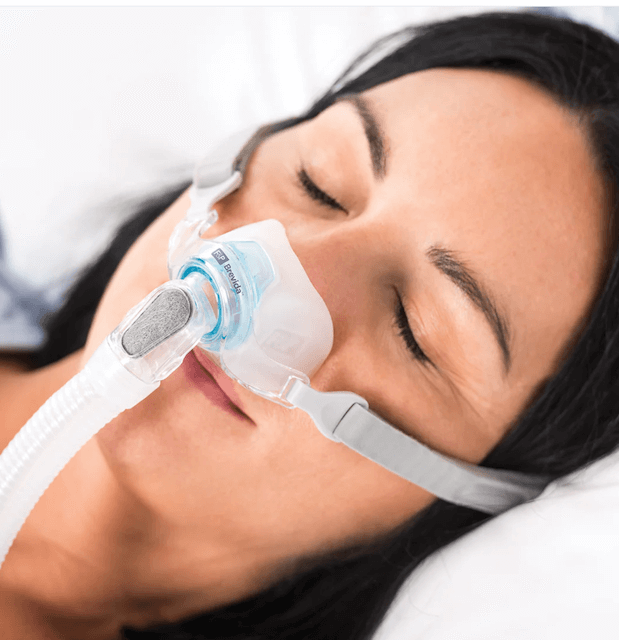
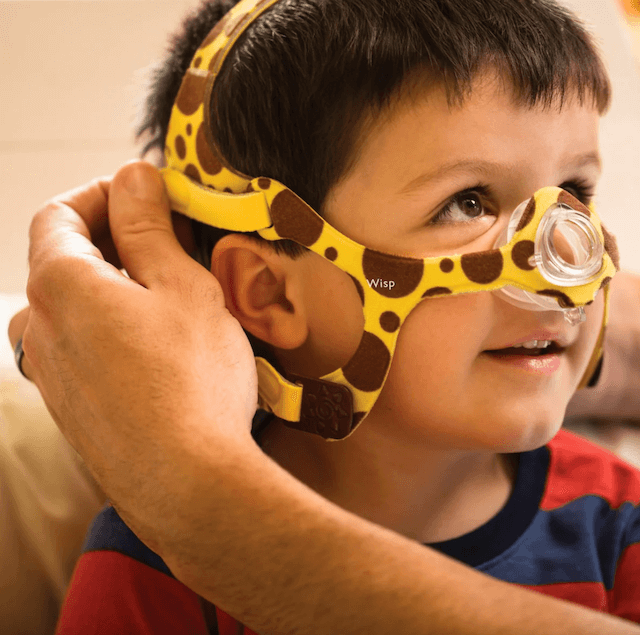
The Brevida sits in the same nasal pillow category as the P10 but with a design difference worth knowing about: the pillows use an AirPillow seal that inflates gently with pressure rather than relying purely on physical contact. This self-adjusting seal maintains integrity through small position shifts in a way that some users find more reliable than traditional nasal pillows when side sleeping.
The headgear is soft and adjustable without being fiddly, and the overall profile is low enough that the pillow interference problem is minimal. Fisher & Paykel have been making respiratory equipment since 1934 and the build quality shows — the Brevida feels more durable than its lightweight design suggests.
The one note of caution is the same as the P10: nasal pillow masks generally work best at lower to moderate pressure settings. If your prescription is on the higher end, discuss with your DME whether nasal pillows are appropriate before committing.
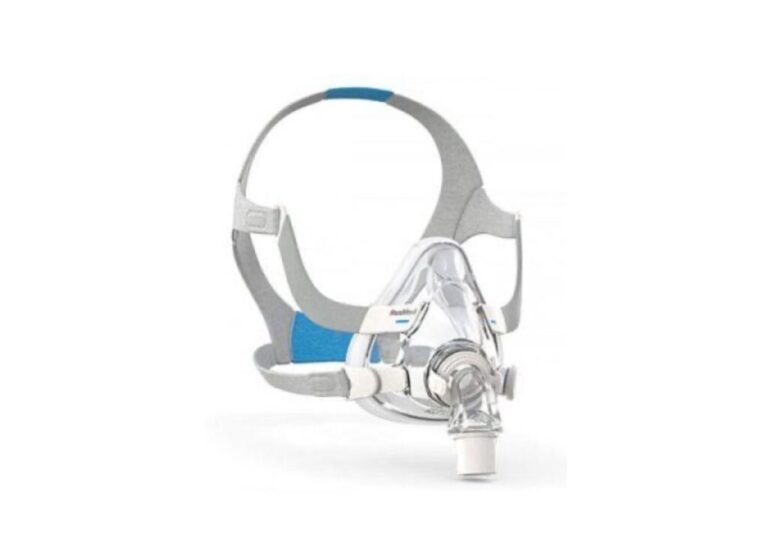
ResMed AirFit F20 — Best Full Face Mask for Side Sleepers

This is my mask. I’m a mouth breather, confirmed by my sleep study, which means nasal-only options have never been viable for me. I’ve been using the F20 as a full face mask side sleeper for over ten years and my current setup works — but I won’t pretend full face masks and side sleeping are a natural pairing. They require more management than nasal options.
What makes the F20 work better than other full face masks for side sleeping is the absence of a rigid forehead support. Traditional full face masks have a frame that extends up to the forehead, creating a lever that gets pushed sideways when you roll over. The F20’s InfinitySeals and streamlined frame have significantly less structure above the nose, which means there’s less leverage for pillow pressure to displace the seal. The magnetic clip connection on the headgear also lets you disconnect quickly in the night without fumbling with straps if you need to.
I use a CPAP pillow with the F20 — the cutouts give the mask frame room so the pillow isn’t pressing directly against it. That combination has been my side-sleeping solution for years. If you’re a mouth breather who needs a full face mask and wants to side sleep, a CPAP pillow alongside the F20 is worth trying before assuming the combination can’t work.
What to Know Before You Choose
The most important variable is whether you breathe through your nose or mouth during sleep. Nose breathers have the most options — the P10, N30i, DreamWear, and Brevida are all viable. Mouth breathers need a full face mask, which means the F20 is your primary option here, with the DreamWear Full Face version as an alternative.
Beyond that, the two design features that most consistently improve side sleeping experience are minimal facial contact and a top-of-head hose connection. Both reduce the ways the pillow interacts negatively with the mask. If a mask has one or both of those properties, it’s going to be more forgiving of the side sleeping position than a conventional design.
The Sleep Foundation’s guidance on CPAP mask selection notes that mask type is one of the most influential factors in long-term CPAP adherence — worth reading if you’re weighing up options and want the broader clinical picture before making a decision.
A CPAP pillow is worth considering alongside whichever mask you choose. For nasal and nasal pillow masks, the benefit is modest — the masks are small enough that standard pillows don’t cause much interference. For full face masks, the cutouts make a meaningful difference to seal stability through the night.
⚠️ MEDICAL DISCLAIMER This blog provides general information only and is not a substitute for professional medical advice, diagnosis, or treatment. Sleep apnea is a serious condition, and CPAP equipment should be used under proper medical supervision. Always consult your doctor or sleep specialist before starting, stopping, or changing any therapy. I share personal experiences as a CPAP user, not as a medical professional. Individual results vary. For medical guidance, please consult a qualified clinician or the American Academy of Sleep Medicine (aasm.org).