CPAP Insurance Compliance: The Four-Hour Rule

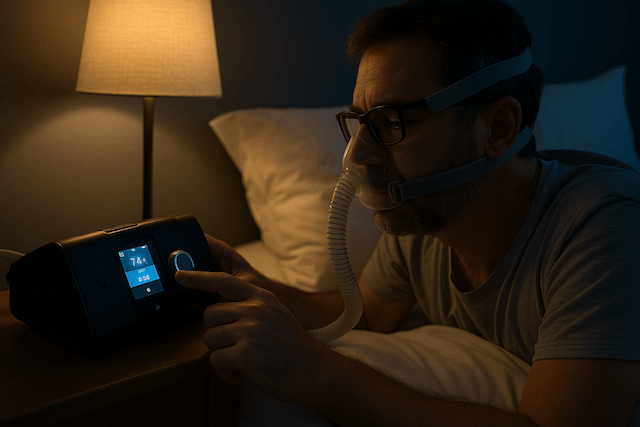
If you’ve started CPAP therapy through Medicare or a US private insurance plan, you’ve almost certainly heard about the four-hour rule. Use your machine at least four hours a night, on at least seventy percent of nights, inside a window of thirty days during your first ninety days of therapy, or your insurer can stop paying for the equipment. That’s the short version. The long version is worth understanding, because compliance numbers don’t always match the effort people feel they’re putting in.
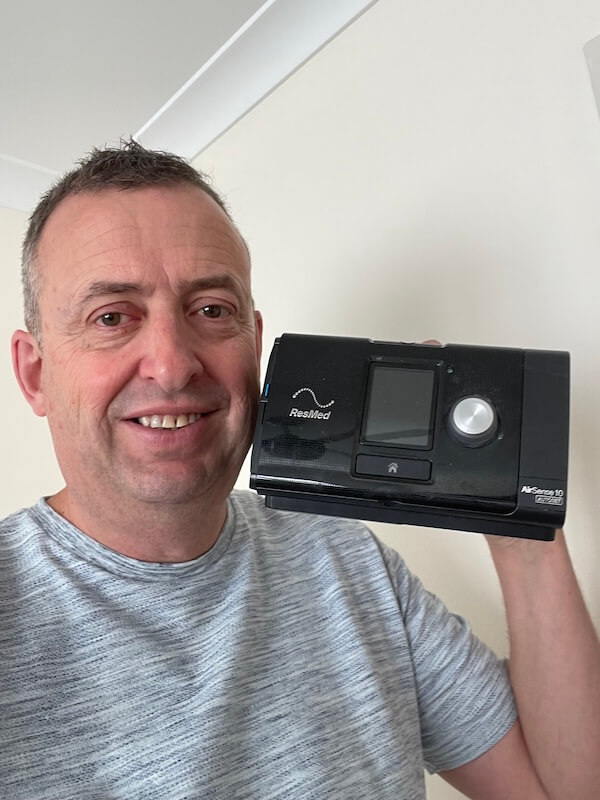
Before we go further, a note about how this page is written. I’m a long term CPAP user and I write about living with sleep apnea every day on this site. I am not a clinician, and I haven’t personally navigated a US insurance compliance audit, so the rules described here are reported from primary sources rather than from a fight with a DME supplier. What I can speak to firsthand is the equipment side. What a ResMed AirSense 10 actually records, what makes the numbers look stranger than they should, and what the difference between four hours and seven hours of pressurized sleep feels like the next morning. That experience pairs with the rules below.
Where the four-hour rule comes from
The compliance standard most US insurers use originates with the Centers for Medicare and Medicaid Services. It applies in full to traditional Medicare and Medicare Advantage plans, and most private insurers have adopted some version of it. The Sleep Foundation summarizes the standard clearly: at least four hours of pressurized therapy per night, on at least seventy percent of nights, inside a consecutive thirty-day window. Seventy percent of thirty is twenty-one. The system does not require perfection. It requires consistency.
The window that matters is the first ninety days after therapy begins. Your durable medical equipment supplier, usually shortened to DME, can pull a compliance report any time after day thirty-one. If the report shows you’ve hit four hours on twenty-one of any thirty consecutive nights inside the ninety-day window, you have met the threshold. If it does not, Medicare typically stops paying for the rental, and you may need a new sleep study before another covered trial can begin.
Two things in this rule get misunderstood often. First, the thirty-day window is rolling. You are not graded only on your first thirty days. Any thirty-night stretch inside the ninety days that contains twenty-one compliant nights will satisfy the requirement. That gives you room to fumble the first week or two while you adjust to the mask and still pass. Second, a compliant night means any calendar night with at least four hours of pressurized therapy. It is not the same thing as a good therapy night, and we will come back to that distinction.
What the machine actually records
Every modern CPAP records two different numbers: machine on time and mask on time. They are not the same. Machine on time is how long the device was running. Mask on time is how long it was actually delivering pressure to you. Compliance reports use mask on time. The Sleep Foundation states this directly. If your mask is off your face, the machine knows, and those minutes do not feed into the compliance number.
On my AirSense 10, this distinction shows up cleanly in the MyAir app as a daily total. The app reports total usage hours for the previous night, the night before, and a running trend. It flags any night below four hours. What the app does not show by default is the granular breakdown of when the mask came on, when it came off, and when leaks broke the seal. That detail lives on the SD card and is visible in either ResMed’s clinician tools or in OSCAR, the free third-party software many home users run. For everyday tracking, MyAir is enough. When a report looks wrong, and you want the real answer, the SD card is where to look.
Why your numbers can look lower than your effort
This is where the real frustration usually lives. People feel like they wore the mask all night, and the report disagrees. The causes are mechanical, not personal.
Mask leak is the most common one. When a full face or nasal mask is leaking heavily, the machine knows. Some systems will continue logging therapy time during a leak, but downstream compliance reports can flag the session as compromised, and the recorded hours can come back lower than the wall clock. I run a full face mask, and a worn cushion will eat my seal within a couple of weeks of when I should have replaced it. The fixes are mundane. Replace cushions on the schedule the manufacturer recommends, wash your face before bed so skin oils don’t break the seal, and re fit the mask if you’ve changed sleeping positions or had a haircut. The deeper guide on why CPAP masks leak covers the troubleshooting steps in detail.
Short sessions are the second issue. If you put the mask on, fall asleep, wake up for a bathroom break, and put it back on for the rest of the night, modern ResMed machines total your daily mask on time across those segments. Where this goes wrong is when the second session never quite starts. People take the mask off, doze without it, and the machine sits idle. Auto start helps. On the AirSense 10, breathing into the mask after a break wakes the machine back up, which means the second half of the night still gets credit. If you have a habit of midnight wakeups, make sure auto start is on.
Power interruptions are the sneaky one. A brief outage will shut the machine off. If you don’t notice, the rest of the night can go unrecorded even though you’re still wearing the mask. A surge-protected outlet or a small battery backup helps. If your area has unstable power, this is worth solving once and forgetting about.
SD card and connectivity problems can create apparent compliance failures that aren’t real. If the SD card is loose, corrupted, or simply full, the machine will still run and the screen will still show usage hours, but the cloud upload that feeds your DME’s dashboard can fail silently. The same is true for the cellular modem in newer machines if your home signal is weak. If your DME tells you a recent stretch shows zero, the first thing to check is the card and the connection, not your effort.
The ramp time misconception
A persistent misconception is that ramp time does not count toward compliance. It does. Ramp lowers your starting pressure so the first few minutes feel easier, then climbs to your prescribed setting over a period you can usually set anywhere from five to forty five minutes. As long as the mask is on and the machine is delivering positive pressure, those ramp minutes count as mask on time for compliance purposes. Clinical and patient education sources are clear on this.
The reason ramp gets blamed for compliance trouble is indirect. A long ramp can make early pressure feel more relaxed, which is good, but if you take the mask off before you fall asleep, the ramp minutes themselves were not the problem. The mask off behavior was. If ramp helps you fall asleep, keep it. If you find yourself fighting the air early, ask your sleep clinician about adjusting the starting pressure or shortening the ramp window. The setting is configurable on every AirSense machine I have used.
How to check your own data
You do not need to wait for a DME report to know where you stand. Three options exist for most CPAP users.
The simplest is the manufacturer app. ResMed AirSense machines pair with MyAir, and older Philips DreamStation users have DreamMapper. These show daily usage hours, a basic seal score, and a trend you can read in seconds. I check MyAir most mornings out of habit. It is the easiest way to spot a missed night before it becomes a pattern.
The middle option is the machine itself. The AirSense 10 displays last night usage and a few key numbers on the home screen, and you can drill into the menu for a seven day average. When my phone is not paired, and I want quick reassurance after a rough night, the machine has the answer.
The most thorough option is OSCAR, the open source program that reads SD card data directly. OSCAR is not required for compliance. It is the right tool if you want to see, minute by minute, when the mask came off, when leaks spiked, and how your pressure responded to events the machine flagged. I have written about interpreting CPAP data separately for readers who want that level of detail.
Looking at your own numbers does two things. It removes the mystery from any confusing compliance report, and it shifts your focus from passing the test to actually doing the therapy. Both matter.
Compliance versus therapy
Four hours a night on seventy percent of nights is an insurance benchmark. It is not a clinical recommendation. The American Academy of Sleep Medicine and most sleep clinicians treat four hours as a floor, not a target. The research behind the rule shows meaningful improvement in daytime sleepiness, blood pressure, and cardiovascular markers among patients who hit four hours, but full therapeutic benefit typically appears at six or seven hours of consistent nightly use.
That difference is real in daily life. After years of CPAP, the gap between a four hour night and a full night of therapy isn’t subtle. Four hours keeps the insurance file open. A full night of pressurized sleep is where I feel like myself the next morning. If you are new to therapy and aiming squarely at the insurance number, you will satisfy the rule and still feel tired. The therapy works longer than the regulation requires.
This is worth saying explicitly because compliance anxiety can backfire. Some people get so focused on hitting four hours that they treat the moment they cross the threshold as the end of the night. They take the mask off, exhausted from the mental load of watching the clock. Those last three or four hours of sleep, unmasked, are exactly the hours your apnea would have been doing the most damage. Hit the four hour bar by accident on your way to a full night, not as the goal.
What to do if you are going to miss
If your numbers are trending toward a failed window, do two things immediately. Contact your DME supplier and contact your prescribing physician. Don’t wait for the report to come back negative. Most providers have seen this many times and have options. A pressure adjustment, a different mask style, a humidity tweak, or treatment for an unrelated issue like nasal congestion can change the trajectory within a week. There are also formal mechanisms for extensions in some situations, particularly if you can document a specific technical problem with the equipment.
Being honest with your provider matters because the alternative, after a failed trial, is harder. A failed window can mean returning the machine, repeating a sleep study, and restarting the entire ninety day clock. That is a delay measured in months, sometimes more, and it is usually avoidable with an early conversation.
If you are new to therapy and the mask itself is the obstacle, the page on getting used to CPAP therapy covers the early adjustment period in detail. If anxiety is the larger issue, the page on overcoming CPAP anxiety covers what worked for me in the early months of treatment.
How private insurance differs from Medicare
Private insurers in the US generally follow a Medicare shaped policy, but the specifics are inconsistent. Some plans apply the four-hour, seventy percent rule almost verbatim. Some are stricter, particularly the high-deductible plans where coverage decisions are tied to documented usage. Some plans don’t track compliance at all once therapy begins. A 2013 analysis published in the National Library of Medicine noted that non Medicare patients with private insurance often do not face the same strict documentation requirements, and long term CPAP can be covered without ongoing adherence proof.
The practical takeaway is to ask your DME supplier two questions when you start. First, what specifically does my plan require for compliance? Second, who pulls the report and when? Both answers vary by plan and by supplier, and getting them in writing is worth the five minutes it takes.
Final thoughts on the four-hour rule
CPAP insurance compliance feels like a test because it is one. The good news is that the test isn’t graded on enthusiasm or sincerity. It is graded on data. Once you understand what your machine is measuring, what affects the measurement, and how to see your own numbers, the rule stops feeling adversarial.
Four hours of mask on time, twenty-one nights out of any thirty, inside the first ninety days of therapy. That is the rule. Then keep going past four hours, because the therapy doesn’t care about the regulation. The therapy cares about how long you actually sleep with positive pressure delivered to your airway.
If you take one practical thing from this page, take this. Track your own data. Don’t wait for someone else’s report to tell you how the night went. The machine knows, the app knows, and once you know, the rule mostly takes care of itself.
⚠️ MEDICAL DISCLAIMER This blog provides general information only and is not a substitute for professional medical advice, diagnosis, or treatment. Sleep apnea is a serious condition, and CPAP equipment should be used under proper medical supervision. Always consult your doctor or sleep specialist before starting, stopping, or changing any therapy. I share personal experiences as a CPAP user, not as a medical professional. Individual results vary. For medical guidance, please consult a qualified clinician or the American Academy of Sleep Medicine (aasm.org).