The Quietest CPAP Machines of 2026: 10+ Years of Personal Use

“This post contains affiliate links. I may earn a commission if you buy through these links, at no extra cost to you. Read my Disclaimer for more details.”
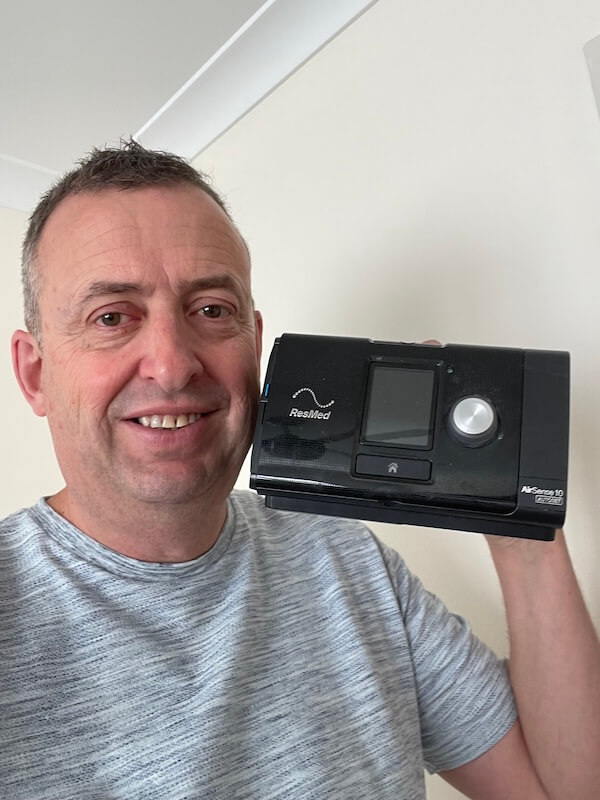
Noise was the first thing my wife mentioned when I started CPAP therapy. Not the machine itself, not the mask, not the tubing — the noise. She’d been sleeping next to my untreated sleep apnea for years, so I assumed anything would be an improvement on what I’d been producing before diagnosis. What I hadn’t considered was that the machine would become its own presence in the room — a steady mechanical hum she’d be listening to for seven or eight hours a night indefinitely.
As it turned out, she barely notices it. The ResMed AirSense 10 I’ve used since my diagnosis in 2014 operates at 26.6 decibels, which in a normal bedroom environment is close to inaudible. She’s told me she can only hear it if she’s actively listening for it. That’s the real-world test that matters more than any spec sheet number, and it’s been the case for over ten years.
I’ve never needed to upgrade machines — the AirSense 10 still runs without issues, which tells you something about the build quality. But over ten years of writing about CPAP and hearing from hundreds of readers, I’ve learned that noise is consistently one of the top concerns people bring to the machine selection conversation. It affects compliance in a direct way: if you’re anxious about disturbing a partner, or self-conscious about the sound in shared accommodation, you’re less likely to use the machine consistently. Noise isn’t a vanity issue. It matters clinically.
What follows is what I know from personal experience with the AirSense 10 and AirMini, supplemented by honest research on the machines I haven’t used myself — with that distinction made clear throughout.
Quick picks:
| Use case | My recommendation |
|---|---|
| Quietest overall (home) | ResMed AirSense 10 AutoSet |
| Latest flagship | ResMed AirSense 11 AutoSet |
| Quietest budget option | Luna G3 Auto CPAP |
| Best travel (personal experience) | ResMed AirMini AutoSet |
| Quietest travel machine | Transcend Micro Auto CPAP |
| Alternative travel option | Luna TravelPAP |
Understanding the Numbers
CPAP manufacturers report noise in decibels, and a few reference points make those numbers meaningful. A quiet bedroom at night typically measures around 30 to 35 decibels of ambient noise. A whispered conversation is roughly 30 decibels. Rustling leaves are around 20. The quietest CPAP machines sit between 26 and 27 decibels — which means they’re quieter than the natural background noise of most bedrooms.
The important caveat is that manufacturer measurements are taken at the lowest pressure setting. At higher therapeutic pressures, every machine is louder. My AirSense 10 is rated at 26.6 decibels, but running at my usual 10 to 13 cm H2O it’s closer to 28 or 29. Still whisper-quiet in practice, but worth knowing when comparing specs.
Decibels also use a logarithmic scale, which means a 3-decibel difference sounds roughly twice as loud. The gap between 26 and 30 decibels is meaningful — you’d notice it in a quiet room, even if both still qualify as quiet machines in absolute terms.
One other variable worth understanding: the sound quality matters as much as the volume. A consistent low-frequency hum is far less disruptive than an intermittent mechanical whirr or a high-pitched hiss from a mask leak. The machines I recommend below produce a steady hum that the brain tunes out relatively quickly — which is a different experience from more erratic noise sources.
Home Machines
ResMed AirSense 10 AutoSet — Quietest Overall
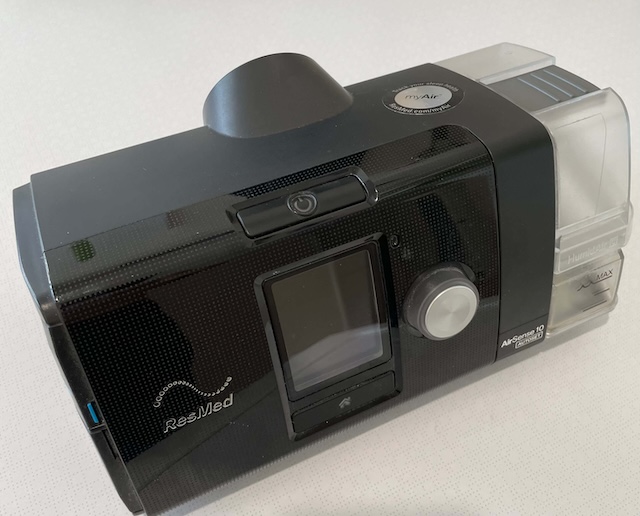
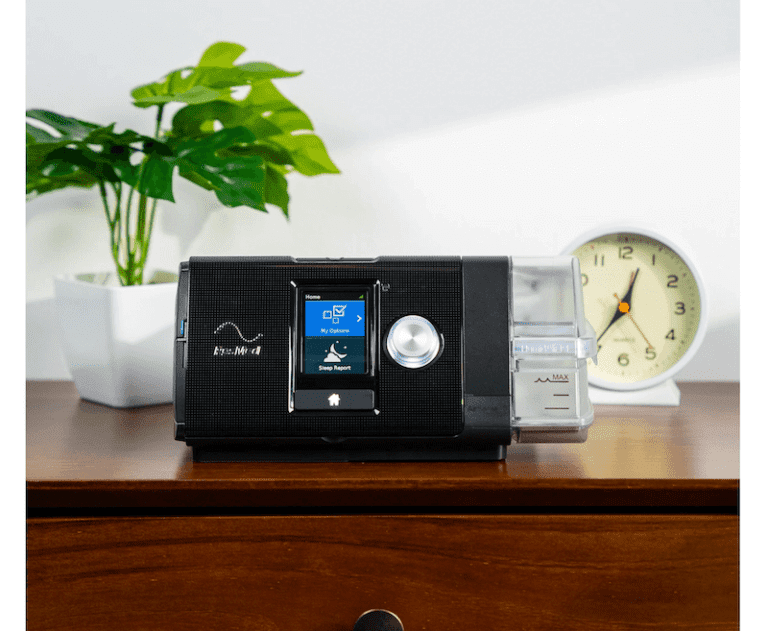
This is my daily driver and has been for over ten years. At 26.6 decibels it’s among the quietest home CPAP machines available, and in ten years I’ve had no mechanical issues.
The sound it makes is a consistent, low-pitched hum. My wife sleeps about two feet away and has told me she can only hear it if she’s actively listening for it. That’s the real-world test that matters more than any spec sheet number. The QuietEasy exhalation system diffuses air through multiple small vents rather than a single port, which distributes and softens the exhaust sound significantly.
At my usual pressures, the noise is marginally above the spec measurement but still well within the whisper range. I’ve used this machine in hotel rooms, at relatives’ houses, and in every environment where noise consciousness mattered, without complaint.
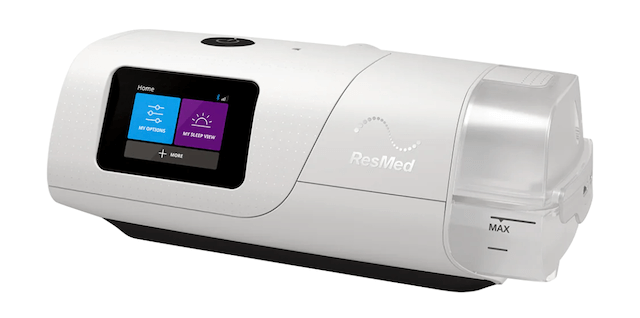
ResMed AirSense 11 AutoSet — Latest Flagship
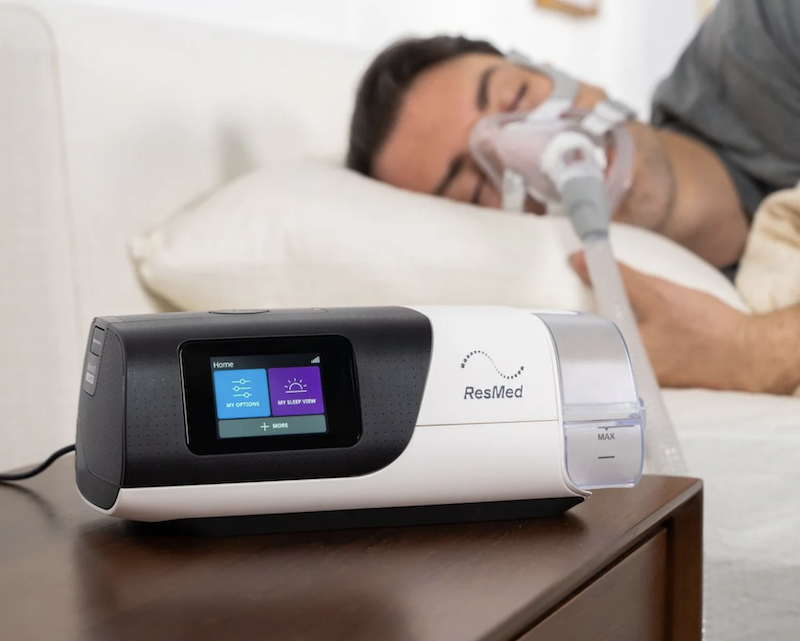
The AirSense 11 is rated at 27 decibels — 0.4 decibels louder than the AirSense 10, which in practice is imperceptible. Both machines are equally quiet in real-world use. The difference between them is the touchscreen interface, the upgraded myAir app coaching features, and a slightly more refined user experience overall rather than anything therapeutic.
I use the AirSense 10 because I bought it a decade ago and it still works perfectly. If I were buying today for the first time, I’d buy the 11. If you already own an AirSense 10 that works well, noise is not a reason to upgrade.
Luna G3 Auto CPAP — Best Budget Quiet Option
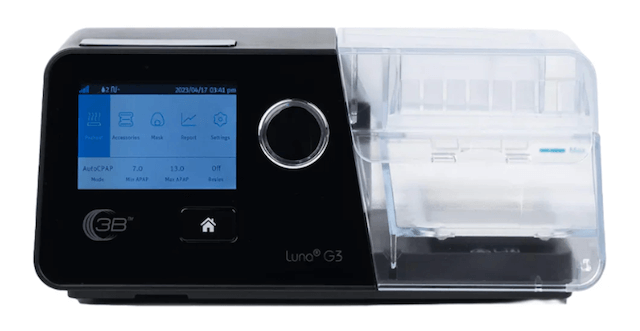
The Luna G3 is rated at 26 decibels — marginally quieter than the AirSense 10 on paper — and at a significantly lower price point. I don’t use it personally, but it comes up consistently in the communities I follow when noise and budget are both priorities, and the feedback is generally positive on the noise front specifically.
The one honest caveat I’d pass on from what I’ve read: some users find the sound quality of the Luna G3’s hum slightly less smooth than ResMed or Philips machines — a very slight mechanical edge to it that a small number of people notice even at low volume. Whether that matters depends on your sensitivity. On pure decibel measurement it’s excellent. On sound character it may be marginally behind the ResMed. For most people it won’t be a meaningful distinction, but it’s worth knowing.
What the Luna G3 lacks compared to ResMed is the smartphone app ecosystem — data is accessed via SD card rather than a connected app, which matters if you want to track your therapy numbers the way I do each morning. For someone who doesn’t care about that and primarily wants a quiet, reliable machine at a reasonable price, the Luna G3 is a legitimate recommendation.
Travel Machines
Travel CPAPs present a harder engineering problem — fitting an effective motor into a small housing while maintaining quiet operation involves real trade-offs. Most travel machines are 3 to 4 decibels louder than their full-size equivalents, which is noticeable but not dramatic.
ResMed AirMini AutoSet — Best Travel Machine (Personal Experience)

At 30 decibels the AirMini is louder than my AirSense 10 at home, and I won’t pretend otherwise. In a quiet hotel room you know it’s running. In a hostel dorm with the ambient noise of multiple people sleeping, it disappears. On a plane the engine noise masks it entirely.
I’ve used the AirMini across eight countries on more than twelve flights and in shared accommodation without anyone raising the noise as an issue. The sound it produces is consistent and even rather than intermittent or mechanical in character, which matters — it’s a steady hum rather than something that draws the ear. My AHI on the AirMini sits at the same level as at home, so the therapy quality is identical despite the slight noise increase.
The one limitation to flag: the AirMini only works with five specific ResMed masks. If you don’t already use the AirFit F20, N20, P10, AirTouch F20, or F30i, you’ll need to switch masks for travel. That was a non-issue for me given I use the F20.
Transcend Micro Auto CPAP — Quietest Travel Option
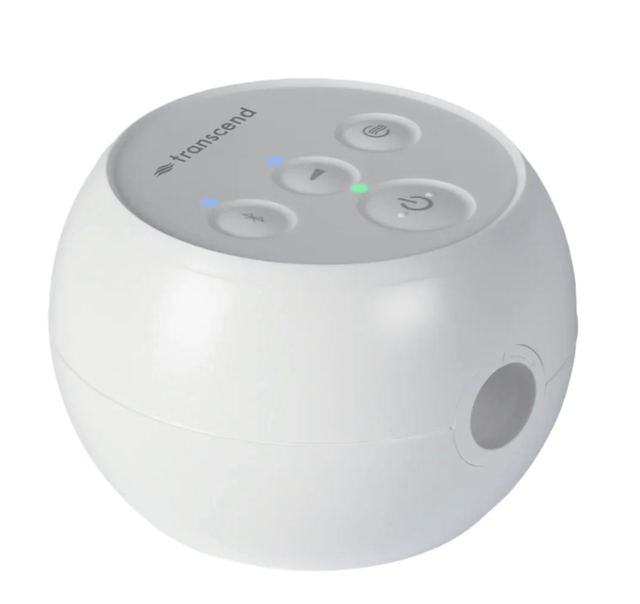
I haven’t personally used the Transcend Micro, but it’s the machine that comes up most consistently when people specifically ask about the quietest possible travel option. At 25 to 29 decibels with the WhisperSoft Muffler it matches or beats most home machines in noise level, which is a remarkable achievement for a device that weighs under half a pound.
The meaningful trade-off compared to the AirMini is humidification. The Transcend Micro uses waterless HME humidification rather than anything water-based, which some people find less comfortable on longer trips or in dry climates. It also works with standard masks — unlike the AirMini’s restricted compatibility — which is a genuine advantage if you’re invested in a non-ResMed mask at home.
For someone who hasn’t already invested in the AirMini ecosystem and for whom quiet operation is the primary travel concern, the Transcend Micro is worth serious consideration. For someone who, like me, already uses the AirMini and is happy with it, switching isn’t necessary.
Luna TravelPAP — Alternative Travel Option

The Luna TravelPAP runs at under 30 decibels and has a distinctive pill-shaped design that doesn’t look like conventional CPAP equipment — which has a practical benefit for travel in that it draws less attention. Bluetooth connectivity to the LightTrip app provides therapy data tracking, which puts it ahead of machines that only offer SD card data access.
Like the Transcend Micro, it uses HME rather than water-based humidification, and like all travel machines it lacks the heated humidifier comfort of a home machine. Compatible with standard masks and FAA-approved for in-flight use.
I haven’t used it personally and my recommendation would be the AirMini or Transcend ahead of it for most people, but it’s a legitimate option particularly if app connectivity matters to you in a travel machine and you prefer the Luna ecosystem.
Practical Tips for Reducing Noise
The machine is only part of the noise equation. A few things make a meaningful practical difference regardless of which machine you use.
Mask leaks are often louder than the machine itself. A hissing or whistling sound coming from around the cushion is a leak, not the machine, and it’s fixable by adjusting the headgear, replacing a worn cushion, or addressing fit. I’ve written in detail about why CPAP masks leak and how to fix it — sorting this out reduces perceived noise more than almost anything else.
Filter maintenance directly affects machine noise. A clogged filter forces the motor to work harder and produces more sound. I replace disposable filters monthly and the difference between a clean and a dirty filter is audible. It’s the simplest and cheapest noise-reduction step available.
Placement matters more than most people realise. I keep my AirSense 10 on a small rubber mat on my nightstand — an old mouse pad works perfectly — which dampens vibration transfer to the wooden surface. Placing the machine slightly further from your head, even by six inches, reduces perceived volume. Keep the air intake vents clear and don’t place the machine against a wall where it could draw in recirculated air.
The Q Lite CPAP muffler is an inline adapter that sits between your machine and hose and uses internal foam baffling to dampen airflow noise. It works and is worth knowing about if you’ve addressed everything else and still find the airflow sound intrusive. The important limitation is that it’s not compatible with heated tubing or water-based humidification — the moisture saturates the foam. If you use either, it’s not an option. But for travel use with HME humidification it can make a meaningful difference, and several users report audible improvement with the AirMini specifically.
White noise masking is the simplest overall approach and works independently of everything else. I run a small fan year-round, which creates enough ambient sound to mask the machine’s hum without being intrusive itself. A fan, a white noise machine, or an air purifier all achieve the same effect.
According to the American Academy of Sleep Medicine’s guidance on CPAP adherence, perceived discomfort — which includes noise — is consistently among the top reasons people discontinue therapy. Getting the noise right is therefore not a comfort preference but a compliance issue. The Sleep Foundation’s overview of CPAP therapy makes the same point: equipment that doesn’t disrupt the bedroom environment is equipment you’re more likely to keep using.
After ten years the machine noise has become as background to me as the hum of the refrigerator. You adapt to it. But starting with the quietest equipment you can access, and addressing the variables within your control, shortens the adaptation period and removes a barrier that causes a meaningful proportion of people to give up on therapy that would otherwise transform their health.
⚠️ MEDICAL DISCLAIMER This blog provides general information only and is not a substitute for professional medical advice, diagnosis, or treatment. Sleep apnea is a serious condition, and CPAP equipment should be used under proper medical supervision. Always consult your doctor or sleep specialist before starting, stopping, or changing any therapy. I share personal experiences as a CPAP user, not as a medical professional. Individual results vary. For medical guidance, please consult a qualified clinician or the American Academy of Sleep Medicine (aasm.org).