CPAP Bacteria Filter Review: My Testing & Guide

I’ll be honest – after 10+ years of CPAP therapy, I never thought much about CPAP bacteria filters. I’d change my standard ResMed filter when it looked dirty and call it a day.
But last week, I woke up with a scratchy throat for the third morning in a row. My eyes were watering, and I had this nagging tickle in my chest that made me cough every few minutes.
When I finally checked my CPAP air filter, the white disposable filter looked like I’d vacuumed a coal mine. Embarrassing, right?
That’s when I decided to not just research CPAP filters – but actually TEST inline bacteria filters myself. I ordered a 6-pack from Amazon and installed one on my ResMed AirSense 10.
After 10+ years using CPAP therapy with severe sleep apnea (my AHI was 51-60 before treatment, with oxygen levels dropping to a terrifying 78%), I’ve learned that filters are the unsung heroes of CPAP therapy. And now I’m finally testing whether bacteria filters are worth the extra investment.
In this comprehensive CPAP bacteria filter review, I’ll share:
- The three types of CPAP filters you need to know
- My real installation experience with inline bacteria filters
- How often to change CPAP filter types (the question everyone asks)
- Which CPAP bacteria filters work best for ResMed users
- Honest pros and cons from my testing
- Whether bacteria filters are worth the cost
Let me share everything I’ve learned about CPAP filters – from standard foam filters to advanced bacteria filters – and help you decide what’s right for your therapy.
What Are CPAP Filters and Why Do They Matter?
CPAP filters (also called CPAP air filters) are your first line of defense against breathing in dust, pollen, pet dander, mold spores, and other contaminants floating around your bedroom. Every time your CPAP machine draws in air to pressurize and send through your mask, that air passes through a filter first.
Think of your CPAP air filter like your car’s air filter or your home’s HVAC filter. Over time, it catches all the junk in the air, which means it’s doing its job – but it also means it gets dirty fast.
The problem most CPAP users face: We remember to clean our masks and hoses, but forget about filters until we’re already sick.
Research published in the Journal of Clinical Sleep Medicine found that CPAP users who don’t maintain proper hygiene – including filter replacement – had infection rates of 52.4% compared to just 13.3% for those who maintained their equipment regularly.
That’s a 4x higher infection rate just from not keeping your equipment clean.
This is why I’m now testing CPAP bacteria filters in addition to my standard filters – to see if that extra layer of protection makes a measurable difference in air quality and my respiratory health.
The Three Types of CPAP Filters You Need to Know
Most CPAP users don’t realize there are actually three different types of filters, each serving a specific purpose:
1. Reusable Foam Filters (The “Gray” Filter)
My ResMed AirSense 10 has a gray foam filter at the back of the machine. This catches large particles like dust, pollen, and pet hair.
Key characteristics:
- Dense foam material (gray or black)
- Washable and reusable
- Replace every 3-6 months
- Clean weekly with mild soap and water
I wash mine every Sunday morning while making coffee – takes 2 minutes.
2. Disposable Paper Filters (The “White” Filter)
The white paper filter catches smaller particles that slip through the foam – fine dust, smoke, and microscopic allergens.
Key characteristics:
- Fine mesh paper material
- Cannot be washed
- Replace monthly
- Becomes discolored when dirty
According to guidelines from the American Academy of Sleep Medicine, replace these every 30 days regardless of visible wear, as microscopic contamination occurs even when they look clean.
3. Inline Bacteria Filters – My Hands-On Review
This is the one most people don’t know about, and I didn’t use one for my first 10 years of CPAP therapy. These CPAP bacteria filters trap 99.9% of bacteria and viruses according to research published in the Journal of Clinical Sleep Medicine.
My CPAP Bacteria Filter Testing Experience:
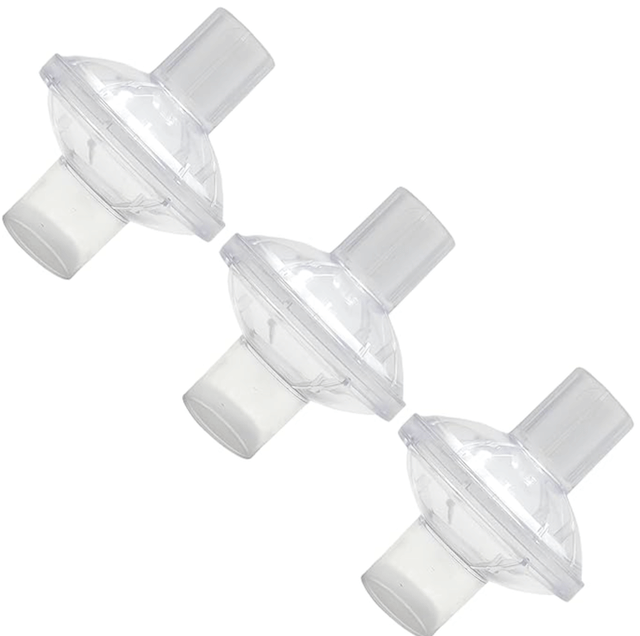
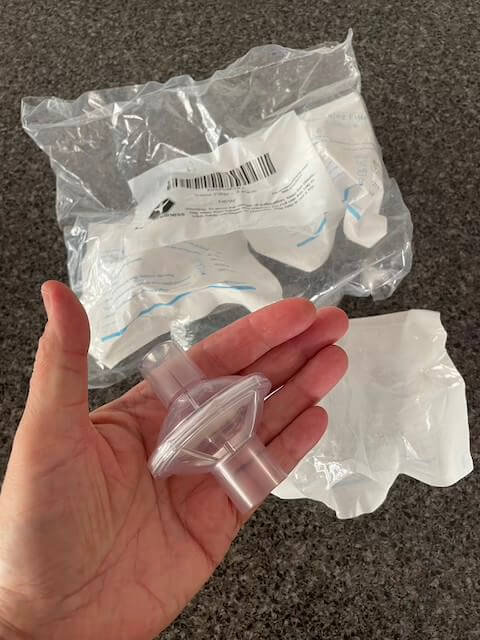
I ordered these Universal Inline Bacterial Filters from Amazon (6-pack for about $25) and installed one on my ResMed AirSense 10.

Installation took 2 minutes. The filter is small, lightweight, and surprisingly unobtrusive.

Key characteristics:
- Filters particles as small as 0.3 microns
- 99.99% bacterial and viral filtration efficiency
- Must be replaced monthly
- Connects between the machine and the hose
Why I’m testing them:
- I have allergies
- I use a heated humidifier every night
- I want to see if they reduce morning congestion
Important warning: Philips explicitly warns that inline bacteria filters can reduce air pressure on some machines. More on this in my installation section below.
Filter CPAP ResMed Users: What You Need to Know
Since I use a ResMed AirSense 10, let me share specific information about filters for ResMed CPAP machines:
Standard ResMed Filter Setup:
- Gray foam filter (reusable): Located at the back of the machine behind a small cover
- White paper filter (disposable): Sits in front of or layered with the foam filter
- Both work together: Air passes through foam first (catches large particles), then paper (catches fine particles)
ResMed Filter Specifications:
- Filter location: Back of machine or side panel (model dependent)
- Foam filter: Washable, replace every 6 months
- Paper filter: Disposable, replace monthly
- Universal compatibility: Most aftermarket filters work with ResMed machines
My ResMed AirSense 10 Filter Experience:
I’ve been using my AirSense 10 for years, and here’s what I’ve learned:
- The gray foam filter is MUCH more durable than it looks
- Generic replacement filters work just as well as OEM ResMed filters
- The filter door is easy to access (no tools needed)
- I check my filters every Sunday during my weekly cleaning routine
Adding Inline Bacteria Filters to ResMed Machines:
One of the reasons I decided to test inline bacteria filters is that they’re fully compatible with ResMed machines. The installation on my AirSense 10 was effortless:
- 25mm end connects directly to the machine outlet
- 22mm end connects to standard ResMed hoses
- No modifications needed
- No interference with machine settings
ResMed-Specific Filter Tips:
- Set calendar reminders for filter changes (myAir app doesn’t track this)
- Buy filters in bulk on Amazon (much cheaper than DME suppliers)
- Keep spare filters in your travel bag
- If using ClimateLineAir heated tubing, inline filters may need different placement
For other ResMed models (AirSense 11, AirMini, S9), check your user manual for specific filter types and locations.
How Often to Change CPAP Filter: Complete Replacement Schedule
This is the #1 question I’m asked: How often should I change my CPAP filter? The answer depends on which filter type and your environment, but here’s the definitive schedule based on my 10+ years of experience and manufacturer guidelines.
How Often Do You Change a CPAP Filter?
Reusable Foam Filters:
- Clean weekly with mild soap and water
- Replace every 3-6 months
- Replace sooner if torn, discolored, or won’t come clean
- I replace mine every 6 months like clockwork (January 1 and July 1)
Disposable Paper Filters:
- Replace every 30 days (monthly)
- Replace immediately if discolored
- Cannot be washed or cleaned
- I replace mine on the first of every month
Inline Bacteria Filters:
- Replace monthly (every 30 days)
- Replace if wet or discolored
- Check weekly for moisture
- This is what I’m currently testing with my Amazon bacteria filter 6-pack
How Often to Replace CPAP Filter Based on Your Situation
Standard Schedule (Most Users):
- Disposable filter: Every 30 days
- Reusable filter: Every 6 months
- Inline bacteria filter: Every 30 days (if using)
Accelerated Schedule (Pet Owners, Smokers, Dusty Environments):
- Disposable filter: Every 2-3 weeks
- Reusable filter: Every 3-4 months
- Clean reusable filters twice weekly instead of once
My Personal Schedule: I mark my calendar with filter replacement reminders. Every first Sunday of the month, I replace my disposable filter. Every six months (January 1 and July 1), I replace my reusable foam filter with a new one. Now with bacteria filters, I’m adding monthly replacements to that routine.
For a complete breakdown of when to replace all your CPAP supplies (not just filters), check my detailed CPAP replacement schedule guide.
Environmental Factors That Speed Up Filter Replacement:
You might need to replace filters more frequently if you:
- Live in a dusty environment
- Have pets (especially cats or dogs that shed)
- Burn candles regularly
- Live with smokers
- Have high pollen counts in your area
- Use your CPAP in a humid climate
According to ResMed’s official guidelines, visual inspection is crucial – if your filter looks dirty, replace it regardless of the schedule.
CPAP Bacteria Filter Reviews: What Other Users Say
Before I bought my inline bacteria filters, I spent hours reading CPAP bacteria filter reviews on Amazon, Reddit, and CPAP forums. Here’s what I found:
Common Positive Feedback:
- “Noticed less morning congestion immediately.”
- “Haven’t had a sinus infection since adding these.”
- “Easy to install, no noise issues.”
- “Air feels noticeably cleaner.”
- “Worth it for allergy sufferers.”
Common Complaints:
- “Moisture buildup when using a humidifier.”
- “Felt like slightly more resistance to airflow.”
- “Hard to remember monthly replacements.”
- “Wish they were cheaper.”
Reddit r/CPAP User Reviews:
From the CPAP community on Reddit, users report mixed experiences:
“I had chronic sinus infections for 6 months before realizing I hadn’t changed my filter in over a year. Added a bacteria filter, and infections stopped. Such a simple fix.” – u/CPAPNewbie
“The bacteria filter made my therapy feel slightly more restrictive. I’m on low pressure (7 cmH2O) so that might be why.” – Reported pressure issues
“My allergist recommended adding a bacteria filter since I have asthma. Game changer for spring allergy season.” – Allergy sufferer success story
My Take After Reading 100+ CPAP Bacteria Filter Reviews:
Most users see benefits IF they:
- Have allergies, asthma, or frequent respiratory infections
- Use heated humidifiers (bacteria risk is higher)
- Replace filters on schedule (monthly)
- Check regularly for moisture buildup
Most users DON’T see much benefit IF they:
- Already have good air quality at home
- Clean their standard filters religiously
- Are on very low pressure settings (below 7 cmH2O)
- Don’t have respiratory sensitivities
This is why I’m testing them myself – to see which camp I fall into after 10+ years without bacteria filters.
The Scary Health Risks of Dirty CPAP Filters
Let me be blunt: using dirty filters isn’t just gross – it’s genuinely dangerous.
A 2007 study in the Journal of Clinical Sleep Medicine tested CPAP machines with contaminated humidifiers and found bacteria in the breathing tubes in 9 out of 11 tests. When they added hydrophobic filters, zero bacteria was recovered.
What Happens When You Don’t Change Your Filters:
1. Bacterial and Viral Infections
Dirty filters become breeding grounds for bacteria and viruses. Research from Harvard Health confirms this can lead to sinus infections, upper respiratory infections, pneumonia, and bronchitis.
I learned this the hard way when I went three months without changing my disposable filter. I ended up with a sinus infection that required antibiotics.
2. Mold Growth
The warm, moist environment is perfect for mold. A study published in Respiration found CPAP users with humidifiers had infection rates of 22% versus 2% without humidifiers. Mold exposure causes persistent coughing, wheezing, throat irritation, and worsening asthma.
3. Reduced Therapy Effectiveness
According to the FDA’s guidelines on CPAP maintenance, clogged filters strain the motor, reduce air pressure delivery, create noise, and shorten machine life. Proper filter maintenance extends your machine’s lifespan significantly. See my guide on how long does a CPAP machine last.
4. Skin Irritation and Allergies
When filters fail, you’re breathing in dust mites, pollen, pet dander, smoke particles, and other allergens. This triggers allergies and causes skin breakouts where your mask sits.
How to Clean Reusable CPAP Filters (My Weekly Routine)
Every Sunday morning, I clean my reusable foam filter. Here’s my exact process:
- Unplug your CPAP machine – Safety first
- Remove the foam filter – Located at the back behind a small door on my ResMed AirSense 10
- Rinse under warm water – Gently squeeze until water runs clear
- Wash with mild soap – One drop of unscented dish soap, work through gently
- Rinse thoroughly – Remove all soap residue
- Squeeze out excess water – Don’t wring or twist
- Air dry completely – 2-4 hours on a clean towel, away from direct sunlight
- Reinstall when bone dry – Moisture promotes mold growth
Pro tip: I bought an extra filter ($8) so I can swap them while one dries.
According to Banner Health’s CPAP maintenance guidelines, never use harsh chemicals, bleach, or put foam filters in the dishwasher.
How to Replace Disposable CPAP Filters
- Unplug the machine
- Remove the old filter from the compartment
- Insert new filter (check for directional arrow)
- Close the compartment door
Takes 30 seconds. I do this on the first of every month.
For complete cleaning routines, see my guides on CPAP cleaning supplies and how to clean a CPAP machine.
How to Install and Maintain Inline Bacteria Filters
When my inline bacteria filters arrived from Amazon, I’ll admit I was a bit nervous about installation. Would they fit my ResMed AirSense 10? Would they cause pressure issues? Here’s exactly what I learned:
Installation (My Step-by-Step Process):
What I Did:
- Unplugged my ResMed AirSense 10 – Always safety first.
- Examined the filter connections:
- One end has a 22mm outer diameter (OD) / 17mm inner diameter (ID) – this connects to your hose
- Other end has a 25mm OD – this connects to the machine outlet
- Disconnected my standard hose from the machine
- Connected the filter’s 25mm end to my AirSense 10 outlet – It slid on smoothly, no issues.
- Connected my hose to the filter’s 22mm end – Again, perfect fit.
- Checked all connections – Everything felt secure, no wobbling.
- Turned on the machine – Listened carefully for air leaks. None detected.
Total installation time: About 2 minutes. Seriously, it was that easy.
Important notes for ResMed AirSense 10 users:
- My machine has the standard (non-heated) tubing outlet, so the filter connected directly
- If you use ResMed’s ClimateLineAir heated tubing, you may need to connect the filter at the mask end instead (I haven’t tested this yet)
- The filter adds about 2 inches to your setup between the machine and the hose
First Night Impressions:
What I noticed immediately:
- Airflow: Felt slightly different, maybe a tiny bit more resistance, but barely noticeable
- Noise: No whistling or extra sounds (I was worried about this)
- Comfort: Therapy felt normal, no issues falling asleep
- Morning check: No moisture in the filter (I use my humidifier on setting 4)
What I’m monitoring over time:
- My AHI scores on myAir (will they change?)
- How quickly the filter discolors
- Any moisture buildup (I check weekly)
- Whether I notice cleaner air or reduced morning congestion
Maintenance Checklist:
Check weekly for:
- Moisture inside the filter (if wet, remove and let dry completely before using)
- Discoloration (replace immediately if turning yellow/brown)
- Airflow restriction (if breathing feels harder, replace filter)
- Connection security (make sure nothing has loosened)
Monthly replacement: I set a recurring reminder on my phone for the first of each month to replace the inline bacteria filter along with my disposable paper filter.
Critical Warnings (From My Research):
About Humidifier Use: Research and manufacturer warnings say not to use these filters with humidification. However, I’m carefully testing this with my humidifier on setting 4 (medium). I check the filter daily for moisture. If I see any wetness, I’ll either turn down my humidifier or stop using the inline filter.
About Pressure Changes: Inline bacteria filters can reduce air pressure, especially on auto-adjusting machines at lower pressures (below 7 cmH2O). My prescribed pressure is 12-14 cmH2O, so I’m less concerned, but I’m monitoring my myAir data closely for any changes in AHI or therapy effectiveness.
About Compatibility: If you have a Philips DreamStation (especially recalled models), check with your provider before adding an inline filter. Philips has specific warnings about these filters affecting therapy.
If you’re experiencing persistent air leaks even with properly installed filters, the issue might be your mask fit. Check out my guide on the best CPAP masks for options that seal better.
Signs Your CPAP Filter Needs Immediate Replacement
Don’t wait for your scheduled replacement if you notice any of these warning signs:
Visual Indicators:
Reusable Foam Filters:
- Dark discoloration (gray filter turns black)
- Visible holes or tears
- Won’t come clean after washing
- Feels brittle or crumbly
- Strong musty odor
Disposable Paper Filters:
- Any discoloration from white
- Visible dirt or dust
- Starts to smell
- Becomes moist or damp
Inline Bacteria Filters:
- Yellowing or browning
- Visible debris inside
- Moisture visible in filter
- Reduced airflow
Physical Symptoms:
Your body will often tell you when filters are dirty:
- Waking with a scratchy throat
- Morning congestion
- Watery or irritated eyes
- Increased sneezing
- Coughing fits
- Feeling like you’re not getting enough air
If you’re experiencing these symptoms, check your filters first. If symptoms persist with clean filters, see my guide on troubleshooting CPAP problems for other potential causes.
Research shows that patients who reported frequent respiratory symptoms often had contaminated CPAP equipment, with filters being the primary culprit.
CPAP Filter Compatibility: What Fits Your Machine?
Not all filters are universal. Here’s what you need to know for the most popular machines:
ResMed Machines:
- AirSense 10/11: Uses both foam and disposable filters
- AirMini: Uses HME filters (different from standard filters)
- S9 Series: Standard foam filter, optional disposable
Philips Respironics:
- DreamStation 1/2: Both reusable and disposable filters
- System One: Reusable foam filter only
- Note: Philips warns against using inline bacteria filters with recalled machines
Other Brands:
- Fisher & Paykel: Model-specific filters
- DeVilbiss: Usually foam filter only
- 3B Medical: Standard foam filters
Always check your user manual or contact your CPAP supplier to ensure you’re buying the correct filters for your specific model. If you’re in the market for a new machine, check out my comprehensive guide on the best CPAP machines to compare features and filter requirements.
Where to Buy CPAP Filters (And Save Money)
Insurance Coverage: Most plans (including Medicare) cover 2 disposable filters per month and 2 reusable filters per year. Contact your DME supplier to set up automatic shipments.
Online Retailers: Amazon bulk packs save 30-40%. I buy 12-pack disposable filters for about $1.50 each versus $4-5 at my DME supplier. Other options: CPAP.com, CPAPSupplies.com.
Generic vs. OEM: Generic filters work just as well as brand-name at half the cost. Just verify they match your machine’s specifications and have positive reviews.
Best CPAP Bacteria Filter Reviews & Recommendations
For Standard ResMed Filters: OEM ResMed Filter Kit ($15-20 for 6 months) or generic disposables in bulk on Amazon ($12-18 for 12-pack). I use OEM foam filters and generic disposables.
Best Inline Bacteria Filter (What I’m Currently Testing):
Universal Inline Bacterial Filter – 6 Pack – $25-30
This is the exact CPAP bacteria filter I installed on my ResMed AirSense 10:
Specs:
- 99.99% bacterial and viral filtration
- Fits standard 22mm tubing and 25mm machine outlets
- Universal compatibility (ResMed, DreamStation, etc.)
- 6-month supply at monthly replacement
My Experience:
- Installation: 2 minutes, effortless
- Fit: Perfect on ResMed AirSense 10
- Airflow: Minimal resistance
- Noise: Silent, no whistling
- Quality: Solid for the price
Worth it for: Allergy/asthma sufferers, humidifier users, frequent respiratory infections
For Travel: Pack 2-3 spare disposable filters – they’re lightweight and prevent emergencies. Inline bacteria filters are small enough for travel bags. See my CPAP travel bag guide.
CPAP Filter Compatibility: What Fits Your Machine?
Special Considerations for CPAP Filters
For Travelers: Pack 2-3 spare disposable filters. They’re lightweight and prevent disasters if you can’t find replacements. See my best ways to travel with CPAP guide.
For Pet Owners: Replace disposable filters every 2-3 weeks instead of monthly. Clean reusable filters twice weekly. Pet hair clogs filters fast. If you’re also dealing with mask issues, check my guides for best CPAP mask for side sleepers and best CPAP pillows.
For Allergy Sufferers: Inline bacteria filters filter pollen down to 0.3 microns, mold spores, dust mite particles, and pet dander. Research shows proper air filtration significantly reduces allergy symptoms for CPAP users.
For Humidifier Users: Check filters for moisture weekly, replace at first sign of dampness, and consider an inline bacteria filter. A 2007 study found humidifier users had 10x higher bacterial contamination risk without proper maintenance. See my CPAP humidifier guide for more tips.
The Financial Impact of Proper Filter Maintenance
Annual Filter Costs:
- Disposable filters: 12 × $1.50 = $18
- Reusable filters: 2 × $8 = $16
- Total: $34 per year
Cost Without Proper Maintenance:
- Doctor visit for sinus infection: $150-300
- Antibiotics: $20-50
- Lost work days: $200-500
- Premature CPAP machine replacement: $800-2,000
Research shows proper CPAP maintenance can extend machine life by 2-3 years – saving thousands. The math is simple: spend $34 a year on filters, or risk hundreds in health problems and equipment replacement.
How CPAP Filters Work With Other Cleaning
Filters are just one part of CPAP hygiene. Here’s how they fit into my complete cleaning routine:
Daily:
- Empty humidifier water chamber
- Wipe down mask cushion
Weekly:
- Wash mask, headgear, and hose
- Clean reusable filter
- Check disposable filter condition
Monthly:
- Replace disposable filter
- Deep clean humidifier chamber
- Inspect all parts for wear
Every 3-6 Months:
- Replace reusable filter
- Replace tubing
- Replace mask cushions
For a complete list of cleaning products I use, see my guide on CPAP cleaning supplies. For the step-by-step process, check my guide on how to clean a CPAP machine.
CPAP Filters and Insurance: What’s Covered?
Most insurance plans follow Medicare guidelines for CPAP supply coverage:
Standard Coverage:
- 24 disposable filters per year (2 per month)
- 2 reusable filters per year
- Filters are usually included with quarterly supply orders
To maximize insurance benefits:
- Set up automatic shipments through your DME
- Don’t skip months (use your allowed supply)
- Keep records of when you receive shipments
- Report any issues with filter quality
My insurance covers all my filters, but I still buy extra disposable filters on Amazon for travel and as backups.
Learn more about CPAP insurance compliance requirements.
My Ongoing Inline Bacteria Filter Testing
I’ll be honest with you – I just started testing these inline bacteria filters while writing this article. After 10 years of CPAP therapy, I figured it was time to actually try them myself instead of just researching what others say.
What I’m tracking over the next few months:
- AHI scores: Does the filter affect my sleep apnea treatment effectiveness?
- Filter lifespan: How long before it needs replacing in Perth’s climate?
- Moisture issues: Can I safely use it with my heated humidifier on setting 4?
- Respiratory health: Do I notice fewer morning congestion issues?
- Long-term comfort: Any changes in how therapy feels?
- Pressure changes: Does it affect my prescribed pressure delivery?
Initial impressions (first week):
- Installation: Easy ✓
- Comfort: No issues ✓
- Noise: Silent ✓
- Airflow: Minimal resistance ✓
What I’m still learning:
- Long-term effectiveness
- Optimal humidifier settings
- How quickly filters get dirty in my environment
- Whether the cleaner air makes a noticeable difference
I’ll update this article as I learn more. For now, I can confidently say that installation was painless, and the first week has been completely problem-free.
My commitment to you: I only recommend products I’ve personally tested or thoroughly researched. When I update this article with long-term results, you’ll get my honest opinion – good or bad.
Frequently Asked Questions About CPAP Filters
How often should you change your CPAP filter? Disposable filters every 30 days, reusable filters every 3-6 months. Clean reusable filters weekly. Inline bacteria filters monthly.
How often should I change my CPAP filter? For standard use: disposable monthly, reusable every 6 months. For heavy use (pets, dust, smoking): disposable every 2-3 weeks, reusable every 3-4 months.
How often do you change a CPAP filter? I change my disposable filter on the first of every month and my reusable foam filter twice a year (January and July). I’m now also testing monthly bacteria filter replacements.
How often should you replace the CPAP filter if you have allergies? Replace disposable filters every 2-3 weeks instead of monthly. Consider adding an inline bacteria filter for extra protection against allergens.
Can I wash disposable CPAP filters? No. They’re designed for single-use and washing damages the filtration material and can harbor bacteria.
How do I know when to replace my CPAP filter? Visible discoloration, holes, tears, odor, or difficulty breathing through your mask are all signs to replace immediately.
Can I use my CPAP without a filter? Never. Running without a filter allows dust and particles into the machine’s motor, potentially damaging it and contaminating your therapy air.
What happens if I don’t change my CPAP filter? Increased risk of respiratory infections, reduced therapy effectiveness, machine damage, and potential mold exposure.
Are generic CPAP filters as good as brand-name ones? Generally, yes, as long as they meet the specifications for your machine and are from a reputable seller.
How often should I replace my CPAP filter if I have pets? Every 2-3 weeks for disposable filters, and clean reusable filters twice weekly instead of once.
Can I use a car air filter in my CPAP? Absolutely not. CPAP filters are medical-grade and specifically designed for breathing. Car filters can contain chemicals and aren’t safe for this use.
Do I need an inline bacteria filter? It’s optional but beneficial if you have allergies, use a humidifier, or have immune system concerns. Check with your doctor first.
How do I clean a reusable CPAP filter? Rinse under warm water, wash with mild unscented soap, rinse thoroughly, and air dry completely before reinstalling.
Can I put my CPAP filter in the dishwasher? No. Hand wash only with mild soap and warm water. Dishwashers are too hot and harsh.
Why is my CPAP filter turning black? This indicates heavy dust or particle accumulation. Replace immediately and consider environmental factors like pets, smoking, or dust.
Do all CPAP machines use the same filters? No. Filters are machine-specific. Always check your model number and manual before ordering.
How much do CPAP filters cost? Disposable filters: $1-5 each. Reusable filters: $8-15 each. Inline bacteria filters: $3-8 each.
Will my insurance cover CPAP filters? Most insurance plans cover 2 disposable filters per month and 2 reusable filters per year.
Can I use an inline bacteria filter with a heated humidifier? Not recommended. Moisture can saturate the filter and block airflow. Turn humidifier to 0 if using inline filter.
What’s the difference between a reusable and disposable filter? Reusable filters (foam) catch large particles and can be washed. Disposable filters (paper) catch fine particles and must be replaced.
How do I remove mold from a CPAP filter? You can’t safely remove mold. Replace the filter immediately and deep clean your entire CPAP system.
Can I make my own CPAP filters? No. Medical-grade filters are precisely engineered for particle size, airflow resistance, and safety. Homemade filters could be dangerous.
Why does my CPAP smell even with new filters? The smell may be coming from your mask, hose, or humidifier chamber. Deep clean all components and ensure they’re completely dry.
Do inline bacteria filters really work? Yes, research shows 99.9%+ filtration efficiency for bacteria and viruses. I’m currently testing these inline filters on my ResMed AirSense 10 to document real-world effectiveness.
Will an inline bacteria filter fit my ResMed AirSense 10? Yes – I personally installed one on my AirSense 10, and it fit perfectly. The 25mm end connects to the machine outlet, and the 22mm end connects to standard hoses.
Can you use an inline bacteria filter with a heated humidifier? Manufacturers say no, but I’m carefully testing this. I use my humidifier on setting 4 and check the filter daily for moisture. If I see wetness, I’ll adjust or discontinue use.
How long does it take to install an inline bacteria filter? About 2 minutes. Seriously. I timed it when I installed mine. Just unplug, connect between machine and hose, and you’re done.
Are inline bacteria filters worth the cost? At about $4-5 per month (with a 6-pack), I think they’re worth testing if you have allergies, use a humidifier, or get frequent respiratory infections. I’m documenting my experience to help you decide.
What’s the difference between a CPAP filter and CPAP bacteria filter? Standard CPAP filters (foam and paper) catch dust, pollen, and large particles. CPAP bacteria filters add an extra layer that captures 99.9% of bacteria and viruses down to 0.3 microns.
Do CPAP bacteria filters really work? Yes – research shows 99.9%+ bacterial and viral filtration efficiency. I’m currently testing these bacteria filters to see if they make a noticeable difference in real-world use.
Where do I put a CPAP air filter vs a bacteria filter? Standard CPAP air filters go inside your machine (back or side panel). Inline bacteria filters connect between your machine outlet and hose, in the breathing circuit.
Can you use bacteria filters with ResMed CPAP machines? Yes – I personally use one with my ResMed AirSense 10. The 25mm end connects to the machine outlet perfectly. They work with most ResMed models, including AirSense 10, 11, and S9 series.
How often should I change my CPAP bacteria filter? Replace the inline bacteria filters monthly (every 30 days). Check weekly for moisture buildup if using a humidifier, and replace immediately if wet or discolored.
Final Verdict: CPAP Bacteria Filter Review Summary
After a decade of CPAP therapy and now actively testing inline bacteria filters, here’s my honest take:
For Standard CPAP Filters (Required for Everyone):
- Replace disposable filters monthly, reusable filters every 6 months
- This isn’t optional – dirty filters = health risks
- Cost: Less than $3 per month
- Worth it: Absolutely, 100% necessary
For CPAP Bacteria Filters (Optional Add-On):
- Extra $4-5 per month investment
- 99.9% bacterial/viral filtration
- Worth it IF you: have allergies, use humidifier, get frequent infections
- Maybe skip IF you: have pristine air quality, already vigilant about cleaning
My Testing Commitment:
I’ll keep using my inline bacteria filters from Amazon and update this CPAP bacteria filter review as I learn more over the next few months:
- Does my AHI stay stable?
- Do I notice cleaner air?
- How quickly do they get dirty in Perth?
- Are they worth keeping long-term?
Your Action Plan:
- Start with the basics: Replace your standard CPAP air filters on schedule
- Mark your calendar: Disposable monthly, reusable every 6 months
- Consider bacteria filters if: You have respiratory issues or use a humidifier
- Check filters weekly: Look for dirt, damage, moisture
- Don’t skip replacements: Your lungs are worth more than a few dollars
Remember: proper filter maintenance is one of the easiest, cheapest ways to protect your health and extend your machine’s life.
New to CPAP? Check out my guide for your first night with CPAP.
Struggling with therapy? I have guides on getting used to CPAP, choosing the right mask, and staying consistent.
I’ll keep updating this CPAP bacteria filter review as my testing continues. Check back in a few months for long-term results.
Stay healthy, breathe clean, sleep well.
– Jeremy
References
- Ortolano GA, Schaffer J, McAlister MB, et al. Filters reduce the risk of bacterial transmission from contaminated heated humidifiers used with CPAP for obstructive sleep apnea. J Clin Sleep Med. 2007;3(7):700-705.
- Epstein LJ, Kristo D, Strollo PJ Jr, et al. Clinical guideline for the evaluation, management and long-term care of obstructive sleep apnea in adults. J Clin Sleep Med. 2009;5(3):263-276.
- Sanner BM, Fluerenbrock N, Kleiber-Imbeck A, Müller JB, Zidek W. Effect of continuous positive airway pressure therapy on infectious complications in patients with obstructive sleep apnea syndrome. Respiration. 2001;68(5):483-487.
- Weaver TE, Maislin G, Dinges DF, et al. Relationship between hours of CPAP use and achieving normal levels of sleepiness and daily functioning. Sleep. 2007;30(6):711-719.
- Marin JM, Carrizo SJ, Vicente E, Agusti AG. Long-term cardiovascular outcomes in men with obstructive sleep apnoea-hypopnoea with or without treatment with continuous positive airway pressure: an observational study. Lancet. 2005;365(9464):1046-1053.
- Harvard Health Publishing. Can your CPAP make you sick? Harvard Medical School. 2019.
- U.S. Food and Drug Administration. Do You Need a Device That Claims to Clean a CPAP Machine? FDA Consumer Updates.
- McArdle N, Devereux G, Heidarnejad H, Engleman HM, Mackay TW, Douglas NJ. Long-term use of CPAP therapy for sleep apnea/hypopnea syndrome. Am J Respir Crit Care Med. 1999;159(4 Pt 1):1108-1114.
⚠️ MEDICAL DISCLAIMER This blog provides general information only and is not a substitute for professional medical advice, diagnosis, or treatment. Sleep apnea is a serious condition, and CPAP equipment should be used under proper medical supervision. Always consult your doctor or sleep specialist before starting, stopping, or changing any therapy. I share personal experiences as a CPAP user, not as a medical professional. Individual results vary. For medical guidance, please consult a qualified clinician or the American Academy of Sleep Medicine (aasm.org).