Luna G3 BiPAP 25A Machine: Affordable BiPAP Worth a Look


Living with sleep apnea is not just about managing a condition. It is about reclaiming your nights and, ultimately, your life. I know this firsthand. I was diagnosed with severe obstructive sleep apnea more than a decade ago, and starting PAP therapy changed everything. You can read my full story here.
Before I go any further, some honesty, because it matters on a page like this. I am a CPAP user. I have never slept a night on a BiPAP machine, including this one. My doctor has never prescribed bilevel therapy for me, and I am not going to pretend otherwise just to write a more convincing review.
So why write about the Luna G3 BiPAP 25A at all? Because BiPAP shoppers face the same problem I faced when I bought my first CPAP machine: a wall of nearly identical product pages, all written by retailers with something to sell, and very little plain language guidance about what actually matters. After more than a decade of nightly PAP therapy, I know which comfort features earn their keep and which ones are marketing. I cannot tell you how this machine feels at 3 a.m., but I can tell you what the documentation says, what users report, and how to think about it if you are deciding where your money goes.
Treat this as a researched buyer’s guide from a fellow patient, not a firsthand review. Everything below comes from manufacturer documentation, retailer spec sheets, and patterns in user reports, filtered through my own years of living with this kind of equipment.
What the Luna G3 BiPAP 25A Actually Is
The Luna G3 BiPAP 25A is a bilevel positive airway pressure machine made by React Health, the company formerly known as 3B Medical. You will still see the 3B Medical name on older packaging, manuals, and forum posts, but it is the same product line under a new corporate banner.
If you are new to the terminology, a BiPAP machine delivers two different pressures: a higher one when you breathe in and a lower one when you breathe out. A CPAP machine, by contrast, holds one continuous pressure all night. That difference sounds small on paper, but for people who need high pressures, or who struggle to exhale against a CPAP, it can be the difference between tolerating therapy and abandoning it. I cover the distinction in detail in What Is a BiPAP Machine and CPAP vs BiPAP.
The 25A sits at the value end of the bilevel market. I like to think of it as the Toyota of BiPAP machines. It is affordable and dependable, but it lacks the polish and ecosystem of something like the ResMed AirCurve 10 VAuto. It covers the essentials, and for a lot of buyers the essentials are exactly what they need.
The Specs That Matter
A spec sheet only helps if you know which lines to read. Here is what stands out on this machine, and why each item matters to someone actually sleeping next to it.
The pressure range runs from 4 to 25 cmH2O, adjustable in increments of half a centimeter. That ceiling of 25 cmH2O is the headline feature. Plenty of budget machines top out lower, and if your prescription calls for high pressure support, the ceiling is the first thing your equipment provider will check. The machine operates in several modes, including standard bilevel (S) and auto bilevel (AutoS), where it adjusts the inhale and exhale pressures within a prescribed window. It can also run in CPAP and AutoCPAP modes, which gives a clinician flexibility during titration.
Heated tubing comes in the box. This is genuinely unusual at this price point. Most manufacturers treat heated tubing as a paid add-on, and after years of dealing with rainout, the condensation that collects in a cold hose and gurgles or splashes at you in the night, I consider heated tubing one of the few comfort features worth insisting on. The integrated heated humidifier offers five humidity levels and five temperature settings plus an auto mode, and it can preheat the water before you start therapy so the first breaths of the night are not cold.
Pressure relief and ramp are both present. The RESlex feature softens pressure during exhalation, and the ramp is adjustable from 0 to 60 minutes, letting the machine start gentle and build to your prescribed pressure as you fall asleep. These are the features I lean on most heavily on my own machine, and their inclusion here matters more than any screen or app.
Noise is rated at under 26 decibels at a pressure of 10 cmH2O. That is quiet, in the same conversational range as far more expensive machines. Independent reviewers back this up. The Sleep Foundation’s review of the Luna G3 BPAP 25A notes that it runs quieter than the average whisper, and that most users would not notice the difference between this machine and ones with marginally lower ratings.
Data lives on the machine, not in an app. The full color screen shows your nightly numbers, including AHI, leak rate, usage hours, and pressure. Detailed data records to an SD card, and the machine includes a built-in cellular modem for transmitting compliance data to your provider. One correction worth making, since I have seen it repeated around the web and an earlier version of this very page got it wrong: the connectivity is cellular, not Wi-Fi. There is no smartphone app for patients comparable to ResMed’s myAir. If you are someone who likes opening an app over coffee to check your night, this is not your machine. If you are happy reading the screen each morning, you lose nothing.
It is FAA compliant for use in flight, weighs under three pounds, and ships with the heated tubing, power supply, filters, SD card, and a carry bag.
Wait, Is This the Luna G3 BiPAP ST?
A quick clarification, because the naming in this product line trips people up, and because plenty of readers land here searching for the ST model specifically.
The 25A is not an ST machine. ST stands for spontaneous/timed, a mode where the machine maintains a backup breathing rate and will deliver a breath on its own if you stop initiating one. ST mode is prescribed for situations where the concern is not just an obstructed airway but the breathing drive itself, including some cases of central sleep apnea and certain respiratory conditions. The 25A has no timed backup. It supports your breaths; it does not initiate them.
Within this same product family, the machine with ST capability is the Luna G3 BPAP 30VT S/T. It offers spontaneous, timed, and spontaneous/timed modes, along with a target tidal volume function that adjusts pressure to maintain consistent ventilation. It is a more clinical device for a more clinical problem, and if your doctor has prescribed ST therapy, the 25A is not a substitute, no matter how attractive the price difference looks. This is one of those decisions that belongs entirely to your sleep physician. If your prescription involves central apneas, you may also want to read my explainer on adaptive servo-ventilation, a related but distinct category of machine.
For the large majority of bilevel users, those with obstructive sleep apnea who need high pressure or struggle with exhalation, the 25A’s auto bilevel modes are the relevant ones, and the rest of this guide is written for that reader.
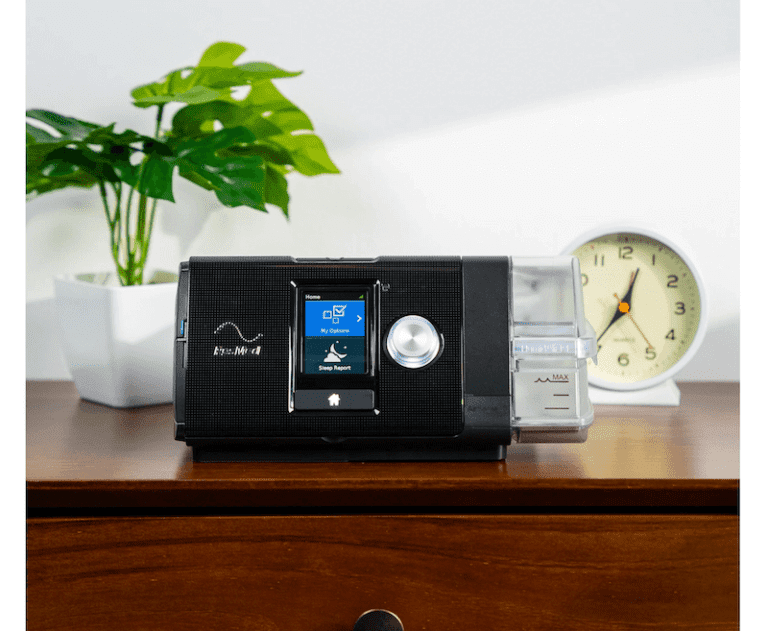
Luna G3 BiPAP 25A vs ResMed AirCurve 10 VAuto
The natural comparison is ResMed’s AirCurve 10 VAuto, the machine most sleep clinics reach for when prescribing auto bilevel therapy. Here is how they stack up on the points that matter:
| Feature | Luna G3 BiPAP 25A | ResMed AirCurve 10 VAuto |
|---|---|---|
| Max pressure | 25 cmH2O | 25 cmH2O |
| Auto bilevel | Yes | Yes |
| Heated tubing | Included | Sold separately |
| Connectivity | Cellular modem plus SD card | Cellular plus SD card |
| Patient app | None | myAir |
| Onboard data screen | Yes, full color | Yes |
| Relative cost | Budget tier | Premium tier, often costing considerably more |
On raw therapy capability, they are closer than the price gap suggests. Both reach 25 cmH2O, both adjust automatically within a prescribed range, and both run quietly. ResMed’s advantages are the myAir app, a more refined interface, and the broadest support network in the industry. Nearly every equipment supplier and sleep clinic knows ResMed machines inside out, and that familiarity has real value when something goes wrong. The Luna’s advantage is straightforward: comparable core therapy, heated tubing included, at a substantially lower cost. I compare the wider field in my best BiPAP machines guide.
Strengths and Weaknesses
The strengths are easy to summarize. You get full auto bilevel therapy up to 25 cmH2O, an integrated heated humidifier with preheat, heated tubing in the box rather than on a separate invoice, quiet operation, clear data on the screen each morning, and FAA compliance for travel, all at a price that undercuts the big brands by a wide margin. For a machine aimed at value buyers, the comfort feature set is unusually complete.
The weaknesses are mostly about ecosystem rather than therapy. There is no patient app, so your data stays on the machine and the SD card unless your clinic pulls it remotely. The interface works fine but feels dated next to ResMed’s screens, and ramp customization is more basic than on premium machines. Support can also be uneven. Some equipment providers in the United States simply do not carry React Health devices, which means setup help and warranty service may run through whichever online retailer you bought from rather than a local supplier. None of these are reasons to avoid the machine, but they are real tradeoffs, and you should go in knowing them.
And to repeat the most important limitation: no timed backup mode and no ASV capability. This machine treats obstructive sleep apnea. It is not for central or complex apnea.
Who This Machine Suits
The clearest case is the buyer paying out of pocket. Bilevel machines are expensive, insurance coverage for them is inconsistent, and if you are funding this yourself, the 25A delivers the core of what the premium brands deliver for far less money. It also makes sense as a step up for CPAP users who fight their exhale. If you have ever lain awake feeling like you are pushing against the machine to breathe out, separate inhale and exhale pressures can transform how therapy feels, and your doctor may agree that auto bilevel is worth trialing.
It works as a backup or secondary machine too. Anyone who has had a machine fail knows the sinking feeling of facing nights without therapy. A capable, affordable second bilevel that is FAA compliant and travels at under three pounds is a reasonable insurance policy for an established BiPAP user.
Who should look elsewhere? Anyone whose prescription calls for ST or ASV therapy, as covered above. Anyone who genuinely values tracking therapy through an app, because no workaround exists here. And anyone whose insurance fully covers a premium machine through a local supplier, since in that case the Luna’s price advantage evaporates and ResMed’s support network wins.
Frequently Asked Questions
These are the questions that come up most often in user forums and patient communities.
Does the Luna G3 work with any mask? It uses the standard 22 millimeter tubing connection, so it is compatible with most CPAP and BiPAP masks across nasal, nasal pillow, and full face styles. As always, mask fit at your actual pressure settings matters more than brand matching.
Can I use this for central sleep apnea? No. This is an auto bilevel machine without a backup rate. Central and complex apnea call for ST or ASV devices, prescribed and titrated by a sleep physician.
Is it hard to live without an app? Less than you might expect. The screen shows AHI, leak rate, usage time, and pressure each morning, and the SD card holds detailed data your clinic can read. What you lose is convenience and trend visualization, not the data itself.
How loud is it? Rated under 26 decibels at 10 cmH2O, which in practice is a low hum most bed partners will not register. User reports consistently describe it as quiet.
Will insurance cover it? It varies. Some providers and equipment suppliers do not stock React Health machines, which is why the 25A is often purchased as a cash alternative. Check with your insurer and supplier before assuming either way.
Can I take it on a plane? Yes. It meets FAA requirements for use during flights. Carry your prescription, and remember that medical devices do not count against carry-on limits with most airlines.
The Bottom Line
If you need auto bilevel therapy for obstructive sleep apnea and you are paying attention to price, the Luna G3 BiPAP 25A earns its place on the shortlist. It matches the premium brands where it counts, with pressure up to 25 cmH2O, included heated tubing, an integrated humidifier with preheat, and quiet operation, and it gives up ground mainly in app polish and supplier support. That is a sensible trade for a lot of people, especially cash buyers and those who want a capable backup machine.
What it will not do is replace a conversation with your sleep physician. Bilevel therapy, and especially the choice between auto bilevel, ST, and ASV, is a clinical decision built on your sleep study, not on a product page. Settle the prescription question first. Then, if auto bilevel is the answer, this machine deserves a serious look.
⚠️ MEDICAL DISCLAIMER This blog provides general information only and is not a substitute for professional medical advice, diagnosis, or treatment. Sleep apnea is a serious condition, and CPAP equipment should be used under proper medical supervision. Always consult your doctor or sleep specialist before starting, stopping, or changing any therapy. I share personal experiences as a CPAP user, not as a medical professional. Individual results vary. For medical guidance, please consult a qualified clinician or the American Academy of Sleep Medicine (aasm.org).