Secondhand Smoke and Sleep Apnea: What the Research Shows

If you have obstructive sleep apnea and live with someone who smokes, or you live or work in places where smoke drifts in from elsewhere, it’s reasonable to wonder how much of your symptom load is being made worse by exposure you didn’t choose. The honest answer is that the research points to a real association, and the biological reasons are plausible, but the picture is more nuanced than headline articles often suggest.
This piece is an educational overview, not a personal account. I write about sleep apnea as a long-term CPAP user with severe obstructive sleep apnea (AHI of 51 at diagnosis). My background is computer science, not medicine. Nothing here is a substitute for a conversation with your sleep physician.
What Counts as Secondhand Smoke
Secondhand smoke, sometimes called passive smoke or environmental tobacco smoke, is what you inhale when you are near someone who is smoking. It is a mixture of two things: the smoke that drifts off the burning tip of a cigarette, cigar, or pipe (called sidestream smoke) and the smoke that a smoker exhales (mainstream smoke).
The U.S. Centers for Disease Control and Prevention notes that tobacco smoke contains thousands of chemicals, with hundreds that are known to be toxic and dozens linked to cancer. Sidestream smoke, because it is unfiltered and burns at a lower temperature, can carry higher concentrations of some toxic compounds than the smoke an actively inhaling smoker pulls through the cigarette filter. You don’t have to be in a cloud of smoke to be exposed. Particulate matter and gas-phase chemicals can linger in indoor air and settle onto surfaces.
Thirdhand smoke is the related idea that residue from tobacco smoke clings to clothing, hair, upholstery, carpets, walls, and the inside of cars long after the visible smoke has cleared. The chemistry is real, although the practical health impact at typical residue levels is still being studied.
The Evidence Linking Secondhand Smoke to Obstructive Sleep Apnea
The connection between active smoking and obstructive sleep apnea has been studied for decades, and the association in adult smokers is reasonably well established. Secondhand smoke is a smaller, but growing, body of evidence.
A 2022 meta-analysis published in Environmental Health pooled data from 26 studies that looked at secondhand smoke exposure and the likelihood of obstructive sleep apnea in both adults and children. The authors reported a statistically significant positive association: people exposed to secondhand smoke had a higher pooled risk of obstructive sleep apnea compared with those who were not exposed. The effect was present in both age groups, and the link held when the smoker in the household was either a mother or a father.
That is not the same as saying secondhand smoke causes obstructive sleep apnea. The anatomy that drives most adult OSA, things like a narrow upper airway, a low-set hyoid bone, a recessed lower jaw, large tonsils, or excess soft tissue around the neck, is largely structural and is not created by tobacco smoke exposure. What the evidence supports is more measured: secondhand smoke exposure is associated with a higher risk of having or developing OSA, and there are biologically plausible reasons why exposure could make existing sleep-disordered breathing worse.
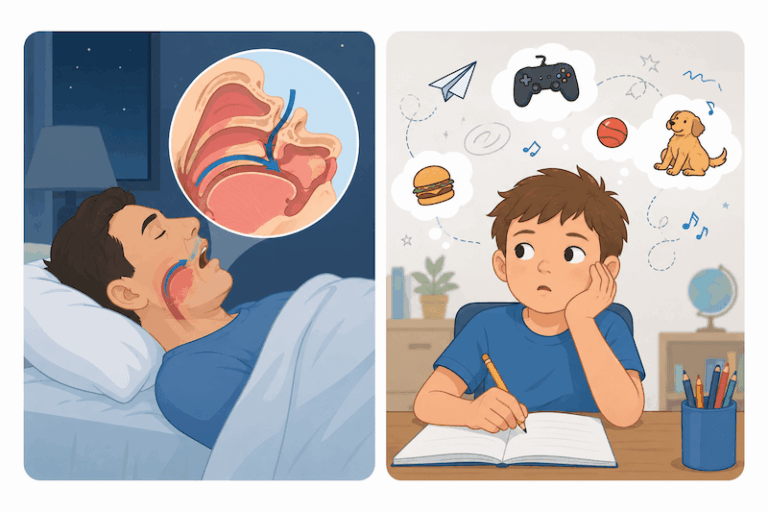
In children, the picture is somewhat clearer. Secondhand smoke is consistently linked to enlarged tonsils and adenoids, more frequent respiratory infections, more severe asthma, and higher rates of snoring and sleep-disordered breathing. Because pediatric OSA is more often driven by enlarged adenotonsillar tissue than by the mechanisms typical of adults, secondhand smoke can act on a more direct pathway in kids. Studies looking specifically at children with severe OSA have found higher apnea-hypopnea index values among those exposed to secondhand smoke compared with those who are not.
Why Smoke Exposure Could Plausibly Worsen OSA
Even setting aside the question of whether secondhand smoke contributes to a new diagnosis, there are several mechanisms that could make breathing during sleep worse for someone who already has OSA.
The first is upper airway inflammation. The lining of the nose, throat, and upper airway is sensitive to airborne irritants. Repeated exposure to combustion products and the chemicals in tobacco smoke can produce inflammation and tissue swelling in exactly the region where obstructive events occur. A more swollen, more reactive airway has less margin before it collapses.
The second is mucus production and nasal congestion. Smoke exposure is well known to increase mucus output and contribute to a stuffy nose. For a CPAP user who is already a mouth breather, nasal blockage tends to push the jaw open further, increase mask leak, and make pressure delivery less effective.
The third is the effect of nicotine and related compounds on upper airway muscle tone. Animal and small human studies suggest that nicotine can disrupt the protective reflexes that help keep the airway open during sleep. The data here are mixed and not as strong as the inflammation evidence, but it is one of the proposed reasons that smokers and people exposed to smoke may have more severe events.
The fourth is sleep fragmentation. Smoke exposure is associated with poorer self-reported sleep quality and more frequent arousals, even in people who don’t have a formal sleep apnea diagnosis. For someone with OSA, more arousals stack on top of the disease itself.
You can see all of these in the research literature on smoking and obstructive sleep apnea, and the same mechanisms are the basis for thinking secondhand exposure works on smaller scales in the same direction.
Where Exposure Tends to Happen
Most exposure for non-smoking adults is at home, in cars, and in shared housing where smoke drifts between units. Outdoor smoking near open windows, balconies, or apartment ventilation can still bring meaningful amounts of smoke indoors. Hotels and rental properties marketed as non-smoking can carry residue from previous guests. Workplaces vary widely depending on local regulation and the type of work.
The point is not to make anyone paranoid. It is that exposure is often invisible. People sometimes assume that if they cannot smell smoke, they are not being exposed. That is not always true, especially with thirdhand residue and with low level chronic exposure that the nose adapts to over time.
CPAP, Masks, and Smoke
A few practical considerations come up for CPAP users specifically.
CPAP filters are not designed to block tobacco smoke or fine particulate matter. The disposable filters in machines like the ResMed AirSense 10 catch dust and larger allergens. They do not meaningfully filter smoke particles, vapor-phase chemicals, or volatile organic compounds. Putting an air filter in front of the machine is not a substitute for cleaner ambient air.
Smoke residue can build up inside humidifier chambers and tubing. If you are routinely running CPAP in a smoky environment, you may notice equipment that yellows or smells faster than expected. Following a sensible replacement schedule becomes more important rather than less.
Mask seal can suffer when nasal congestion is in play. People who already struggle with leak, especially mouth breathers using full face masks, tend to get pushed further toward open-mouth breathing when their nose is irritated. That is a path to higher leak rates and lower therapy effectiveness.
None of this is a reason to give up on CPAP. It is a reason to think about the air the therapy is delivering.
Reducing Exposure
The most effective intervention is also the simplest: don’t share enclosed indoor spaces with active smoking. The CDC’s longstanding position is that there is no safe level of secondhand smoke exposure, and that ventilation, air cleaning, and separating smokers from non-smokers within the same building do not eliminate exposure for non-smokers.
Reasonable steps that have evidence behind them include making the home and car smoke-free, asking smokers to smoke well away from doors, windows, and vents, and not allowing smoking in vehicles even with windows down. For a household where someone is unwilling or unable to quit, having them change clothes and wash hands before close contact reduces, but does not eliminate, thirdhand exposure.
A HEPA air purifier with an activated carbon stage can reduce some airborne particles and odors in a single room. Carbon filtration helps with some of the gas-phase chemicals that HEPA alone cannot catch. These devices are useful, but they are an addition to source control, not a replacement for it.
Smoking cessation is the largest possible improvement, both for the person who smokes and for everyone around them. National quitlines, primary care, and pharmacist-led cessation services have a much better track record than people often expect. If a partner or family member is open to quitting, that conversation is worth having on its own merits.
Frequently Asked Questions
Can secondhand smoke cause sleep apnea in someone who would not otherwise have it?
The honest answer is that the structural features that drive most adult obstructive sleep apnea are not created by smoke exposure. Secondhand smoke is best understood as a risk factor that can worsen sleep-disordered breathing rather than a primary cause in adults. In children, the picture is closer to direct contribution because of the way smoke exposure affects adenotonsillar tissue and upper airway inflammation, both of which are central to pediatric OSA.
How long after exposure stops do airway changes settle down?
Acute irritation tends to ease within a couple of days once exposure ends. Mucus production and nasal congestion often improve over one to two weeks. Tissue inflammation and the broader effects of long term exposure can take longer to resolve, and some changes from years of heavy exposure may not fully reverse. The general direction is toward improvement, but the timeline varies a lot from person to person and depends on factors like underlying allergies, asthma, and the duration and intensity of past exposure.
Will my CPAP filter protect me from secondhand smoke?
Standard CPAP filters are not designed to remove tobacco smoke or fine particulate matter. They handle dust and larger allergens. Smoke particles, gas-phase chemicals, and odors pass through. The effective approach is to address the air in the room, not to rely on the machine’s filter.
Is vaping around someone with sleep apnea a safer alternative?
Vapor from e-cigarettes is chemically different from combustion smoke, but it is not inert. Aerosols from vaping contain nicotine, propylene glycol, vegetable glycerin, flavoring compounds, and trace metals, and a growing literature reports airway inflammation and changes in lung function from regular exposure. For someone with OSA, the prudent approach is to treat vape aerosol the same way as cigarette smoke: keep it out of shared indoor air and out of the bedroom.
My partner only smokes outside. Could that still affect me?
It can, in two ways. Smoke can drift back inside through open windows, doors, and ventilation, especially when smoking happens close to the building. Thirdhand residue travels in on clothes, hair, and skin and can transfer in close contact. The risk is generally lower than indoor smoking, but it is not zero. Smoking well away from the house, changing clothes, and washing hands before bed reduces, although does not eliminate, the exposure.
What can I do about smoke from a neighbor’s apartment?
Multi-unit housing is one of the harder situations because you do not control the source. Sealing gaps around doors, windows, and shared vents helps. A HEPA-plus-carbon air purifier in the bedroom can reduce, but not eliminate, drifting smoke. Many leases and local regulations now address smoke transfer between units; documenting the issue and raising it with a landlord or strata is a reasonable step. In persistent cases, moving may be the only durable solution.
Does cannabis smoke have similar effects?
Combustion smoke, regardless of what is being burned, contains many of the same particulate matter and irritant compounds that affect the airway. The literature on cannabis smoke and OSA is much smaller than the literature on tobacco, but the mechanism by which any combustion smoke could worsen airway inflammation is the same. Edibles and tinctures avoid the airway exposure entirely; vaporizers reduce some, although not all, of it.
I quit smoking years ago. Could past exposure still be affecting my sleep apnea now?
Years of smoking can leave lasting changes in airway tissue and lung function, and former smokers as a group still show some elevated risk markers compared with people who never smoked. The benefits of quitting accumulate over time, and the further out from cessation, the closer many measures move toward never-smoker baselines. If you are a former smoker and your therapy feels like it is not delivering the relief you expected, that is worth raising with your sleep physician; it is not a reason to assume CPAP cannot help.
How do I have the conversation with someone who smokes around me?
This is the part that is genuinely hard, and there is no script that works in every household. The general principles that tend to land better than confrontation are leading with your own experience rather than their behavior, being specific about what would help (smoke-free bedroom, smoke-free car, distance from open windows), and offering support if quitting is on the table. The conversation works best when it is not framed as an ultimatum on the first attempt.
A Measured Conclusion
Secondhand smoke is one of several controllable factors that can make sleep apnea harder to live with. The evidence for an association with OSA is real, especially for children, and the mechanisms by which exposure could worsen breathing during sleep are biologically plausible. It is not the only thing that matters, and for many people it is not even the dominant factor. Weight, alcohol, sleep position, mask fit, pressure settings, and untreated nasal issues all sit alongside it.
If you are working with a sleep physician on stubborn symptoms, environmental exposures are worth raising explicitly. They are easy to overlook in a clinic visit because they don’t show up on a polysomnogram, and the patient is often the only person in the room who knows what the air looks like at home.
For more on the broader landscape of obstructive sleep apnea, CPAP compliance, or recognizing sleep apnea symptoms, other articles on this site go deeper on each topic.
External references:
- Centers for Disease Control and Prevention, About Secondhand Smoke: https://www.cdc.gov/tobacco/secondhand-smoke/index.html
- Wang J, et al. What is the association between secondhand smoke (SHS) and possible obstructive sleep apnea: a meta-analysis. Environmental Health, 2022: https://ehjournal.biomedcentral.com/articles/10.1186/s12940-022-00868-6
⚠️ MEDICAL DISCLAIMER This blog provides general information only and is not a substitute for professional medical advice, diagnosis, or treatment. Sleep apnea is a serious condition, and CPAP equipment should be used under proper medical supervision. Always consult your doctor or sleep specialist before starting, stopping, or changing any therapy. I share personal experiences as a CPAP user, not as a medical professional. Individual results vary. For medical guidance, please consult a qualified clinician or the American Academy of Sleep Medicine (aasm.org).