Is Sleep Apnea Genetic? What Happened When My Son Had Surgery


After more than a decade with severe obstructive sleep apnea, you stop asking only how to treat the thing and start asking where it came from. I was diagnosed with an apnea-hypopnea index of 51, which is deep in the severe range, and for a long time I treated that as bad luck or a consequence of how I was living. It was only later, once I started thinking past my own treatment, that a harder question arrived. How much of this was written into me before I had any say, and if it was, what does that mean for the people who share my genes?
If you came here carrying some version of that worry, maybe about yourself, maybe about a child, you are in the right place, and you are asking a reasonable question. I am not a doctor. I write as a patient who has lived inside this condition for years and read a great deal trying to understand my own. So take what follows as a long-term patient walking you through what the research actually says, not as medical advice. Where it matters, talk to a sleep specialist.
So is it inherited, or not?
Here is the distinction that almost every article blurs. Sleep apnea is not directly inherited the way a single gene disorder is. You do not receive one broken gene from a parent that hands you the condition. The Sleep Foundation puts it plainly: sleep apnea is not passed down as a discrete inherited disease, but several of the physical traits tied to it do run in families.
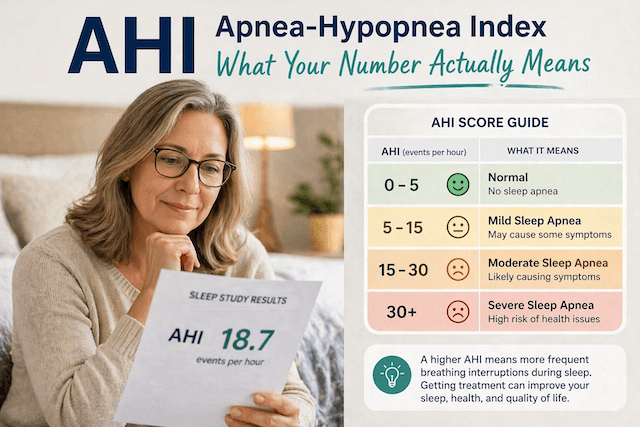
That sounds like a hedge until you see how strong the familial signal actually is. The most convincing evidence comes from twins, because identical twins share nearly all their DNA while fraternal twins share about half, so a trait that resembles itself far more closely in identical pairs is telling you something genetic is at work. A 2019 twin study published in Respiratory Research ran full overnight sleep studies on 71 Hungarian twin pairs and found that obstructive sleep apnea, defined by an AHI of 5 or higher, was about 73 percent heritable, with the underlying severity measures landing in a similar range. Tellingly, daytime sleepiness was mostly driven by environment rather than genes. In plain terms, the breathing problem itself appears largely inherited, while how exhausted it leaves you depends a lot on your habits and your life.
So both things are true at once. There is no sleep apnea gene to test for, and the condition is still strongly familial. You do not inherit apnea. You inherit the raw materials, and whether they ever assemble into the full thing is not fixed at birth. That last part is where the hope lives, and I will come back to it.
What is actually being passed down
Once I understood that there was no single gene, the obvious next question was what exactly travels through a family. The answer is a cluster of physical traits that, in combination, make the upper airway more likely to collapse while you sleep.
The most important is the structure of your face and jaw. Craniofacial shape is one of the most heritable things about you, which is why families share profiles down the generations, and the airway underneath those profiles tends to follow the same pattern. A lower jaw set further back than ideal carries the tongue back with it and crowds the throat. A high, narrow palate reduces the room in the mouth. A long soft palate or a long uvula adds tissue that can vibrate and obstruct. None of these is dangerous sitting in a chair awake. They turn dangerous when sleep, gravity, and relaxed muscle tone let a marginal airway close.
Soft tissue matters too. The size of your tongue and the tone of the small muscles that hold your airway open both have genetic components, and both decide whether the airway stays patent once you drop into deeper sleep and everything relaxes. So does the way your body stores fat, since genetics influence not just how much weight you carry but where, and weight around the neck and tongue base narrows the airway directly while abdominal weight presses on the diaphragm and lowers lung volume. Two people at the same weight can carry very different risk depending on where their bodies prefer to put it.
There is a fourth, less understood category, which is the way your brainstem regulates breathing and senses rising carbon dioxide. That control has genetic components and is thought to matter more for central than obstructive apnea, but the evidence is still developing.
Beyond these everyday tendencies, there are specific genetic conditions where apnea is part of the syndrome rather than a coincidence. Down syndrome combines midface underdevelopment, a relatively large tongue, and low muscle tone, and carries high rates of OSA. Marfan syndrome involves connective tissue laxity that can affect the airway. Chiari malformations, where part of the brain extends into the spinal canal, can drive central apnea by affecting brainstem function. If your family is dealing with one of these, the genetic question is already settled and the real question is whether the apnea is being monitored and treated.
Why a clean family history means less than you think
This is the part of my own situation that I think helps other readers most, because so many of them share it. As far as I know, I am the only person in my family with a diagnosed case. For a long time I read that as reassuring. I no longer do, and here is why the absence of a family history is much weaker evidence than it feels like.
Sleep apnea was barely diagnosed before the 1990s. Anyone in your family tree who died earlier, no matter how loudly they snored or how often they nodded off at the table, was almost certainly never tested, because sleep clinics as we know them simply did not exist yet. On top of that, snoring was treated as a family punchline rather than a symptom, and the breathing pauses a spouse occasionally noticed were dismissed as quirks. Women were, and still are, underdiagnosed, because the textbook patient in everyone’s mind is a heavyset middle-aged man with a thick neck, while women more often present with fatigue, headaches, and insomnia and get missed.
So when I say nobody else in my family has it, what I can honestly rule out is a diagnosed history. That is not the same as ruling out the genetics. The predisposition can run quietly through generations of people whose breathing was never once examined. If you are the first in your family to be diagnosed, you have not discovered that your relatives were clear. You have more likely discovered that you were the first one anyone actually checked.
What to watch for in children and teenagers
If your worry is pointed at a child, that instinct is worth following, but it helps to know that sleep apnea in children does not always look the way it does in adults. A tired adult goes quiet and sleepy. A tired child often gets wired instead, so the picture can read as restlessness, irritability, or trouble focusing rather than obvious exhaustion.
The signs worth noticing include loud and habitual snoring rather than the occasional stuffy night, restless sleep with odd positions or a neck craned back as the body hunts for an open airway, persistent mouth breathing, and daytime behavior that gets labeled as something else, since untreated sleep-disordered breathing in kids is regularly mistaken for attention problems. Morning headaches, bedwetting in an older child, and any frank pauses in breathing you happen to witness all belong on the list. So does growth, because deep sleep is when growth hormone is released, and children who are not getting enough of it can fall off their curve.
None of these alone proves anything. Together, and especially alongside a family pattern of apnea or heavy snoring, they are a reason to raise it with a doctor rather than wait it out. It also helps to understand where ordinary snoring ends and a real concern begins, which is exactly what my piece on whether it is snoring or sleep apnea is for, and there is a fuller checklist for parents wondering about their child if you want a structured starting point.
What to actually do if it might run in your family
Start with the conversation nobody starts. Ask your parents whether they snore. Ask your siblings whether their partners have ever mentioned gasping or breathing pauses. Ask your own partner to watch you for a few nights. Sleep is private and people do not talk about it, which is why most untreated apnea goes unnoticed by the very person living it, while the person sleeping beside them has noticed for years and said nothing.
Take screening seriously, especially as you get older, since the airway loses tone with age and weight that was easy to keep off gets harder. If a close relative has a diagnosis, the least you can do is run a quick self-check. The STOP-Bang questionnaire is widely used because it is fast and weights the factors that matter, and my rundown of sleep apnea symptoms and the short self check on whether you might have it cover the same ground from the patient’s side. None of these diagnoses anything, but a high score is a clear nudge to get tested.
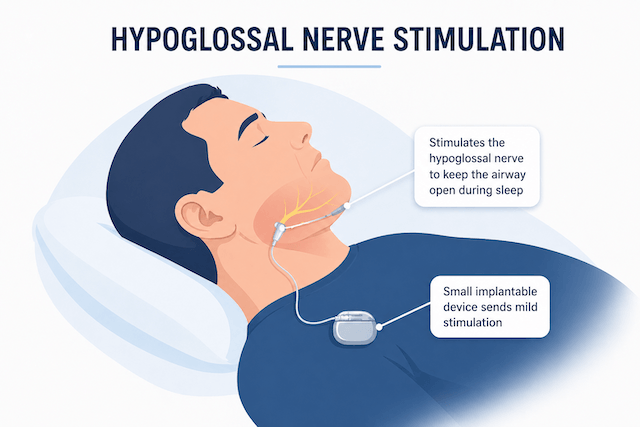
Testing is far more accessible than it used to be. You no longer necessarily need a night in a lab wired to a dozen sensors, since an at home sleep test is often enough to confirm the picture when symptoms are clear, and it is usually the practical first step a doctor will suggest. If a test confirms obstructive sleep apnea, the conversation turns to treatment, which for most people means CPAP, and in selected cases a discussion of surgery when there is a specific structural problem to address.
There is one more step that I think gets overlooked, and it is aimed at those of us who already have a diagnosis. If you have apnea, the people who share your genes are at higher risk, and the way you handle your own treatment quietly teaches them what to expect. If you suffer through a badly fitted mask and resent the machine, you teach the next generation that treatment is something to endure. If you actually engage with it, dial in the comfort, and treat the machine as the thing that gives you your days back, you teach them something far more useful. I have written about what that engagement looks like over the years in my piece on living with sleep apnea.
How I try to hold all this
The temptation, once you understand the genetics, is to swing to one of two extremes. Either you decide it is fate and shrug, or you panic and start treating every snore in the house as a crisis. Neither is right. Genes load the dice, but weight, age, alcohol, and sleep position are what pick them up and roll them, and that is genuinely good news, because it means a real part of the risk stays in your hands and in your children’s hands. A predisposition toward a crowded airway is not a sentence. It is information, and information you can act on early is the most valuable kind.
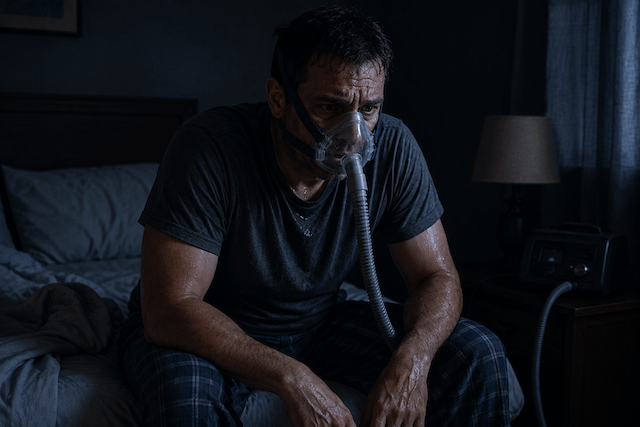
That is the honest takeaway I would pass to anyone arriving here worried about what they may have inherited or passed on. Pay attention to symptoms, use a screening tool, get tested if the picture warrants it, and start the family conversations that awareness makes possible. Sleep apnea, caught and treated, is one of the more manageable serious conditions out there. I have lived that for more than a decade, and the machine on my nightstand is steady proof that an airway you were born with does not get the last word.
⚠️ MEDICAL DISCLAIMER This blog provides general information only and is not a substitute for professional medical advice, diagnosis, or treatment. Sleep apnea is a serious condition, and CPAP equipment should be used under proper medical supervision. Always consult your doctor or sleep specialist before starting, stopping, or changing any therapy. I share personal experiences as a CPAP user, not as a medical professional. Individual results vary. For medical guidance, please consult a qualified clinician or the American Academy of Sleep Medicine (aasm.org).