Best CPAP Pillows of 2026: What to Look for and What I Recommend

“This post contains affiliate links. I may earn a commission if you buy through these links, at no extra cost to you. Read my Disclaimer for more details.”
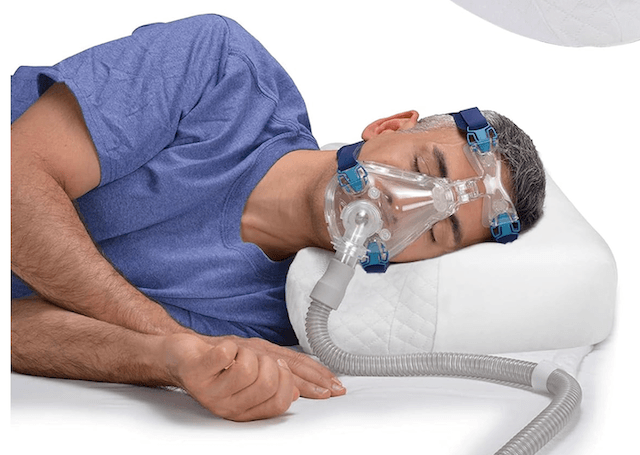
I don’t personally use a CPAP pillow, and I want to say that before anything else. I have been a side sleeper with a full face mask for more than a decade, and I solved the mask meets pillow problem a different way, mainly by sleeping at a slight angle on a firmer standard pillow that gives the mask frame room to sit without pressing into my face. It works for me. It also took a fair amount of trial and error to land on, and plenty of the readers who write to me have not solved it that way.
What I do understand, from a decade of nightly full face mask use and from the questions that land in my inbox constantly, is exactly what a regular pillow does wrong for a CPAP user. When you roll onto your side on a standard pillow, the pillow presses against the mask cushion and breaks the seal. The air starts leaking, you lose therapy effectiveness, and the noise often wakes you. The mask frame digs into the side of your face. The hose gets pinched or pulled. By three in the morning you have either ripped the mask off or rolled onto your back, because side sleeping has become more effort than it is worth.
That is the problem a CPAP pillow is built to solve, and for a lot of side sleepers it is the single change that finally makes therapy comfortable enough to stick with. My background is in computer science rather than medicine, so treat everything here as the perspective of a patient who has lived with this for a long time, not as clinical advice. With that said, here is how these pillows work, what to look for, and the two I would point a side sleeper toward today.
What a CPAP Pillow Actually Does
A CPAP pillow looks like an ordinary pillow until you notice the cutouts. These are recessed sections carved into the sides of the pillow, and they create a pocket for the mask to sit in when you lie on your side. Instead of the pillow surface pressing flat against the mask cushion, the cushion drops into the recess, so nothing pushes against the seal. The hose has room to route off the edge of the pillow naturally rather than getting trapped under your head. Your face rests on the pillow, not on the mask frame.
That is the whole idea, and it is a simple one. The reason it matters so much is that a broken seal is not a minor annoyance. A continuous positive airway pressure machine works by delivering a steady stream of air that props the upper airway open while you sleep, which is why a leak undermines the entire point of the therapy. The team at Cleveland Clinic describes CPAP as one of the most common and effective treatments for obstructive sleep apnea precisely because it keeps the airway open through the night, and the benefit of that only holds if the air is actually reaching you. A pillow that stops your mask from shifting is protecting the therapy, not just your comfort.
For back sleepers, this is rarely an issue, since the mask sits clear of the pillow when you face the ceiling. The trouble belongs almost entirely to side sleepers and, to a lesser degree, to people who change position through the night. If you wake up with red marks on your face, with the mask shoved sideways, or with the machine reporting leaks it did not report when you slept on your back, you are the person these pillows were designed for.
Quick Picks
| Your situation | My recommendation |
|---|---|
| Best overall, especially for side sleepers | Borden Textile CPAP Pillow |
| Best memory foam | HOMCA CPAP Pillow |
Borden Textile CPAP Pillow — Best for Side Sleepers
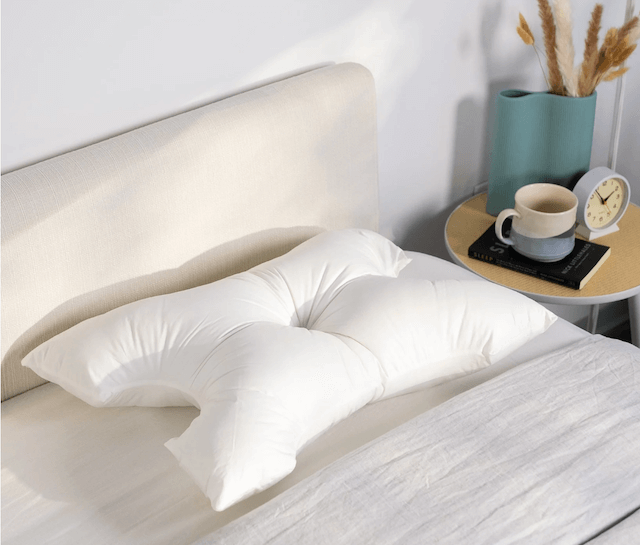
The Borden is built around the side sleeping position, which is the situation most people are in when a standard pillow starts fighting their mask. The contoured cutouts are shaped to give a full face mask frame somewhere to go, not just the slimmer nasal or nasal pillow styles, so it suits the heavier masks that tend to cause the worst pressure problems. As a full face mask user myself, that is the detail I would care about most if I were shopping, because a shallow cutout that only clears a small nasal cushion is no help to someone wearing a larger frame.
The fill is a softer polyester fiber rather than memory foam. Some people much prefer that lighter, less enveloping feel, and the trade-off is that fiber tends to run cooler than foam, which is worth something if you already sleep warm with a humidifier running beside the bed. The cover uses a cooling fabric for the same reason, and there is a center dimple that cradles the head without the firmer contouring you get from a molded foam pillow. The materials are hypoallergenic, which is a reasonable point in its favor if you have sensitive skin or react to certain fabrics.
I want to be straight about the limits of fiber fill, because it is not all upside. A fiber pillow compresses more over time than memory foam and will eventually need replacing sooner, and it offers less rigid structure if what you actually need is firm neck support. If you have tried soft pillows before and found that your head sinks too far, this may not be the one for you, and the memory foam option below will suit you better. But for a side sleeper whose main problem is the mask shifting and the seal breaking, this is a sensible, available, purpose-built starting point, and it is the pick I would reach for first.
HOMCA CPAP Pillow — Best Memory Foam
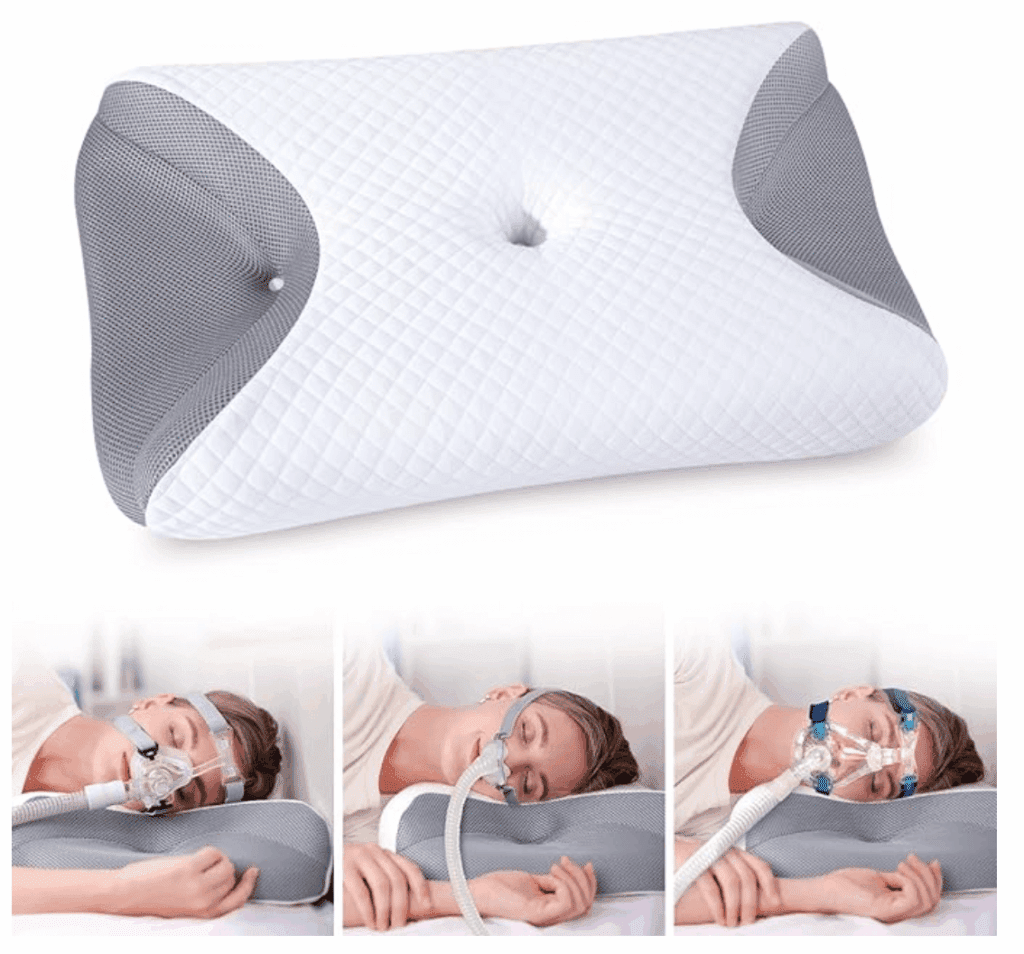
If you want the firmer, more structured feel of memory foam rather than the softer fiber of the Borden, the HOMCA is the one I would look at. It is more contoured and more ergonomic, with a cervical shape that provides pronounced neck support, which is the thing fiber pillows give up in exchange for their softer feel. If your real complaint is not just the mask shifting but also waking with a stiff neck, the trade leans toward foam.
It comes in two height options, roughly 4.33 inches on the high side and 3.54 inches on the low, which makes it practical to dial in the right loft whether you are tall and broad-shouldered or smaller-framed. Loft matters more than people expect. Too low and your head drops and bends your neck one way, too high and it bends the other, and either one can leave you sore in a manner that has nothing to do with your mask. Having two heights to choose from takes some of the guesswork out of it.
The feature specific to this pillow is the ear cutout, a small hollow that relieves the pressure on the ear that side sleepers often feel against firmer foam. If you have avoided memory foam pillows in the past because of exactly that discomfort, it is worth knowing this design has tried to address it. There is also an optional booster pad of about 0.8 inches available from the manufacturer for anyone who finds the standard heights just slightly too low, and a small adjustment like that can make a disproportionate difference to neck alignment when you need it.
The honest caveat with any memory foam pillow is heat. Foam holds warmth more than fiber does, so if you already run hot at night this is the category to be cautious with. For people who do not, the support and shape retention of foam are genuine advantages, and the HOMCA is a solid example of the type.
What Actually Makes a CPAP Pillow Worth Buying
The cutouts are the non negotiable feature. A pillow marketed as CPAP friendly without proper recessed cutouts on the sides is just a regular pillow with better marketing. What you are looking for is enough depth in the cutout that when your head is resting in a side sleeping position, the mask frame sits down in the recess rather than caught between your face and the pillow surface. If you wear a full face mask, check that the cutout is deep enough for the larger frame and not sized only for a slim nasal cushion.
Beyond the cutouts, the variables that matter are fill material, height, and symmetry. Memory foam gives you more structure and holds its shape better over the years, but it runs warmer. Fiber fill is softer and cooler but compresses faster and will need replacing sooner. Height matters for neck alignment, which is why adjustable loft is worth a small premium, and it is the reason the HOMCA’s two height options are a genuine selling point rather than marketing filler.
Symmetry is the one people overlook. If you sleep on one side all night every night, a pillow with a cutout on a single dominant side is fine. If you are a restless sleeper or you alternate sides, you want recesses on both sides so you are not waking up to flip and reorient the pillow at midnight while half asleep. A pillow you have to manage is a pillow you will eventually stop using.
It is also worth thinking about your mask before your pillow, because the two interact. If you are a side sleeper choosing a mask, some designs handle pressure against the pillow far better than others, and the right mask plus the right pillow together solve more than either does alone. The same goes for the skin side of the problem. If your trouble is irritation and marks rather than leaks, a pillow helps, but so do CPAP mask liners and a closer look at how to prevent strap marks.
When a Pillow Will Not Fix the Problem
A CPAP pillow is a comfort tool, not a repair for a setup that is wrong at the source. If your mask does not fit properly or your pressure is set incorrectly, no pillow will rescue it, and you can spend money chasing a symptom while the real cause sits untouched. A leaking mask in particular is worth taking seriously early. Mayo Clinic lists a leaky mask among the most common CPAP problems and advises calling your provider or equipment supplier if it shows up in the first couple of weeks of therapy, because it usually points to fit or pressure rather than to your pillow.
So the order of operations matters. Confirm that your mask fits and seals when you are lying still on your back. Confirm that your pressure is what your clinician prescribed and that any comfort features are set sensibly. If the mask and pressure are right and you are still waking with leaks or facial marks only when you sleep on your side, then the pillow is very likely the remaining variable, and it is one of the lowest cost things you can change. If your mask is leaking regardless of position, the pillow is not your answer, and you can read more about why CPAP masks leak before you spend anything.
Giving a New Pillow a Fair Trial
One thing I would gently push back on is the instinct to judge a new pillow on the first night. Any change to your sleep setup feels strange at first, and a CPAP pillow is a noticeable change in shape and feel. Give it a week of consistent use before you decide. Most people who end up happy with one needed a few nights to stop noticing it and start simply sleeping.
Hygiene is the other practical point. With nightly use, a pillow that sits inches from a humidified airstream and against your skin needs regular cleaning, so a removable, washable cover is not a luxury feature, it is the thing that keeps the pillow usable over the long term. Both pillows here come with covers you can wash, and I would treat washing them as part of the same routine you already follow for your mask and tubing.
If you have your mask fit dialed in and your pressure right, and side sleeping is the only thing still breaking your therapy, a purpose-built pillow is an inexpensive change that solves a genuinely frustrating problem. Of the two here, the Borden Textile pillow is where I would start for most side sleepers, with the HOMCA as the better choice if you specifically want firmer memory foam support.
⚠️ MEDICAL DISCLAIMER This blog provides general information only and is not a substitute for professional medical advice, diagnosis, or treatment. Sleep apnea is a serious condition, and CPAP equipment should be used under proper medical supervision. Always consult your doctor or sleep specialist before starting, stopping, or changing any therapy. I share personal experiences as a CPAP user, not as a medical professional. Individual results vary. For medical guidance, please consult a qualified clinician or the American Academy of Sleep Medicine (aasm.org).