Best CPAP Masks for Children: The Two Real Options

If your child has been diagnosed with obstructive sleep apnea, you are probably feeling some mix of relief at finally having an answer and worry about what comes next. I understand part of that. I have lived with severe obstructive sleep apnea for more than a decade, and I use CPAP every night. What I do not have is firsthand experience fitting a CPAP mask on a child, and I have no affiliate relationship with either manufacturer covered here, so this is not a ranked list of picks. It is an overview of what actually exists in the pediatric mask market, drawn from the manufacturers’ own specifications, the clinical guidance, and what more than a decade of nightly mask use has taught me about what makes a mask work. Which one suits your child is a decision for you and your child’s sleep specialist. I am a patient, not a doctor, and your child’s sleep specialist should always have the final word on equipment.
One more thing before the recommendations, because it matters. For adults like me, CPAP is the standard first treatment. For children, it usually is not.
CPAP Is Usually Not the First Treatment for Kids
This surprises a lot of parents. The American Academy of Pediatrics recommends adenotonsillectomy, which is surgical removal of the tonsils and adenoids, as the first line of treatment for most otherwise healthy children with obstructive sleep apnea. You can read the AAP clinical practice guideline, Diagnosis and Management of Childhood Obstructive Sleep Apnea Syndrome, for the full reasoning. In children, enlarged tonsils and adenoids are the most common cause of airway obstruction, and removing them often resolves the problem outright.
CPAP enters the picture for children in a few specific situations. Some children are not good surgical candidates. Some have sleep apnea that persists after surgery, which is more common in children with obesity, craniofacial differences, Down syndrome, or neuromuscular conditions. And some need CPAP as a bridge while waiting for surgery or while other treatments are explored. The American Academy of Sleep Medicine has stated that CPAP can be used safely and effectively in children, including young children, provided that evaluation and management are handled by clinicians with genuine expertise in pediatric sleep apnea.
So if your child has been prescribed CPAP, it means a specialist has looked at their specific situation and decided this is the right tool. The next job is finding a mask they will actually wear, because a mask that sits in a drawer treats nothing. I learned that lesson on my own face as an adult. It is even more true for a six-year-old.
Why There Are So Few Pediatric Masks
You will notice this guide covers two masks, not ten. That is not laziness. The pediatric CPAP mask market is genuinely small. Most manufacturers focus on adults, and only a handful of masks have been designed and sized specifically for children’s faces. Some older children and teenagers end up fitted with the smallest adult sizes, but that is a decision for your equipment provider and sleep specialist, not something to guess at. For younger children, the two purpose-built options below are essentially the market.
Philips Respironics Wisp Pediatric Nasal CPAP Mask
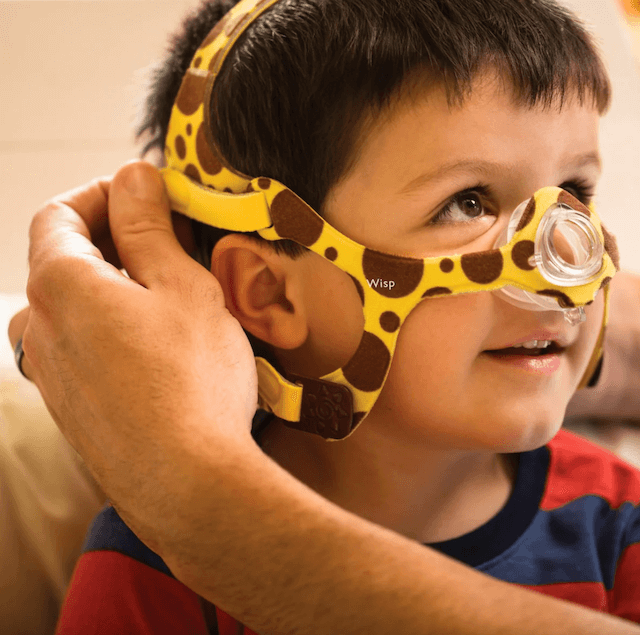
The Wisp Pediatric is one of the most widely used CPAP masks for children, and the design choices explain why. Philips took its popular adult Wisp nasal mask and rebuilt it around pediatric facial proportions, with a soft fabric frame and a yellow giraffe spotted pattern that makes the mask look more like something from a storybook than a piece of medical equipment. That sounds like a gimmick until you remember that the single biggest obstacle in pediatric CPAP is getting the child to accept the mask at all. Philips even pairs the mask with a Jacky Giraffe cartoon that parents can watch with their child during setup.
Functionally, there is real substance here. The mask comes in three pediatric cushion sizes so your equipment provider can dial in the fit, and it is intended for children weighing more than 22 pounds (10 kilograms). A leak correction dial lets you adjust the seal without taking the mask off your child’s face, which matters at two in the morning when a leak starts whistling, and you would rather not wake them fully to fix it. The fabric frame keeps hard plastic off the cheeks, and the low profile leaves your child’s field of vision clear for reading or winding down before lights out.
Full specifications are on the Philips Wisp Pediatric product page.
Strengths
- The giraffe-themed fabric design genuinely helps with acceptance, which is the whole battle
- Three cushion sizes allow proper fitting as your child grows
- Leak correction dial allows adjustments without removing the mask
- Minimal contact frame reduces red marks and skin irritation
Limitations
- Nasal only, so it is not suitable for children who breathe through their mouth at night
- Fabric frame parts need to be air dried, which means cleaning requires a little planning
As a lifelong mouth breather who has only ever been able to use a full face mask, I will say the nasal-only limitation is worth taking seriously. If your child sleeps with their mouth open, raise it with the sleep specialist before committing to any nasal mask.
ResMed Pixi Pediatric Nasal CPAP Mask
The Pixi takes a different approach. Where the Wisp Pediatric is an adult design adapted for children, ResMed built the Pixi from scratch for children aged two to seven, using anthropometric data on children’s bone structure, facial features, and skin sensitivity. The result is a thin, soft silicone cushion made from a single wall of material, designed to seal gently on a small face without needing to be cranked tight.
Two safety and convenience features stand out. First, the headgear includes an emergency latch that lets a parent or caregiver remove the mask quickly with one hand, while keeping the strap settings in place so you do not have to refit it the next night. Second, the tubing can attach to either the left or right side of the cushion, which helps with side sleeping and stomach sleeping and keeps the hose from dragging across your child’s face. The headgear is designed to sit away from the eyes and ears, with three points of adjustment to accommodate growth across the supported age range.
Full specifications are on the ResMed Pixi product page.
Strengths
- Purpose-built for ages two to seven using pediatric facial data
- Emergency latch allows fast removal without losing the headgear adjustment
- Tubing attaches on either side, friendly to side and stomach sleepers
- Thin silicone cushion is gentle on sensitive skin
- Clear line of sight with no forehead support blocking vision
Limitations
- Nasal only, so it shares the Wisp’s limitation for children who mouth breathe
- One frame size covering ages two to seven, so fit at the edges of that range can vary
- No giraffes
Do You Need a Prescription for a Child’s CPAP Mask?
In the United States, yes, in most cases. CPAP masks are regulated medical devices, and reputable suppliers require a prescription even for replacement masks. For children this is not just red tape. The prescription ties the mask to pressure settings chosen by a pediatric sleep specialist, and pediatric pressures and mask fit need closer supervision than adult therapy does. Some retailers sell fit packs that include multiple cushion sizes so you can find the right fit at home, but you will still need the script. If you are only replacing a worn mask without changing therapy settings, your existing prescription may cover it. Ask your supplier.
What to Look For in a Pediatric CPAP Mask
After more than a decade of nightly mask use, I can tell you the things that decide whether a mask works are rarely the things on the marketing page. For a child, I would weigh these factors, in roughly this order.
Fit comes first. An ill fitting mask leaks, and a leaking mask delivers unreliable pressure, dries out eyes, and wakes everyone up. Pediatric sizing and adjustable headgear are non negotiable, and a professional fitting through your equipment provider is worth insisting on.
Breathing style matters just as much. Both masks above are nasal masks, which work well for children who breathe through their nose. If your child breathes through their mouth during sleep, a nasal mask alone may not deliver effective therapy. I know this territory well, since mouth breathing is exactly why I have worn a full face mask every night for more than a decade. Pediatric full face options are limited and usually handled through your specialist, and some clinicians use a chin strap alongside a nasal mask instead. This is a conversation to have before purchase, not after. If you want background on the difference, I have written about nasal versus full face masks from the adult side.
Then comfort and skin. Children’s skin marks and irritates more easily than adult skin. Soft cushions, fabric contact surfaces, and headgear that does not press on the eyes or ears all reduce the friction, literal and otherwise, of nightly use.
Finally, appeal. It feels trivial next to the clinical considerations, but a mask your child thinks looks fun is a mask they are more likely to put on without a fight. The giraffe spots earn their place.
Tips for Parents Starting CPAP With a Child
I adjusted to CPAP as an adult, with an adult’s understanding of why the strange mask blowing air at my face was good for me. A young child does not have that, so acceptance has to be built rather than explained. The approaches below are the ones pediatric sleep clinics commonly recommend, and they line up with what worked for me in my own first weeks of therapy.
Start with daytime practice. Let your child handle the mask, wear it without the machine running, then wear it during quiet activities like stories or television. Short, low pressure exposure builds familiarity before you ever ask them to sleep in it.
Make the story friendly. Some parents frame the mask as pilot gear or superhero equipment. Whatever fits your child, give the mask a positive identity rather than presenting it as a medical chore.
Reward consistency, not perfection. A sticker chart or small reward system for each night of use can carry a child through the awkward early stretch. Expect setbacks. A few rough nights at the start does not mean therapy is failing. My own first week as an adult included waking up having pulled the mask off in my sleep, and I still adapted within days.
Stay close to the clinic. Pediatric CPAP should be actively supervised. If the mask is leaving deep marks, if your child fights it night after night, or if the pressure seems to distress them, call the sleep clinic rather than pushing through. My own therapy only started working after I went back and had a pressure setting corrected, and children deserve at least that much responsiveness.
Keep it clean. Wash the cushion daily with warm water and mild soap, paying attention to the area around the nose bridge where oil and residue build up, and let fabric parts air dry out of direct sunlight. Most suppliers suggest replacing pediatric cushions every two to three months because softened silicone seals poorly on a small face.
One more thing worth knowing about long term use. Because children’s facial bones are still growing, sleep specialists monitor kids on long term CPAP for any effect of nightly mask pressure on facial development. This is a known consideration in pediatric sleep medicine, it is managed with proper fitting and regular follow up, and it is one more reason a child’s therapy should stay under specialist care rather than being run on autopilot. If you want a broader picture of how the condition shows up in kids, I cover symptoms and diagnosis in my post on sleep apnea in children.
Final Thoughts
A correctly treated child sleeps better, learns better, and behaves better, and parents tell sleep clinics this transformation can be dramatic. I can speak to the adult version personally. Treating my own severe sleep apnea gave me back mornings without headaches and days without brain fog, and I would want that for any child diagnosed with this condition. The Wisp Pediatric and the Pixi are the two purpose built masks most young children start with, and I have no stake in which one ends up on your child’s nightstand. Either one, properly fitted and consistently worn, gives therapy its best chance. Work closely with your child’s sleep specialist, be patient through the adjustment period, and keep your child’s comfort at the center of every equipment decision.
⚠️ MEDICAL DISCLAIMER This blog provides general information only and is not a substitute for professional medical advice, diagnosis, or treatment. Sleep apnea is a serious condition, and CPAP equipment should be used under proper medical supervision. Always consult your doctor or sleep specialist before starting, stopping, or changing any therapy. I share personal experiences as a CPAP user, not as a medical professional. Individual results vary. For medical guidance, please consult a qualified clinician or the American Academy of Sleep Medicine (aasm.org).