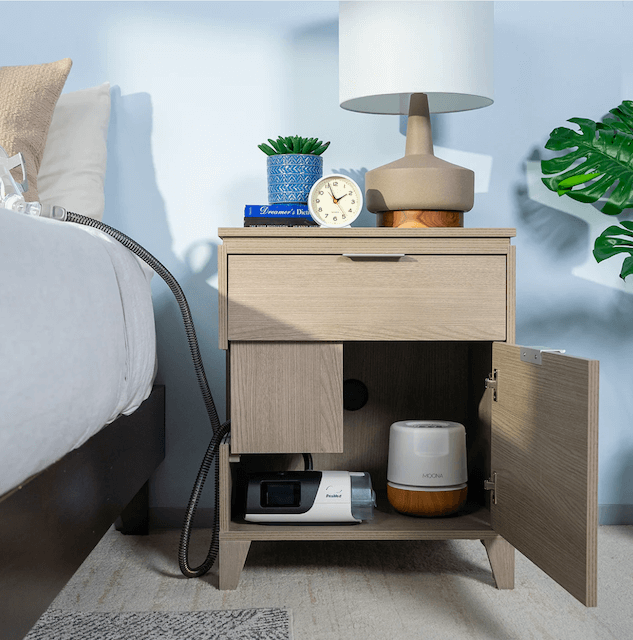
Best CPAP Hose Holder: Stay Tangle-Free and Sleep Better

“This post contains affiliate links. I may earn a commission if you buy through these links at no extra cost to you. Read my Disclaimer for more details.”

If you have ever woken up with your CPAP hose wrapped around your arm, twisted into the sheets, or tugging the mask sideways off your face, you already understand the problem this little accessory is trying to solve. Hose management almost never comes up when you are first set up with therapy. The focus is on the mask, the pressure, and getting through the first few nights. Then weeks later you realize the tube itself has quietly become the thing waking you up.
I want to be upfront about something before we go any further. I do not use a hose holder. After more than a decade on CPAP with my ResMed AirSense 10 at home and a ResMed AirMini for travel, I worked out a machine placement that keeps my tube where I want it without extra hardware. My background is in computer science rather than medicine, and I write here as a patient who has lived with this equipment, not as a clinician. So this guide is research based. So many readers ask me which hose holder to buy that I went and looked closely at the options, and what follows is an honest walk through the designs that come up most often, who each one suits, and how to decide whether you need one at all.
What a Hose Holder Actually Does
A CPAP hose holder lifts your tubing up and away from the bed so it stops fighting you during the night. That sounds minor until you have spent a few weeks pulling a tube out from under your shoulder every time you roll over.
When the hose is suspended above you rather than lying across the mattress, three useful things happen. The tube stops catching on your arms, your partner, and the bedding as you change position. The constant low level tension that pulls on your mask seal eases off, which means fewer leaks at the cushion. And the tube is far less likely to fold into a sharp kink that restricts airflow. A holder also gives you a tidy place to hang the hose to dry after cleaning, which is a small bonus that turns out to matter more than you would expect.
None of this is exotic. Most holders are a stand or arm that sits near the head of the bed and keeps a gentle curve in the tube from the machine to your face. The differences between models come down to how they anchor, how much they move with you, and how easily they pack for travel.
How I Compared the Options
I did not test these in my own bedroom, and I am not going to pretend otherwise. What I can do is read the design honestly, compare how each one anchors and adjusts, and weigh up the consistent themes in owner feedback across retailers. Where a manufacturer makes a specific claim about reach or weight, treat it as a starting point and check the current product listing before you buy, because these accessories get revised often.
With that said, here are the three designs I would point a reader toward, each for a different situation.
1. LONYEON CPAP Hose Holder
Best for a no-installation setup that works with any bed
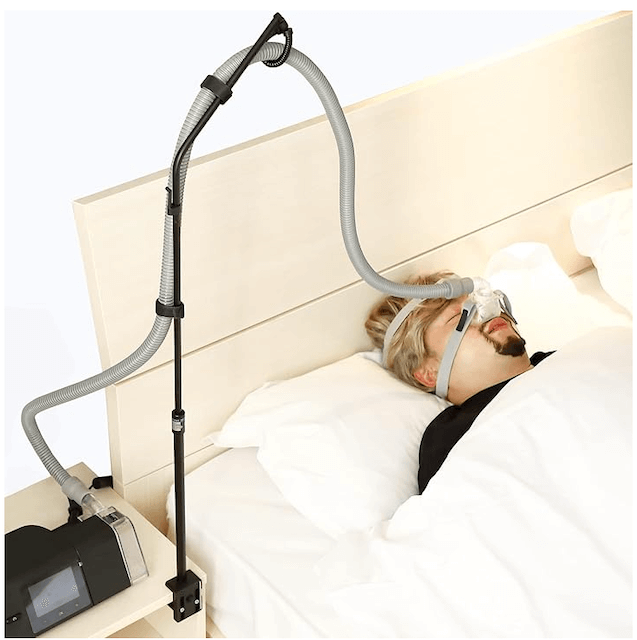
The LONYEON is a freestanding holder with a flexible gooseneck arm and a weighted base. You set it on your nightstand, and it stays put on its own weight, with nothing to clamp or screw into the bedframe. That single quality is why it tends to be the easiest recommendation. It does not care whether you have a platform bed, an adjustable base, or a mattress on the floor, and it works just as well in a rental where you cannot mount anything to the wall.
The arm bends and rotates freely, so you can shape the curve of the tube to your sleeping position and adjust it again if you switch sides. There is a hook on it for hanging the mask during the day or letting the hose dry after a wash. The metal construction is built to resist rust, which matters for something that lives in a humid bedroom and gets damp tubing draped over it.
The trade-off is footprint. A weighted base needs surface area, and if your nightstand is already carrying the machine, a water reservoir, a phone, and a lamp, you may not have room for it. Measure your free space before ordering.
2. PurePAP Tangle Free CPAP Hose Holder
Best for travel and small bedrooms
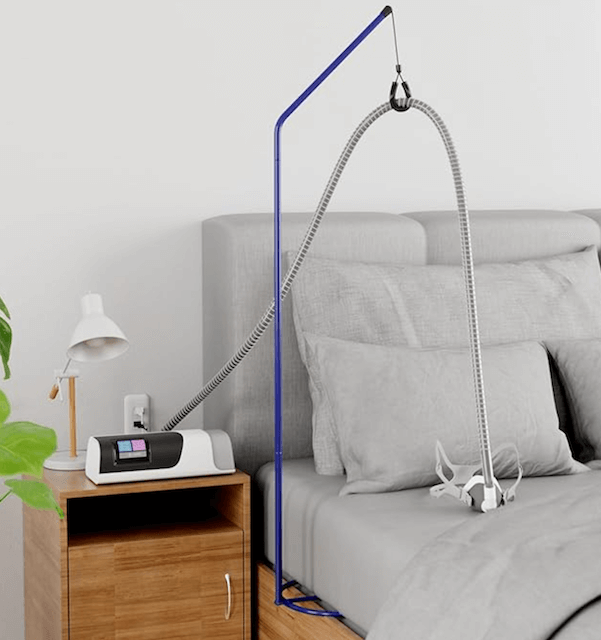
The PurePAP takes the opposite approach. Instead of standing on a surface, it anchors under the mattress, with a swivel arm rising up beside the bed. Nothing sits on your nightstand, and there is no visible hardware, which keeps the bedroom uncluttered and frees up surface space for the machine itself.
It is light and folds flat, so it is genuinely easy to throw in a bag. If you travel often, that portability is the main reason to look here rather than at a heavier stand. The swivel arm follows you as you move, which is the whole point of a holder.
The catch is that the under-mattress design needs a bed with a gap between the mattress and its base, such as a box spring or a slatted platform. It will not work with a mattress directly on the floor, and some adjustable beds do not leave room for it. Heavier sleepers also note that a stand anchored under bedding is not quite as rock steady as a weighted floor stand. For most people, that is a fine trade for the smaller footprint, but it is worth knowing.
3. ALADUSA CPAP Hose Holder and Tubing Lift
Best budget pick for trying the idea out
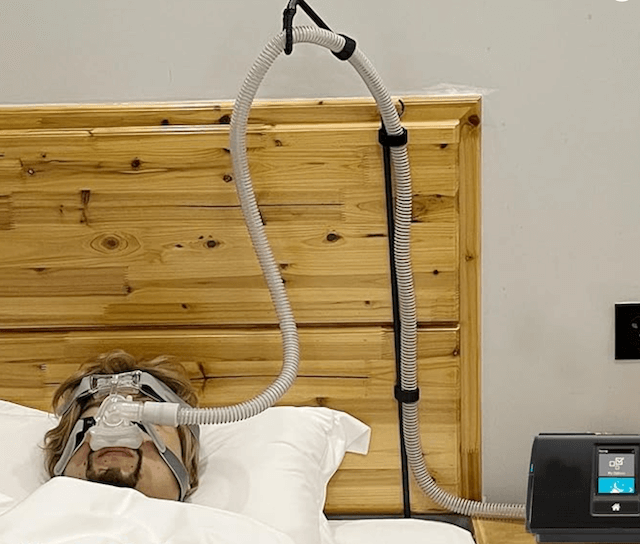
The ALADUSA uses a similar under mattress design to the PurePAP but at a lower price, which makes it a sensible way to find out whether a holder helps you before you commit more money. A wide base tucks under the mattress for stability, the top rotates so the tube can follow your movement, and the whole thing folds down for travel with a bag included.
It mixes metal and plastic parts rather than going all metal, and that shows up in the feedback. Some owners find the plastic components feel less solid than pricier all metal stands, and the rotating joint can stick if it is not assembled cleanly. For an entry level holder used to test whether the concept works for you, that is a reasonable compromise. If you decide a holder belongs in your setup for the long term, you can always upgrade to something sturdier later.
How to Choose the Right One for You
The best holder is the one that suits your bed, your sleep style, and how much you travel. A few questions sort out most of the decision.
What does your bed and nightstand look like? If your nightstand is crowded, a freestanding base may simply not fit, and an under mattress model makes more sense. If your mattress sits on the floor or on a frame with no gap underneath, the under mattress designs are out, and a weighted stand is the way to go. Think too about where the machine sits relative to your head, because the holder needs to create a smooth arc from the machine to the mask without introducing a new bend.
How much do you move at night? If you shift position often, you want an arm with a good range of motion that swivels and follows you. If you mostly stay put, almost any holder will do. Side sleepers in particular benefit from a holder set toward the center of the bed so the tube has slack on whichever side you turn to.
Do you travel? If you are regularly on the road or you camp with your machine, portability moves up the list. The PurePAP and ALADUSA fold flat and pack easily. A heavier freestanding stand technically packs too, but it eats luggage space. For what it is worth, my own AirMini travel kit comes with enough to manage the tube on the road that I have never needed a dedicated holder away from home.
What mask and hose are you using? Holders support the tube itself, so they work with essentially any machine, including standard CPAP, BiPAP, and APAP units. The thing to check is hose length. A standard six foot hose suits any holder, but an extended hose changes how much slack and height you need. If you run heated tubing, make sure the holder does not pinch the heating wire or the power cord.
What is it worth? Most holders land somewhere between roughly twenty and sixty dollars. All metal stands tend to outlast mixed material ones, and the moving parts (joints and swivels) are where cheaper models fail first, so it is worth reading owner feedback on durability before you choose the lowest price.
Why Hose Management Matters for Your Therapy
It is easy to dismiss the tube as a minor detail, but the way it behaves at night feeds directly into whether therapy actually works for you.
A tube that drags on the mask breaks the seal. Even brief leaks let pressure escape and can rouse you just enough to fragment your sleep, which undercuts the whole reason you are wearing the mask. A tube that folds into a kink does something similar from the other direction by adding resistance, so the pressure reaching your airway is lower than what your machine is set to deliver. And the everyday frustration of fighting your equipment is, in my experience reading the CPAP community for years, one of the quiet reasons people drift away from therapy in the early months when they should be settling in.
This is the same logic behind keeping your gear clean. The American Academy of Sleep Medicine and ResMed both advise washing the tubing with mild soap and warm water and letting it air dry fully, which is precisely where a holder doubles as a drying rack. If you are tempted by an automated cleaning gadget instead, the FDA has noted that mild soap and water is enough for most CPAP accessories and that you should follow your manufacturer’s instructions rather than assume a machine is necessary.
Setting It Up So It Actually Helps
A holder only works if it is positioned well. The goal is a gentle arc from the machine to the holder to your mask, with no sharp angle anywhere along the way.
Start by setting the arm so the tube clears your body when you move but does not hang so high that it pulls down on the mask. Put the mask on, lie in your usual position, and look at the curve of the tube. It should bow softly without sagging onto you or pulling tight. Then check your other common positions and make sure there is enough slack in each. Most people do best with the holder set slightly above and behind the pillow, where it can act as a support point that follows the head as it turns.
If the tube still tugs the mask loose after you have positioned the holder, the length may be wrong for your bed, or the holder may be creating tension rather than relieving it. If it keeps tangling, a hose cover can add a little bulk that makes the tube less prone to wrapping, and it also helps with the condensation that causes rainout in cooler rooms.
Other Ways to Manage Your Hose
A dedicated holder is not the only answer, and for some setups it is not even the best one.
Simple clips that attach to the sheets or mattress edge route the tube along a set path. They cost less than a full holder and are fine for mild tangling, though they give you less lift and less freedom to move. A CPAP pillow with cutouts is designed mainly for mask comfort but also channels the tube away from your face, which can be enough on its own. And a hose cover sometimes solves the problem indirectly by making the tube easier to see and grab as you shift.
Then there is the approach I landed on myself, which is to skip the accessory and fix the machine placement. Raising the machine a little, moving it to a dedicated CPAP nightstand, or simply repositioning it closer to your head can create the elevation you were trying to buy. It took some trial and error, but I found a placement that keeps my tube out of the way without anything bolted to the bed. Whether that works for you depends on your room, and that is exactly why these holders exist for the people it does not.
Hose Care and Replacement
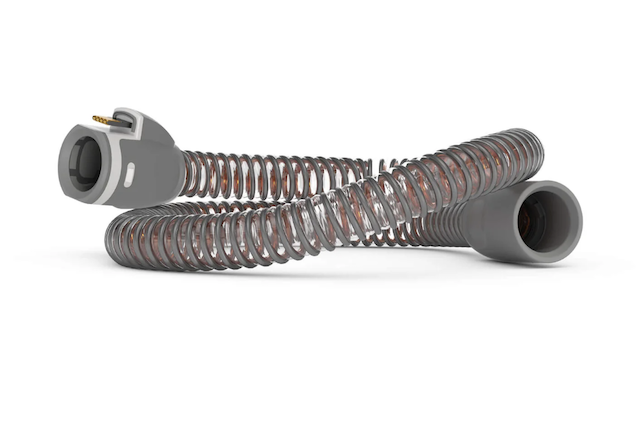
A holder pairs naturally with a clean, well-maintained hose. Disconnect the tube from the machine and mask, wash it through with mild soap and warm water, rinse until there is no residue, and hang it to dry away from direct sunlight. Hanging it vertically from a holder lets water drain from both ends and helps prevent the damp pockets where mold takes hold.
Even with good care, tubing wears out. Manufacturers generally suggest replacing the hose around every six months, and sooner if you see cracks, discoloration that will not clean off, a smell that survives washing, or a stiffness that makes the tube kink more easily. Many insurance plans cover replacement on roughly that schedule. If you are not sure where you stand, my CPAP replacement schedule guide lays out the typical intervals for each part.
Frequently Asked Questions
Do I actually need a hose holder? Not necessarily. If your tube tangles, pulls your mask loose, or makes you sleep stiffly to avoid disturbing it, a holder addresses a real problem. But plenty of people, myself included, get there with machine placement alone. Try optimizing your setup first, and reach for a holder if the problem persists.
Will it work with my machine? Yes. Holders support the tube, not the machine, so they work across CPAP, BiPAP, and APAP units from any brand. The only thing to confirm is that the holder suits your hose length.
Can I travel with one? Some, like the PurePAP and ALADUSA, fold down and come with a bag. A heavier freestanding stand packs less gracefully. If you travel often, choose for portability or, as I do, lean on what comes with your travel machine.
How do I clean the holder itself? Wipe it down with a damp cloth now and then. Metal parts can take a little mild soap and water, dried well to keep rust off. Check the joints every so often so they keep moving smoothly.
A Few Final Thoughts
A hose holder is a small accessory that can make a real difference for the right person, and a needless purchase for someone whose setup already works. If you are waking with the mask displaced, untangling the tube every night, or holding yourself stiff to keep from disturbing it, one of the three above is worth trying, and they are inexpensive enough that the experiment costs little. If your tube already sits where you want it, you may not need anything at all.
What I would encourage, more than any particular product, is the willingness to keep adjusting your setup until it feels easy. Therapy matters too much to your long term health to let a frustrating tube be the thing that drives you away from it. Getting comfortable with CPAP is a process of small fixes that add up, and the hose is one piece of that puzzle. If you are still in the early stretch, my guide on getting used to CPAP therapy covers the rest.
⚠️ MEDICAL DISCLAIMER This blog provides general information only and is not a substitute for professional medical advice, diagnosis, or treatment. Sleep apnea is a serious condition, and CPAP equipment should be used under proper medical supervision. Always consult your doctor or sleep specialist before starting, stopping, or changing any therapy. I share personal experiences as a CPAP user, not as a medical professional. Individual results vary. For medical guidance, please consult a qualified clinician or the American Academy of Sleep Medicine (aasm.org).