How to Sleep Peacefully with a Snoring Partner


If you are sharing a bed with someone whose snoring is keeping you awake, this page is for you. I want to say up front who I am and how I am writing this, because it matters. I am not the partner trying to sleep through the noise. I was the snorer.
I lived with severe obstructive sleep apnea for years before I was diagnosed. My wife slept next to me through all of it. She is the reason I got tested. My background is in computer science, not medicine, so what I can offer here is a patient’s perspective from both sides of the bed, along with strategies that helped us and information from credible sleep medicine sources. None of it is medical advice or a substitute for a real conversation with a doctor.
I will cover three things on this page. First, what you can do tonight to get more sleep. Second, what you and your partner can try together to reduce the snoring itself. Third, how to tell when snoring is not just snoring, and when it is time to push for a sleep study.
What you are actually dealing with
Snoring is the sound of soft tissue at the back of the throat vibrating as air pushes past it during sleep. It is extremely common. The American Academy of Sleep Medicine notes that about 40 percent of adult men and 24 percent of adult women are habitual snorers, and that roughly half of all people snore at some point in their lives. If you are lying awake right now, you are part of a very large club of people whose sleep is being disrupted by someone they love.
What I want you to take from those numbers is not reassurance. It is the opposite. Because snoring is so common, it gets dismissed. Couples treat it as a nuisance, a running joke, an unavoidable feature of marriage. It can be all of those things, and it can also be a sign that something is going wrong with the snorer’s breathing at night. I will come back to that, but it is worth keeping in mind while you read the rest.
The other thing worth saying plainly is that your exhaustion is real and it is not minor. Losing sleep night after night does not just make you grumpy. It affects mood, focus, immune function, blood pressure, and the patience you have for the person snoring beside you. You are allowed to take this seriously even if your partner sleeps right through it.
Strategies for tonight
The most reliable short-term wins are about reducing the noise that reaches your ears and shifting your own sleep timing. None of these fix the underlying snoring, but they can salvage tonight while you work on the bigger picture.
Earplugs are the first thing I would try, mostly because they cost almost nothing and the downside is small. Soft foam plugs from a chemist or supermarket are a fine starting point. You roll them between your fingers, insert, and hold while they expand to seal the ear canal. They are not perfect. They will not eliminate a loud snore at close range, but they take the edge off enough that you can fall asleep, which is usually the hard part. If foam plugs irritate you or fall out during the night, moldable silicone plugs are a step up. There are also sleep-specific earbuds and earplug systems sold for this exact problem. I would start with the cheap option before spending money on anything fancier.
White noise is the other side of the same idea. Rather than blocking sound, you cover it with a steady, predictable noise that your brain can ignore. A small fan in the corner of the room works. So does a basic white noise machine, an air purifier, or one of the many free apps that play rain, brown noise, or a steady hum through a phone or smart speaker. The goal is a constant sound floor that masks the rise and fall of your partner’s snoring. Stick with one sound. Switching between options every few minutes defeats the purpose.
Going to bed earlier than your partner is another tactic that often gets overlooked. The first part of the night, before you reach deep sleep, is when you are most easily woken by noise. If you can already be asleep by the time your partner gets into bed, you are more likely to stay asleep through the early snoring. This is not a long term solution, but it can salvage a tough week.
The last option in this category is sleeping in a separate room. People often treat this as a sign that something has gone wrong in the relationship. I would push back on that framing. Sleep is not the same as intimacy, and many couples sleep apart for stretches and are perfectly happy. If you have tried earplugs and white noise and you are still losing hours of rest every night, an honest conversation about sleeping separately, even just on the worst nights, is reasonable. It also tends to make the snorer take the problem more seriously, which can be the push that gets them to a doctor.
Strategies to reduce the snoring itself
Coping with the noise only goes so far. The other half of this is helping your partner snore less.
Sleeping position matters more than most people realize. Snoring is usually worse when the snorer is on their back, because gravity pulls the tongue and soft tissue toward the throat and narrows the airway. Getting them to sleep on their side often makes a noticeable difference. Some people use a body pillow to make side sleeping more comfortable. Others use the old tennis ball trick, sewing or pinning something into the back of a sleep shirt so rolling onto the back is uncomfortable. There are also dedicated positional therapy devices that vibrate gently when you roll supine. The mechanism does not matter much. What matters is keeping them off their back.
Alcohol close to bedtime is another reliable factor. Even a moderate drink within a few hours of sleep relaxes the airway muscles further and tends to make snoring worse. If your partner drinks regularly in the evening, shifting that earlier or cutting back is one of the simplest experiments you can run together. You will often hear the difference within a few nights.
Nasal congestion drives a lot of snoring, too. A blocked nose forces the snorer to breathe through the mouth, which collapses the airway in a way that produces more noise. If they are dealing with allergies, a persistent cold, or chronic congestion, treating that can quiet the night significantly. I have a separate page on how to stop snoring from a stuffy nose if that sounds like your situation. Structural issues like a deviated septum or enlarged tonsils are also worth investigating with a doctor if congestion seems chronic and constant.
Body weight is the third big lever. Extra tissue around the neck narrows the airway and predisposes a person to both snoring and obstructive sleep apnea. This is not something to bring up in the middle of the night, and it is a sensitive topic for a lot of people, but it is honest information. If your partner has gained weight and the snoring has gotten worse over the same period, those two things are very likely related.
The general principle behind all of these levers is the same. Snoring is a mechanical problem. Anything that widens the airway, keeps it open, or stops it from collapsing helps. I cover more options on my pages about the common causes of snoring and what you can do about each one in my piece on how to stop snoring.
When snoring is more than snoring
This is the section I most wish someone had handed my wife earlier.
Not all snoring is harmless. Some of it is a symptom of obstructive sleep apnea, a condition where the airway repeatedly collapses during sleep and breathing stops for stretches of ten seconds or more. The snorer usually has no idea this is happening. The partner often does, because they are the one lying awake watching it. I have a longer piece comparing the two on is it snoring or sleep apnea, which is worth reading if any of this rings a bell.
The signs that snoring may be more than just snoring include long pauses in breathing followed by a gasp, snort, or choke. Loud, irregular snoring with sudden silences. Restless sleep with frequent movement. Waking up unrefreshed no matter how long they were in bed. Excessive daytime sleepiness, especially the kind that has them nodding off at the wheel or in meetings. Morning headaches. Mood changes. There is also a documented link between sleep apnea and migraine, which I cover separately on my page about sleep apnea and migraine headaches.
I had several of these signs for years. I was tired in a way that sleep did not fix. I had morning headaches. I would fall asleep on the couch within minutes of sitting down in the evening. My wife noticed the worst part, which was the breathing pauses. She watched me stop breathing, wait, then come back with a sharp inhale, over and over. She is the one who pushed me to get tested. I am grateful she did, because untreated obstructive sleep apnea has serious cardiovascular consequences over time, and mine was severe.
If any of this sounds familiar in your own bedroom, the next step is a sleep study, either an overnight study at a sleep clinic or a home sleep apnea test. You can read more about what that process actually looks like on my sleep apnea diagnosis page. The point is not to panic. The point is to stop guessing and get data.
What changes when it gets treated
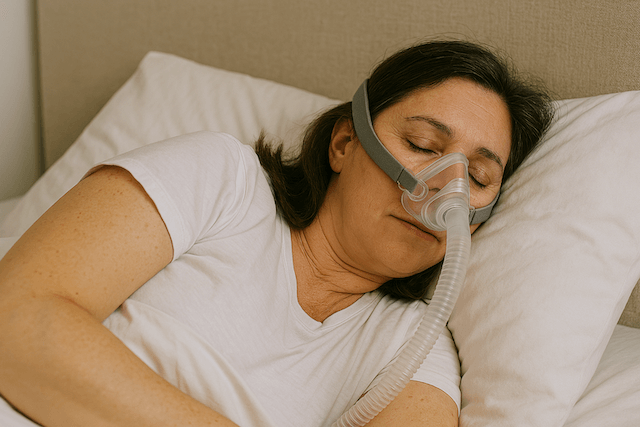
I want to be honest about what comes next, because the prospect of a CPAP machine puts a lot of people off pursuing a diagnosis in the first place. I have used a ResMed AirSense 10 for the better part of a decade, with a full face mask because I am a chronic mouth breather. It is not glamorous equipment. It takes some getting used to. I wrote about that adjustment on my CPAP anxiety page and about the full arc of treatment on living with sleep apnea.
What I can tell you from the snorer’s side is that the noise stops. Properly fitted CPAP therapy holds the airway open with gentle air pressure, and once that is happening, the snoring goes away. Bed partners almost always notice the difference within the first few nights. The Sleep Foundation has a practical guide to coping while a snorer pursues diagnosis that pairs well with this page if you want a second perspective.
For the partner, treatment is the difference between exhausted and rested. For the snorer, it is the difference between a slow slide toward cardiovascular trouble and getting their energy and focus back. It is worth the awkward conversation that gets you there.
Having the conversation
The hardest part of this is often not the earplugs or the sleep study. It is the discussion in between.
Snoring is involuntary. Most people who snore do not know how loud they are or how it sounds from a few inches away. Bringing it up at three in the morning, after another night of broken sleep, is almost guaranteed to go badly. Raise it during the day instead, when neither of you is tired or defensive. Be specific about what it is doing to you, including how you feel during the day, not just at night. Frame it as a shared problem that affects both of you, rather than a flaw in them. And if the snoring fits any of the red flag patterns I described above, say so plainly. You may be the only person in a position to notice, and that observation is genuinely valuable.
My wife did this with me, calmly and repeatedly, until I went and got tested. I am thankful she did. If you are reading this and recognizing your partner in any of it, you might be that person for them.
⚠️ MEDICAL DISCLAIMER This blog provides general information only and is not a substitute for professional medical advice, diagnosis, or treatment. Sleep apnea is a serious condition, and CPAP equipment should be used under proper medical supervision. Always consult your doctor or sleep specialist before starting, stopping, or changing any therapy. I share personal experiences as a CPAP user, not as a medical professional. Individual results vary. For medical guidance, please consult a qualified clinician or the American Academy of Sleep Medicine (aasm.org).