Sleep Apnea and COVID: What the Research Says

I have severe obstructive sleep apnea, diagnosed more than a decade ago, and I have used a CPAP machine almost every night since. When COVID-19 became part of everyday life, I had the same questions a lot of CPAP users had. Does sleep apnea make COVID more dangerous? Should I keep using my machine if I catch it? And could COVID itself affect the way I breathe at night?
I eventually caught COVID myself. It knocked me around a bit, more than a head cold but well short of anything that needed a hospital, and I kept using my CPAP the whole time. So part of this page comes from experience. The rest comes from reading the research carefully, and I want to be upfront about something. My background is in computer science, not medicine. I am a patient who reads studies closely, not a doctor. Nothing here is medical advice, and the single most important sentence on this page is the one asking you to talk to your own doctor about your own situation.
The relationship between sleep apnea and COVID is more tangled than most people expect, because it runs in more than one direction at once. This page works through four separate questions. Does having sleep apnea make a COVID infection worse? Does sleep apnea raise the odds of long COVID? Can COVID actually cause sleep apnea that was not there before? And if you already have sleep apnea and you get infected, what should you do with your CPAP machine? The honest answers range from fairly well established to genuinely uncertain, and I have tried to be clear about which is which.
If you want the longer story of how I came to sleep apnea in the first place, that lives on my living with sleep apnea page. This one stays focused on COVID.
Does sleep apnea make COVID worse?
This was the first question I had, and it is the one with the most evidence behind it.
Obstructive sleep apnea is common. It affects at least eight percent of adults, and the figure climbs past twenty percent in people over sixty. It involves the upper airway collapsing repeatedly during sleep, which causes drops in blood oxygen, fragmented sleep, and a body that spends the night under low grade stress. None of that is good company for a respiratory infection.
Early in the pandemic, researchers started noticing that sleep apnea patients seemed to do worse with COVID. A US healthcare system analysis published in the American Journal of Respiratory and Critical Care Medicine identified sleep apnea as a risk factor for COVID-19 death. A large Finnish biobank study, drawing on hundreds of thousands of records, found that obstructive sleep apnea was an independent risk factor for severe COVID-19 serious enough to require hospitalization. Independent is the important word there. It means the link held up even after the researchers accounted for the other things sleep apnea travels with, such as obesity, high blood pressure, diabetes, and older age.
That last point deserves a pause, because it is easy to misread the early findings. Sleep apnea overlaps heavily with conditions that are themselves COVID risk factors. Untangling apnea from the company it keeps is genuinely difficult, and the most cautious researchers have always said so.
The study that changed how I think about this was a longitudinal one published in the journal Sleep and Breathing. Instead of looking back at records, it followed a large group of people over time and watched who caught COVID. Overall, people with obstructive sleep apnea were roughly twice as likely to come down with a COVID infection. But the researchers then split the group by whether the apnea was being treated. The result was striking. People whose sleep apnea was untreated were at clearly elevated risk, around three times more likely to be infected. People whose apnea was treated were not at elevated risk in the same way.
I am not going to overstate a single study, and the confidence intervals around those numbers are wide. But the direction of that finding matters, and it reframes the whole question. The risk that the research keeps pointing to is not really sleep apnea on its own. It is sleep apnea left unmanaged. If you are a CPAP user reading this and worrying, the most useful thing I can tell you is that consistent therapy appears to be the lever you actually control. That is the same message that runs through everything I write about CPAP compliance, and it turns out to apply here too.
There is a plausible biological story underneath all of this. Untreated apnea produces repeated oxygen dips, inflammation, and strain on the cardiovascular system, the same strain I describe on my page about sleep apnea and cardiovascular health. A body already running that gauntlet every night has less in reserve when a respiratory virus arrives. That is reasoning, not proof, but it fits the pattern the studies keep finding.
Sleep apnea and long COVID
The second question is about what happens after the infection clears, and here the evidence is also reasonably strong.
Long COVID, the collection of symptoms that lingers for months after the initial illness, has been estimated to affect more than six percent of people who get COVID. It can include fatigue, breathing problems, brain fog, and disturbed sleep. Sleep apnea, frustratingly, can cause many of the same symptoms, which makes the overlap hard to study and hard to live with.
The most substantial work on this comes from the National Institutes of Health RECOVER Initiative, which examined enormous electronic health record networks covering millions of patients. After controlling for the obvious confounders, including how severe the initial COVID infection was, age, sex, race, ethnicity, and underlying conditions, the researchers found that adults with obstructive sleep apnea were significantly more likely to experience long COVID. In the largest patient cohort the increased odds were about seventy five percent. In a second large cohort the increase was smaller, around twelve percent. The effect was real in both, even if its size depended on the dataset. You can read the NIH summary of that work here.
Two further details from that research are worth knowing. The risk appeared higher in women with sleep apnea than in men with sleep apnea, which the researchers could not fully explain, though one suggestion is that women tend to go undiagnosed for longer and so may carry more severe untreated disease by the time it shows up in their records. And in children, no significant link between sleep apnea and long COVID survived once other conditions such as obesity were accounted for.
The honest takeaway here is the same as before. The shared web of risk factors makes it hard to say sleep apnea causes long COVID. What the data supports is an association, and a strong enough one that anyone with sleep apnea recovering from COVID should take lingering symptoms seriously rather than waving them off. If brain fog is your main complaint, I have written separately about CPAP therapy and brain fog, because the two can be difficult to tell apart.
Can COVID cause sleep apnea?
The third question is the newest, and I want to be careful with it, because the evidence is genuinely preliminary.
It is one thing to say sleep apnea makes COVID worse. It is another to ask whether COVID can cause sleep apnea in someone who never had it. That sounds backward, but there is an emerging line of research suggesting it might happen.
A large retrospective study drawing on records from a major US health system tracked patients for as long as four and a half years after infection. It found that people who had tested positive for COVID, both those who were hospitalized and those who were not, had a higher risk of being newly diagnosed with obstructive sleep apnea than people who never tested positive. I want to flag clearly that this study is still a preprint and has not yet completed peer review, so it should be read as an early signal rather than a settled conclusion. But it is large, and the association persisted years out, which is hard to dismiss.
The proposed explanations are reasonable. Hospitalization for COVID often involves long periods of immobilization, steroid treatment, and weight gain, all of which are recognized contributors to sleep apnea. And even in people who were never hospitalized, the lingering effects of COVID may affect respiratory function and the architecture of sleep itself in ways that could let apnea take hold.
A smaller study added a practical wrinkle that I think matters more for everyday readers. Researchers took a group of patients whose main complaint after COVID was fatigue or excessive sleepiness, and put them through formal sleep studies. About a third of them turned out to have obstructive sleep apnea that had never been diagnosed. Read that again, because it is the useful part. Some of what gets labeled as long COVID fatigue may in fact be undiagnosed sleep apnea quietly doing its usual work.
That does not mean every tired COVID survivor has sleep apnea. It means the symptom is worth investigating properly rather than assuming. If you came through COVID and never got your energy back, and especially if a partner mentions snoring or pauses in your breathing, it is worth asking a doctor whether a sleep assessment makes sense. My page on how to tell if you have sleep apnea walks through the warning signs in more detail.
Using your CPAP when you have COVID
The fourth question is the practical one, and it is the part of this page where I can speak from direct experience rather than from reading.
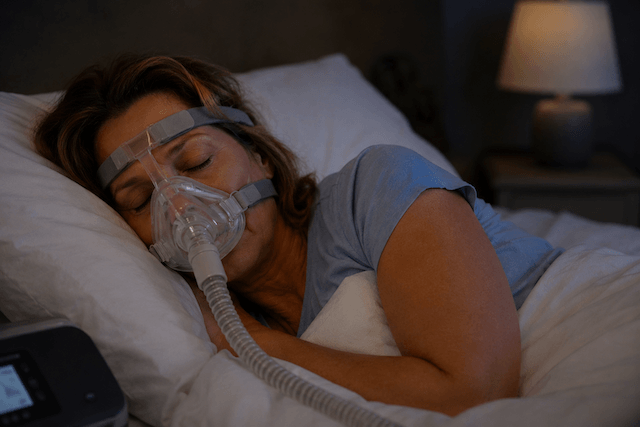
When I caught COVID, the first thing I wanted to know was whether I should keep using my CPAP. The consensus among sleep medicine bodies, including the American Academy of Sleep Medicine, is that most people with sleep apnea should keep using their machine even while infected. Their CPAP guidance for patients is worth reading in full and is available here. The reasoning is straightforward. Stopping treatment lets the apnea come straight back, which means worse sleep, more strain on the heart, and higher blood pressure, none of which you want while your body is already fighting a virus. Good sleep supports the immune system, and for someone with untreated severe apnea, going without the machine is not really restful sleep at all.
I should be honest that this is still a decision to make with a doctor, not a blanket rule. The severity of your apnea and your overall health both matter. But for me, with severe obstructive sleep apnea, stopping was never realistically on the table, and no clinician I have read suggests it should be the default.
There is one genuine complication, and it is about the people you live with rather than about you. A CPAP machine pushes a steady stream of air, and your exhaled breath vents out through the mask and tubing. If you are infectious, that airflow can carry virus particles into the room. The reassuring part is that the research to date suggests a CPAP spreads less virus than ordinary breathing, speaking, or coughing already do. The standard advice, all the same, is to sleep in a separate bedroom while you are infectious if you possibly can.
Here I will be straight with you, because the whole point of this site is honesty rather than a tidy story. In our house, a separate bedroom was not practical, and my wife and I stayed in the same room while I was sick. I am not holding that up as the correct choice, and if you can isolate, the guidance says you should. I am simply not going to pretend I did something I did not do. If you are in the same position, it is worth a frank conversation with your doctor and with the people you live with about what is realistic and what the trade-offs are.
The other thing I did do was clean my equipment more often than usual. My normal routine is already regular, and I follow the manufacturer’s instructions rather than improvising, partly because I am cautious about anything that might affect a machine’s warranty. While I had COVID, I simply ran that routine more frequently. Warm water and mild soap for the mask, tubing, and humidifier chamber, rinsed well and left to air dry out of direct sunlight, and a wipe down of the outside of the machine. If you want the full method, my guide on how to clean a CPAP machine covers it, and my page on why distilled water matters is relevant for the humidifier. It is also sensible to replace your filters and any disposable accessories once you have recovered. For a wider look at running CPAP therapy through any illness, not just COVID, I have a separate page on using a CPAP machine when you are sick.
One small practical note from my own setup. I use a full face mask because I am a chronic mouth breather, and a stuffy nose from a respiratory infection makes a full face mask even more valuable, since it does not depend on clear nasal breathing the way a nasal mask or nasal pillows do. If a blocked nose is making your therapy miserable, that is worth raising with your provider too.
When to get medical help
Everything above assumes a manageable illness. It is not a substitute for watching for the signs that COVID has become serious.
Get medical attention promptly if you develop trouble breathing, persistent pain or pressure in the chest, confusion, a bluish tint to the lips or face, or an inability to stay awake. Those are recognized emergency warning signs, and a CPAP machine is a treatment for sleep apnea, not a treatment for COVID pneumonia or low blood oxygen from the infection itself. If your breathing is deteriorating, the machine is not the answer and you should be speaking to a doctor or emergency service, not adjusting your settings.
For most people, a COVID infection while on CPAP therapy is uncomfortable but uneventful. That was roughly my experience. The illness was a moderate nuisance, the machine kept doing its job, and I increased my cleaning and got on with recovering. The research, taken as a whole, points in a consistent direction. Sleep apnea and COVID interact; the interaction is not in your favor, and the clearest thing within your control is treating your apnea consistently. That is not a dramatic conclusion, but on a topic this muddy, an honest and undramatic conclusion is the right one.
A note on what this page is and is not
I am not a medical professional. I am someone who has lived with severe obstructive sleep apnea for more than a decade, who has had COVID and used CPAP through it, and who reads the research with a careful eye because my own health depends on it. This page is meant to inform and to point you toward better questions for your own doctor. It is not a diagnosis, a treatment plan, or a substitute for individual medical advice. The science around COVID continues to develop, and some of what is described here, particularly the question of whether COVID can cause sleep apnea, may look different as more studies are completed. If you have sleep apnea, or think you might, please work with a qualified clinician who knows your history.
⚠️ MEDICAL DISCLAIMER This blog provides general information only and is not a substitute for professional medical advice, diagnosis, or treatment. Sleep apnea is a serious condition, and CPAP equipment should be used under proper medical supervision. Always consult your doctor or sleep specialist before starting, stopping, or changing any therapy. I share personal experiences as a CPAP user, not as a medical professional. Individual results vary. For medical guidance, please consult a qualified clinician or the American Academy of Sleep Medicine (aasm.org).