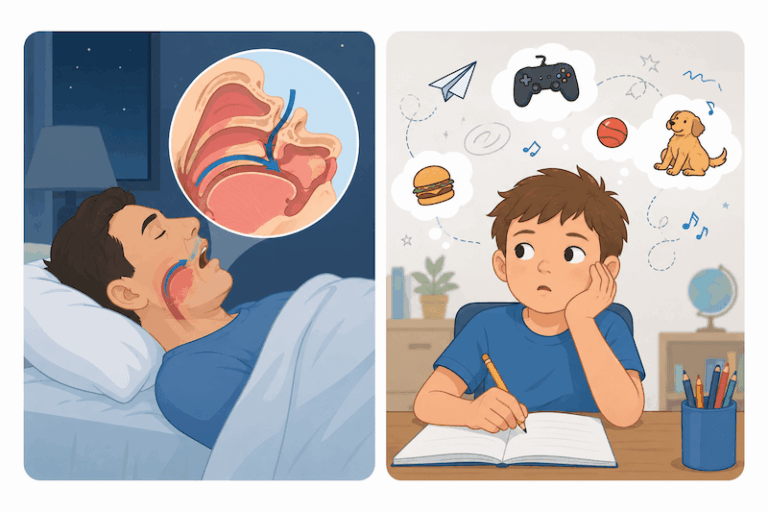
Sleep Apnea and Dementia: What the Research Shows


If you have sleep apnea, or you love someone who does, you have probably wondered at some point whether all those interrupted nights are doing something lasting to the brain. It is a fair question, and it is one I have thought about myself. I was diagnosed with severe obstructive sleep apnea more than a decade ago, with an AHI of 51 at the time, which means my breathing was stopping or shallowing more than fifty times an hour before I started treatment. When research started connecting sleep apnea and dementia, it landed differently for me than a typical health headline. This is my profile, the studies are describing.
I want to be clear about what I am and am not before we go any further. My background is in computer science, not medicine. I am a patient who has lived with this condition for a long time, who reads the research carefully, and who tries to report it honestly. I am not a doctor, and nothing here is medical advice. What I can do is walk you through what the evidence currently says, where it is strong, where it is genuinely uncertain, and what that might mean for someone managing sleep apnea today.
Is there a link between sleep apnea and dementia?
The short answer is yes, there is a link, and it shows up consistently across a large body of research. The longer and more honest answer is that a link is not the same thing as proof of cause, and that distinction matters a great deal here.
When researchers pool together long term studies that follow people over many years, they keep finding the same pattern. People with sleep apnea are more likely to be diagnosed with dementia later in life than people without it. One systematic review and meta-analysis that combined data from more than a million patients found that those with sleep apnea had a meaningfully higher risk of developing a neurocognitive disorder, with the association strongest for Alzheimer’s disease and Parkinson’s disease. Interestingly, that same review did not find a statistically significant link with vascular dementia, which runs against what some people might expect given how sleep apnea strains the cardiovascular system.
The broader picture is similar. Updated reviews that look at sleep disorders generally, including insomnia and disordered breathing, continue to identify obstructive sleep apnea as one of the sleep conditions associated with cognitive decline and a higher rate of dementia diagnosis. The Sleep Foundation summarizes the consensus plainly, noting that studies have found people with sleep apnea carry a higher risk of developing dementia, alongside more immediate effects on attention, thinking, and memory.
So the question is there a link between sleep apnea and dementia has a clear answer. The harder questions are why the link exists, how strong the effect really is for any one person, and whether treating sleep apnea changes the outcome.
Why researchers think the connection exists
This is the part I find genuinely interesting, because it is where biology starts to explain the statistics. There are several mechanisms researchers point to, and they probably work together rather than in isolation.
Oxygen drops during the night
Every time the airway collapses during an apnea, blood oxygen levels fall. In someone with severe untreated sleep apnea, this can happen dozens of times an hour, all night, for years. These repeated dips are called intermittent hypoxemia, and the brain does not tolerate them well. Low oxygen can damage the small blood vessels that feed brain tissue and can trigger inflammation and oxidative stress, both of which are associated with neurodegeneration.
A 2025 study from neurobiologists at the University of California, Irvine added an important wrinkle to this. They found that oxygen drops during REM sleep specifically were linked to early brain changes in regions tied to memory, even in older adults who had no cognitive impairment yet. The entorhinal cortex, one of the first areas affected in Alzheimer’s disease, showed the strongest relationship to this REM related oxygen loss. The researchers made a point that I think is worth sitting with. They argued that counting breathing events alone, the way the standard severity score works, may miss the real physiological harm being done. Someone with a mild number on paper could still be experiencing significant oxygen loss during REM sleep.
If you want to understand this side of the picture better, I have written separately about blood oxygen levels during sleep and about how oxygen deprivation can affect the brain in whether sleep apnea can cause brain damage.
The brain’s overnight cleaning system
The second mechanism is one of the most compelling discoveries in sleep science in recent years. The brain has a waste clearance network sometimes called the glymphatic system. During deep, slow wave sleep, this system becomes far more active and flushes out metabolic byproducts that build up during waking hours. Two of the substances it clears are amyloid beta and tau, the same proteins that accumulate in the brains of people with Alzheimer’s disease.
Here is the problem for someone with sleep apnea. Deep sleep is exactly what apnea fragments. Each breathing event tends to pull the sleeper up out of the deeper stages and back toward lighter sleep or a brief arousal. If you are doing that repeatedly all night, you are spending less time in the slow wave sleep the glymphatic system depends on. Research has shown that people with obstructive sleep apnea have measurable signs of reduced glymphatic function, and that disordered breathing is associated with higher amyloid burden. The logic is straightforward even if the full picture is still being worked out. If the brain cannot take out the trash efficiently, the trash accumulates, and over many years that accumulation is part of what drives dementia.
This is also why sleep apnea and memory loss are so often discussed together. Memory consolidation happens during sleep, and the same fragmented nights that impair waste clearance also interfere with the brain’s ability to file away and strengthen memories.
Vascular strain and inflammation
Sleep apnea is hard on the cardiovascular system. It raises blood pressure, stresses the heart, and is linked to a higher risk of stroke. Vascular damage in the brain is itself a contributor to cognitive decline. I have covered the heart side of this in more detail in my piece on sleep apnea and cardiovascular health and the stroke connection in sleep apnea and stroke risk. The reason the meta-analysis findings on vascular dementia were a little surprising is that you might assume this pathway would show up clearly. The honest read is that the data on specific dementia subtypes is still developing and not perfectly consistent.
Can sleep apnea cause dementia, or is it the other way around?
This is where I have to slow down and be careful, because it is the question most likely to be answered badly.
Most of the strong evidence linking sleep apnea and dementia comes from observational studies. Researchers follow large groups of people for years and compare who develops dementia and who does not. These studies are valuable, but they show association, not causation. They cannot fully rule out the possibility that some other factor drives both conditions, or that the relationship runs partly in the opposite direction.
And the opposite direction is plausible. The relationship between disrupted sleep and Alzheimer’s pathology appears to be bidirectional. Poor sleep may promote the buildup of amyloid, and amyloid buildup may in turn worsen sleep. Early brain changes can affect the parts of the brain that regulate breathing and sleep architecture, which could make sleep disordered breathing more likely or more severe. So when someone asks can sleep apnea cause dementia, the most accurate answer I can give is this. Sleep apnea is considered a credible and biologically plausible risk factor, and it is increasingly treated as one of the modifiable contributors worth addressing, but it has not been definitively proven to cause dementia on its own.
That framing is not me hedging for its own sake. It is the actual state of the science. A widely cited estimate from a major dementia commission suggests that close to forty percent of dementia cases could potentially be delayed or prevented by addressing modifiable risk factors across a lifetime. Sleep apnea is now part of that conversation, but proving that treating it changes dementia outcomes would require long randomized trials that are difficult and expensive to run. Several are underway.
Does treating sleep apnea reduce the risk?
This is the question I care about most as a patient, and I wish the answer were cleaner than it is.
There is encouraging evidence. Some studies have found that people who used positive airway pressure therapy regularly had a lower rate of Alzheimer’s diagnosis and a delayed onset of mild cognitive impairment compared to those who did not use it. Several randomized controlled trials in cognitively healthy older adults have linked CPAP use to improvements in cognition. A pilot study in people who already had mild cognitive impairment suggested that those who stuck with CPAP showed slower decline over a year than those who did not.
But the evidence is genuinely mixed, and I am not going to pretend otherwise. At least one retrospective study of patients who already had mild cognitive impairment did not find that CPAP use delayed progression to dementia. Part of the difficulty is that the cognitive damage from years of untreated apnea may be partly done by the time someone starts therapy, and part of it is that CPAP only helps if it is actually used. Adherence is the hidden variable in almost every one of these studies. A machine in the closet does nothing.
The reasonable interpretation, and the one most sleep researchers seem to hold, is that treating sleep apnea is very likely good for the brain even if we cannot yet quantify exactly how much it lowers dementia risk. CPAP reliably reduces those oxygen drops and restores more normal sleep architecture, which addresses two of the main mechanisms described above. It also clearly improves the things we can measure in the near term, including daytime alertness, mood, and the mental fog so many patients describe. I have written about that near-term effect in my post on CPAP therapy and brain fog, and brain fog, while not the same thing as dementia, is a real and frustrating part of untreated sleep apnea for a lot of people.
For me personally, this uncertainty is not a reason to relax. It is a reason to stay consistent. I cannot run a controlled experiment on my own brain, but I can make sure my apnea is well managed every single night rather than gambling on the hope that the link turns out to be weaker than it looks. Consistency is the part that is genuinely within a patient’s control, and I have written about how to build that habit in staying consistent with CPAP therapy.
What about supplements for sleep apnea and dementia?
People searching this topic sometimes look for a supplement that might help with both sleep apnea and dementia at once. I want to be direct here because it is a Your Money or Your Life topic and bad information does real harm. There is no supplement that has been shown to treat obstructive sleep apnea, and there is no supplement proven to prevent dementia. Apnea is a mechanical and physiological problem with the airway and breathing control, and it needs a treatment that addresses that, whether that is positive airway pressure, an oral appliance, weight management, surgery, or another clinically appropriate option. If anyone is selling a pill that promises to fix both conditions, treat that as a reason for skepticism rather than hope. The genuinely evidence-based move is to get the apnea properly diagnosed and treated.
What this means if you have sleep apnea
If you take one thing from this, let it be a sense of proportion rather than alarm. A higher risk is not a sentence. Plenty of people with sleep apnea never develop dementia, and dementia has many contributors, including genetics, age, and other health conditions that have nothing to do with sleep. Reading about the link between sleep apnea and dementia should not send anyone into a spiral of worry, because chronic stress is not good for the brain either.
What the research does support is a calm, practical conclusion. Sleep apnea is one of the few risk factors on the dementia list that you can actually do something about. You cannot change your age or your genes, but you can get tested if you suspect you have undiagnosed apnea, and you can treat it consistently if you have been diagnosed. If you are not sure whether your symptoms point to apnea, my overview of sleep apnea symptoms is a reasonable starting point, as is the general primer on what obstructive sleep apnea actually is.
The connection between dementia and sleep apnea is also a strong argument against the common habit of shrugging off apnea as just snoring or just bad sleep. The studies suggest the stakes reach well beyond feeling tired the next day. That was part of what kept me committed to therapy through the unglamorous early months, and it is part of the longer story I tell in living with sleep apnea.
For a deeper, clinically focused look at how researchers are trying to untangle exactly which features of apnea matter most for cognition, the peer reviewed journal SLEEP published a thoughtful overview on obstructive sleep apnea, cognitive impairment, and dementia that is worth reading if you want the detail.
The honest bottom line
There is a real and well documented link between sleep apnea and dementia. The biology behind it, especially the oxygen drops and the disruption of the brain’s overnight cleaning system, gives that link a plausible mechanism rather than just a statistical coincidence. At the same time, an association is not proof of cause, the relationship may run in both directions, and we do not yet have the long randomized trials needed to say exactly how much treating apnea lowers dementia risk.
Where that leaves a patient is actually a reasonably hopeful place. Sleep apnea is treatable, and treating it well addresses the very mechanisms researchers worry about. Nobody can promise that consistent therapy will keep dementia away, but it is one of the clearest, most controllable steps available, and the broader benefits for the heart, mood, and daily clarity are not in doubt. If you have sleep apnea, the takeaway is not fear. It is a good reason to get diagnosed if you have not been, and to take treatment seriously if you have.
This article is written from the perspective of a long-term patient, not a medical professional. My background is in computer science. It is intended for general information and is not a substitute for advice from a qualified doctor. If you have concerns about sleep apnea, memory, or cognitive health, please speak with a healthcare provider who can assess your individual situation.
⚠️ MEDICAL DISCLAIMER This blog provides general information only and is not a substitute for professional medical advice, diagnosis, or treatment. Sleep apnea is a serious condition, and CPAP equipment should be used under proper medical supervision. Always consult your doctor or sleep specialist before starting, stopping, or changing any therapy. I share personal experiences as a CPAP user, not as a medical professional. Individual results vary. For medical guidance, please consult a qualified clinician or the American Academy of Sleep Medicine (aasm.org).