Sleep Apnea and Weight Lifting: A Lifter’s Honest Guide


I have severe obstructive sleep apnea. My AHI at diagnosis was 51, which puts me well into the severe range, and I have been on CPAP therapy for more than a decade. I am not a doctor and not medically trained in the slightest, so what you are reading here is a patient’s view backed by published research, not medical advice. I also lift weights, which is the reason this page exists. When the question is whether weight lifting helps sleep apnea or makes it worse, the honest answer has two sides, and most of what is written online only covers one of them.
The short version is this. Regular exercise, including resistance training, has been shown in multiple controlled studies to reduce the severity of obstructive sleep apnea, often without any significant change in body weight. That is genuine, replicated evidence, and it is worth taking seriously. The complication is that the same activity, taken in a certain direction, can also increase a known risk factor for sleep apnea. Lifters who chase very large neck and upper body development can end up with more airway crowding than they started with, regardless of how lean they are. Both things are true at the same time, and which one applies to you depends on what kind of lifter you actually are.
The rest of this page walks through what the research says about exercise and AHI, where weight lifting specifically fits in, what cardio adds, why the bodybuilder paradox exists, and what I have personally noticed after years of lifting consistently while on therapy. If you lift and you suspect you have sleep apnea, there is also a section near the end on what to actually do about it.
Does exercise help sleep apnea?
Yes, and the evidence is stronger than most people realize. A 2024 systematic review and meta analysis published in the Journal of Clinical Sleep Medicine, the official journal of the American Academy of Sleep Medicine, pooled results from controlled trials and found that exercise training significantly reduced the apnea hypopnea index by an average of about seven events per hour. It also reduced daytime sleepiness on the Epworth Sleepiness Scale and improved cardiopulmonary fitness measured as VO2peak. The effect on AHI showed up regardless of baseline severity or body mass index.
That last point matters more than it looks. Across multiple meta-analyses, the AHI reduction from exercise persists even when BMI does not change much. In other words, exercise is not just helping by trimming body fat. It seems to be doing something more direct to the airway and to sleep itself. The leading explanations researchers have proposed are stronger and more fatigue-resistant upper airway dilator muscles, reduced overnight fluid shift from the legs to the neck, and improved sleep architecture that makes the airway less prone to collapse.
There is one nuance worth being honest about, especially if you are already on CPAP. The same JCSM analysis ran a subgroup analysis on CPAP adherent patients and found that exercise still improved their fitness scores but did not produce a further reduction in AHI or daytime sleepiness on top of what therapy was already delivering. That fits what you would expect. If pressurized air is already keeping your airway open every night, adding lifting will not push your AHI lower than therapy has already pushed it. The benefits in that case shift toward cardiovascular health, body composition, daytime energy, mood, and general resilience. Those are not small benefits. They are just different from the AHI story that gets repeated in most articles on this topic.
Weight lifting versus cardio for sleep apnea
The same body of research that supports exercise as a treatment also gives a hint about what kind of training does the most. Several reviews have run subgroup analyses comparing aerobic exercise alone to combined aerobic plus resistance training. Combined training has consistently come out ahead for AHI reduction. The differences are not dramatic, but they point in the same direction across studies, and the mechanism is reasonable. Resistance training adds strength and endurance in the muscles that stabilize the upper airway, while aerobic work delivers most of the cardiovascular and fluid balance benefits.
That does not mean you have to lift to see improvement. Cardio alone reduces AHI in the trials, just by a smaller margin. People often ask whether cardio is enough on its own, and the honest answer is that it does most of the heavy lifting in the data and is the easier place for many sedentary patients to start. Walking, cycling, swimming, and rowing all qualify. I keep a walking pad at home for days when the weather makes outdoor walking impractical, and that has become a reliable way to get steady aerobic work in without thinking about it.
Where lifting earns its place is in the combination. If you have the time and the inclination to train both, the research suggests you get a small but real additional benefit on top of cardio alone. There is also the obvious benefit that lifting protects muscle mass and bone density as you get older, which matters for general health independent of sleep apnea. None of this is meant to make exercise sound like a replacement for CPAP. It is not. It is meant to make the case that lifting, done sensibly, sits firmly on the helpful side of the ledger for most people with sleep apnea.
The bodybuilder paradox
Now the other side. Sleep apnea risk does not only track body fat. It also tracks the geometry of your airway and what surrounds it, and neck circumference is one of the most reliable indicators researchers have. The Mayo Clinic notes that a neck circumference greater than 17 inches in men or 16 inches in women is associated with elevated risk. The reason is that any extra tissue around the airway, whether it is fat or muscle, contributes to crowding and to airway collapse during sleep when the muscles relax.
Most of the time, when a clinician sees a neck above those thresholds, the extra tissue is adipose. That is the typical case and the one Mayo’s framing addresses. But the airway does not know the difference between fat and muscle when you are unconscious and your upper airway dilators have gone slack. This is why studies of certain athletic populations show surprisingly high rates of sleep apnea despite low body fat percentages. American football linemen and competitive bodybuilders are the most cited examples in the literature. A muscular neck does not protect you from sleep apnea, and in some cases it can move you toward it.
The practical takeaway for lifters is not to stop training. The takeaway is that if you are deliberately pursuing significant neck and upper body hypertrophy, you may be adding mass to a region that affects your airway, and the benefits of resistance training that the OSA literature describes were generated in patients doing moderate resistance work, not in patients running serious bodybuilding programs. If you are a typical lifter who trains the whole body two to four times a week without trying to grow a 19 inch neck, this is not your problem. If you are deeply into hypertrophy of the head and neck region, it is worth knowing the risk exists, particularly if you snore, wake unrefreshed, or have any of the other classic symptoms.
There is also a separate consideration around anabolic substance use, which is documented in the literature as an independent risk factor for sleep disordered breathing. That is outside what I want to cover here as a patient writer, but it is worth flagging that the bodybuilder paradox is partly about anatomy and partly about pharmacology in some subgroups, and the two effects can compound.
What lifting actually feels like when you already have sleep apnea
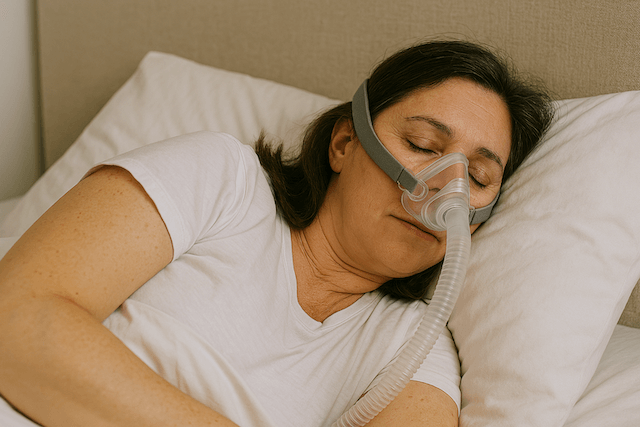
I have been on CPAP therapy for more than a decade. My therapy is consistent. I lift regularly, alongside walking for general activity. I am not going to tell you that lifting changed my AHI numbers, because I have not run any kind of structured experiment to test that, and because as I noted above, in someone already on therapy you would not expect to see a further AHI drop from training. What I can tell you, honestly and without dressing it up, is that I generally sleep better and feel better when I am lifting consistently. That is a subjective report, not a measurement, but it is the report I have to give and it matches what the research describes around sleep quality, daytime energy, and overall wellbeing improving with regular training.
The honest framing for any lifter on CPAP is that therapy handles the breathing problem and training handles a lot of the downstream consequences of having had sleep apnea for any length of time. Cardiovascular strain, poor metabolic health, low mood, low daytime energy, and reduced fitness are all things sleep apnea contributes to over the years. Therapy stops the nightly damage. Training is one of the most direct ways to rebuild on top of it. That has been my experience and it is consistent with what shows up in the cardiovascular literature on sleep apnea more broadly.
A practical note from being a lifter who travels and camps with therapy. I take a ResMed AirMini on the road, and my home setup is a ResMed AirSense 10 that I am currently weighing replacing with the AirSense 11. The training side of life has never been the reason to skip therapy, on the road or otherwise. If you lift consistently, you will get used to the fact that being on CPAP every night is what makes the next training day workable. Skipping it because you are tired or because you are away from home undoes part of the gain you are working for.
If you lift and suspect you have sleep apnea
A lot of lifters reading a page like this are not yet diagnosed. They might snore, wake up groggy, fall asleep on the couch in the afternoon, or have a partner who has noticed pauses in their breathing. The temptation when you are reasonably fit and not visibly overweight is to dismiss the possibility, because sleep apnea is still culturally pinned to an image of significant obesity. That image is incomplete. Lean, muscular people get OSA. Athletic people get OSA. Plenty of people with low body fat and visible fitness get diagnosed in their thirties and forties despite never having been overweight.
The classic symptoms to actually pay attention to are loud snoring, witnessed pauses in breathing, waking up gasping or choking, dry mouth or sore throat in the morning, morning headaches, daytime sleepiness, brain fog, and irritability. Higher than expected blood pressure is another one. I had high blood pressure at diagnosis, which resolved meaningfully after I started therapy. Morning headaches were another symptom I had that disappeared with CPAP, and I have written about the migraine and headache resolution side of my own story elsewhere on the site for anyone who wants the longer version.
If any of that pattern looks familiar, a home sleep test is the easiest entry point. They are widely available, cost a fraction of an in lab study, and are usually enough to confirm or rule out moderate to severe OSA. If the test comes back positive, a sleep physician will work through next steps with you, which usually means CPAP or a similar form of positive airway pressure therapy. The training does not stop. You just train as someone with diagnosed and treated OSA, which is most of what this page is about. Knowing your numbers also makes you a better participant in your own care over time. If you want a beginner level explanation of what the events per hour metric actually means once you start using a machine, that is on the site too.
Closing thoughts
The honest summary is that weight lifting helps sleep apnea more than it hurts, for almost everyone who reads a page like this. The exercise literature is favorable, the combined aerobic and resistance pattern is the most favorable of all, and the subjective benefits show up reliably in patients who train consistently. The paradox at the extreme end of the spectrum, where lifters chase very large neck and upper body mass, is real but narrow. It applies to a small percentage of trainees and it does not negate the general picture.
What I would not do is treat lifting as a substitute for therapy. CPAP is the treatment that addresses the breathing problem directly and night after night. Lifting addresses what sleep apnea does to the rest of you. The two work together. If you are already diagnosed and already on therapy, keep training. If you lift and you suspect you have sleep apnea, get tested rather than guessing based on how fit you look in the mirror. Sleep apnea does not particularly care.
I am not a doctor and nothing on this page is medical advice. If you have symptoms of sleep apnea or are considering changes to how you treat it, talk to a qualified sleep physician.
⚠️ MEDICAL DISCLAIMER This blog provides general information only and is not a substitute for professional medical advice, diagnosis, or treatment. Sleep apnea is a serious condition, and CPAP equipment should be used under proper medical supervision. Always consult your doctor or sleep specialist before starting, stopping, or changing any therapy. I share personal experiences as a CPAP user, not as a medical professional. Individual results vary. For medical guidance, please consult a qualified clinician or the American Academy of Sleep Medicine (aasm.org).