Best Nightstand for CPAP Machine: My 3 Picks

“This post contains affiliate links. I may earn a commission if you buy through these links at no extra cost to you. Read my Disclaimer for more details.”Why would you want a nightstand for your CPAP machine?
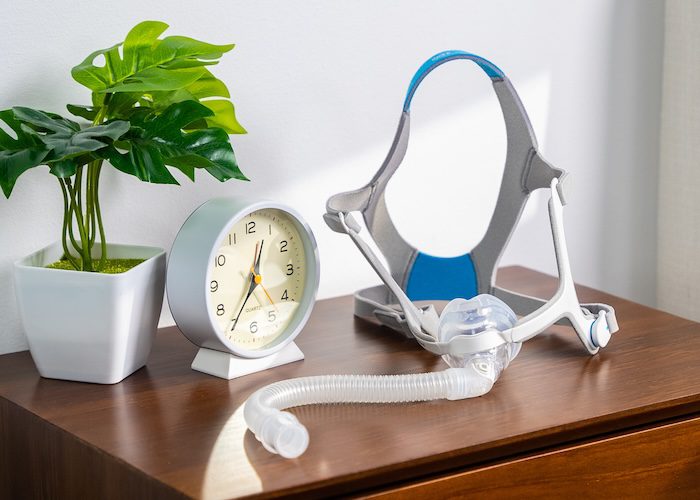
When I first started CPAP therapy, my machine lived on a standard nightstand already crammed with a lamp, books, my phone charger, and whatever else had accumulated there over the years. The tubing dangled off the edge and got caught on things. The humidifier chamber was awkward to refill without moving everything out of the way first. The water jug for distilled water lived on the floor because there was nowhere else to put it. It worked, technically, but it was a minor frustration every single night.
I’ve stayed on a standard nightstand — my current setup works well enough that I’ve never made the switch — but over the years I’ve paid close attention to what dedicated CPAP nightstands actually offer, because the question comes up constantly from readers who are either setting up their first CPAP station or trying to make their bedroom feel less like a medical supply room.
The honest case for a dedicated CPAP nightstand comes down to three things. First, purpose-built hose management — channels or rear cutouts that route the tubing cleanly so it doesn’t drag across the surface, get caught on drawers, or pull on the mask during the night. Second, ventilation — CPAP machines generate some heat in operation, and enclosed surfaces trap it, while a properly ventilated nightstand keeps airflow moving around the machine. Third, storage sized for the actual accessories involved: space for distilled water, replacement filters, mask wipes, and a spare cushion, all within arm’s reach without being on display.
The embarrassment factor is real, too, and worth acknowledging without judgment. A lot of people living with sleep apnea don’t want their medical equipment on show when guests visit or when they’re staying somewhere other than their own bedroom. A nightstand that hides the machine inside a cabinet when not in use is a legitimate thing to want.
I don’t recommend these from my personal use — this is based on my research and what I hear from the community. These are the three I’d point someone toward.
Quick picks:
| Your situation | My recommendation |
|---|---|
| Best overall / modern design | CPAP Soho Nightstand |
| Best classic wood look | CPAP Charleston Nightstand |
| Best Amazon option | Northwood Calliger by Seven Oaks |
CPAP Soho Nightstand — Best Overall
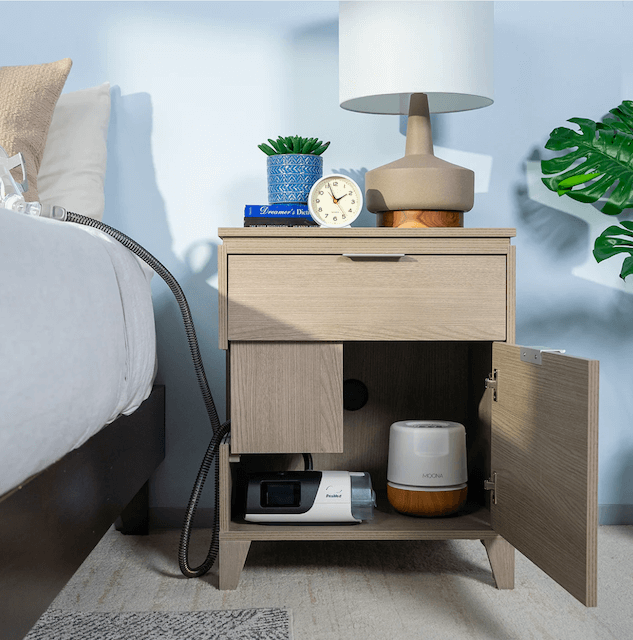
The Soho is purpose-designed for CPAP use rather than being a standard nightstand with a hole drilled in the back, and the difference shows. The rear cutout handles hose routing cleanly, keeping tubing off the surface and reducing the snagging that causes mask displacement during the night. The back panel manages cord access while providing ventilation so the machine isn’t sitting in a closed, warm space.
The drawer is deep enough for the full range of accessories — filters, wipes, a backup mask cushion, and a reasonable-sized water container — which matters because having everything in one place removes the small daily friction of hunting for supplies at bedtime. Available in Grey Ash, Walnut, and Maple, and configured for either the left or right side of the bed.
For someone setting up their CPAP station properly for the first time, or someone who’s been making do with a cluttered standard nightstand and wants to address it properly, this is where I’d start.
CPAP Charleston Nightstand — Best Classic Wood Look
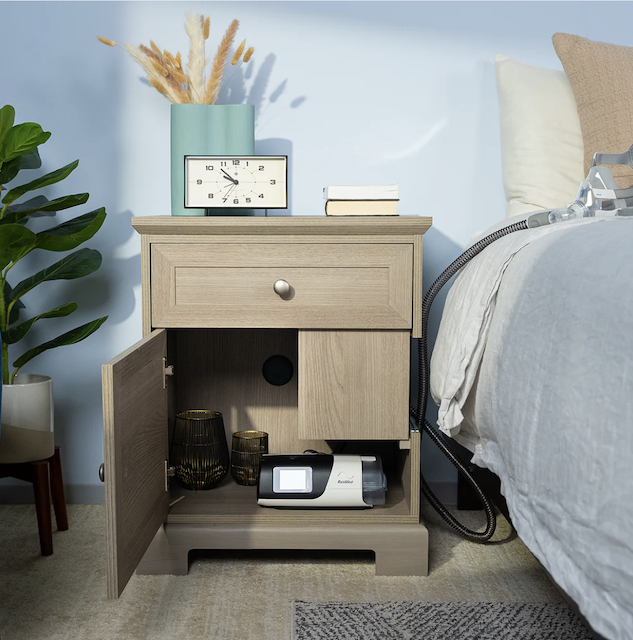
The Charleston takes a different approach to the machine visibility problem — rather than routing everything through the back, it uses a pull-out tray that brings the machine to the surface at bedtime and tucks it away inside a cabinet during the day. The cabinet has a ventilation port so the machine can sit inside without overheating, and the soft-close drawers mean you’re not creating noise when you’re opening them at midnight.
For anyone whose bedroom has traditional or transitional furniture, the Soho’s modern aesthetic might look out of place. The Charleston’s classic design fits the kind of bedroom where the Soho would feel clinical. Same functional specifications, different visual register. Available in Grey Ash or Walnut, and like the Soho, configurable for both sides of the bed.
Northwood Calliger by Seven Oaks — Best Amazon Option
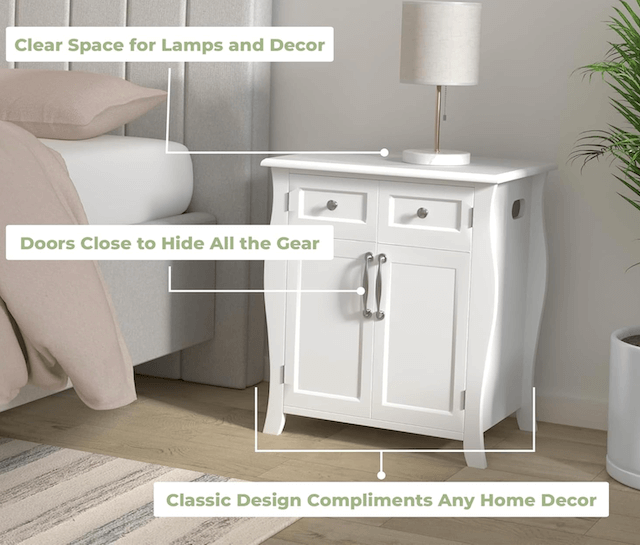
The Calliger is the right recommendation for anyone who wants a CPAP-specific nightstand but isn’t ready to spend at the SleepDoctor price point, or who simply prefers the convenience of Amazon shipping. It’s designed specifically for CPAP users — the built-in hose channel and open-back design are purpose-built rather than retrofitted — which puts it ahead of generic nightstands that happen to have a cable hole.
The storage is generous enough for all the standard supplies, and the white finish suits most bedroom environments without requiring a design-specific decision the way the Soho and Charleston do. It’s the most straightforward option on this list and the one I’d suggest for someone who wants to solve the problem practically without overthinking it.
What Actually Makes a Nightstand Work for CPAP
The features worth prioritising, based on what comes up repeatedly in the community, are in roughly this order.
Hose management is the most practically important. A standard nightstand has no way to route tubing without it draping over the edge or running across the surface, where it gets caught on things. All three nightstands above address this — it’s the core reason to buy one specifically designed for CPAP rather than a general piece of furniture.
Ventilation matters more than most people initially realise. The ResMed AirSense 10 and similar machines draw air in and exhaust warm air out during operation. An enclosed surface without airflow traps that heat around the machine, which can affect performance over time. An open back or ventilation port solves this.
Surface height relative to your bed is a practical consideration that’s easy to overlook when ordering online. The machine and mask should be easily reachable without sitting up fully — roughly level with the top of your mattress is the target. Check the dimensions against your bed height before ordering.
Storage matters for compliance. Research on CPAP adherence consistently identifies convenience as one of the main factors in whether people use their machine every night. Having your supplies — distilled water, replacement filters, mask wipes — within arm’s reach at the bedside removes small barriers that accumulate into missed nights over time. A nightstand with adequate storage specifically sized for those items is a genuine adherence intervention, not just a tidiness preference.
The AASM’s guidance on sleep environment emphasises keeping the bedroom organised and oriented toward sleep as a factor in sleep quality. A CPAP setup that functions smoothly and doesn’t require navigating clutter at the end of the day contributes to that environment rather than working against it.
A dedicated CPAP nightstand isn’t essential — I’ve managed without one for over ten years. But if your current setup is causing nightly friction, or if you want your bedroom to feel less like a treatment room, it’s a practical and relatively affordable fix.
⚠️ MEDICAL DISCLAIMER This blog provides general information only and is not a substitute for professional medical advice, diagnosis, or treatment. Sleep apnea is a serious condition, and CPAP equipment should be used under proper medical supervision. Always consult your doctor or sleep specialist before starting, stopping, or changing any therapy. I share personal experiences as a CPAP user, not as a medical professional. Individual results vary. For medical guidance, please consult a qualified clinician or the American Academy of Sleep Medicine (aasm.org).