Best CPAP Hoses to Improve Sleep Quality

“This post contains affiliate links. I may earn a commission if you buy through these links, at no extra cost to you. Read my Disclaimer for more details.”

For the first stretch of my CPAP journey, I was waking up to water in my hose almost every night. The condensation would collect in the tubing, and when I moved or the pressure shifted, it would hit my mask with a gurgling sound and occasionally spray cold water directly into my nose. It felt like sleeping with my face in an aquarium. I’d lie there at 3 am, trying to decide whether to disconnect and drain the hose or just endure it, and either way, the sleep disruption was significant.
The fix was the ResMed ClimateLineAir heated tube, which is the only hose I’ve used since making the switch and the one I’d recommend to any AirSense 10 or 11 owner dealing with the same problem. Heated tubing keeps the air warm as it travels from the machine to your mask, which prevents the temperature drop that causes condensation to form in the first place. It didn’t reduce my rainout. It eliminated it.
The hose is underappreciated in most CPAP conversations, which tend to focus on machines and masks. But the tube is the link between them, and a cold standard hose running through a bedroom that drops temperature overnight will cause problems regardless of how good your machine and mask are. Getting the hose right matters.
Quick picks:
| Your machine | My recommendation |
|---|---|
| ResMed AirSense 10 | ResMed ClimateLineAir Heated Tube (Series 10) |
| ResMed AirSense 11 | ResMed ClimateLineAir Heated Tube (Series 11) |
| ResMed AirMini | ResMed AirMini Tubing |
| Philips DreamStation | Philips Respironics Heated Tube |
| Any machine, budget option | Sunset Standard CPAP Tubing |
ResMed ClimateLineAir Heated Tube — Series 10 — What I Use
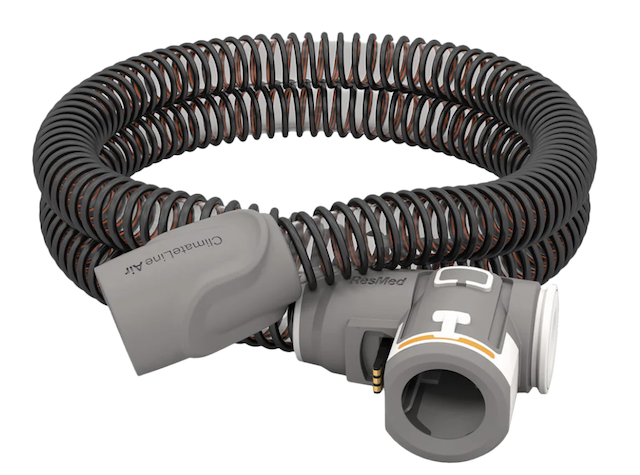
This is the hose on my AirSense 10 and has been since I made the switch from standard tubing. The ClimateLineAir integrates directly with the AirSense 10’s HumidAir humidifier and Climate Control system, which means the machine manages temperature and humidity automatically rather than you having to find a manual setting that works for your room conditions. There’s a sensor in the tubing that reads the ambient environment and adjusts the heat output accordingly — warmer on a cold night, less heat when the room is warmer.
The practical result is that I haven’t woken up to water in the hose since. Not once. The air arrives at the mask at a consistent temperature and humidity level, the condensation has nowhere to form, and the night is uninterrupted. That’s the outcome that matters.
The tubing itself is soft and flexible with swivel ends that don’t fight you when you change position during the night. It runs six and a half feet, which gives enough slack for most bedroom setups. The 90-day warranty is standard for CPAP accessories.
Important note on compatibility: this hose only works with the AirSense 10 and AirCurve 10 series with a HumidAir heated humidifier attached. It has electrical connections at both ends for the heating element — you cannot use it as a standard hose on other machines, and standard hoses cannot use the Climate Control features of the AirSense 10.
ResMed ClimateLineAir Heated Tube — Series 11
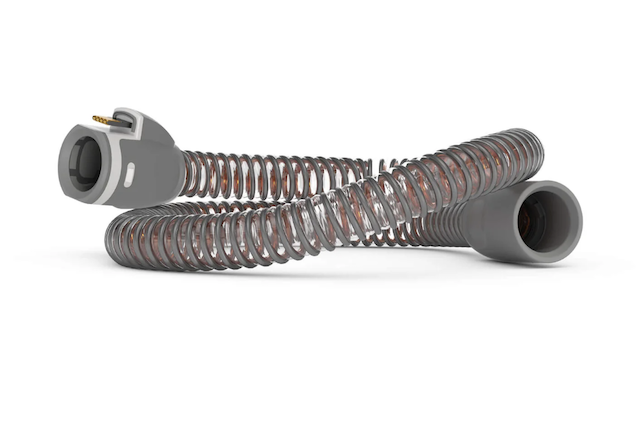
The Series 11 equivalent of the hose above, designed specifically for the AirSense 11’s Climate Control system. Same principle, same outcome — automatic temperature and humidity adjustment that eliminates rainout — but engineered to the updated machine’s connections and algorithm.
I don’t use the AirSense 11 myself, but the ClimateLineAir is the correct hose for anyone who does. Using a Series 10 hose with a Series 11 machine or vice versa is not recommended — the connectors and control systems differ between generations. If you’ve recently upgraded from an AirSense 10 to an 11, the hose needs to change too.
ResMed AirMini Tubing
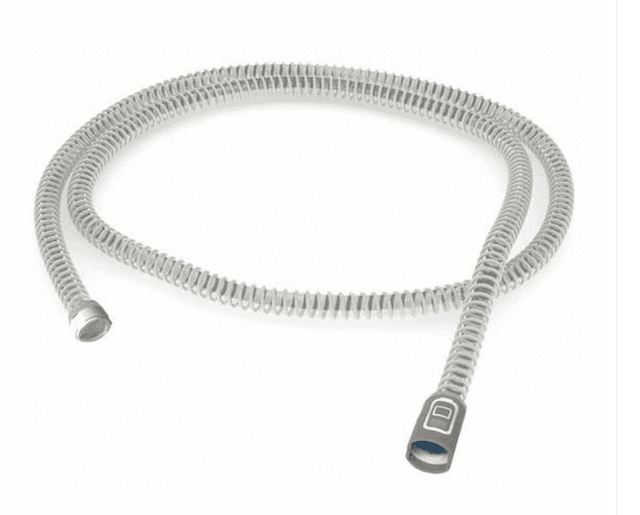
The AirMini uses a narrower 15mm hose rather than the standard 22mm tube, so it requires its own specific tubing. Standard hoses won’t fit. The AirMini tube is lighter and more compact than a standard hose, which is part of what makes the overall travel setup so packable — the entire machine, hose, and mask fits comfortably in a small bag.
The AirMini doesn’t use water-based humidification — it uses the HumidX filter system instead — so there’s no heated tube in the same sense as the ClimateLineAir. The hose just carries air. Rainout is less of an issue without a water humidifier, though the HumidX Plus is worth considering for very dry environments.
If you use an AirMini and your hose is wearing out or you want a spare for travel, this is the correct replacement.
Philips Respironics Heated Tube for DreamStation
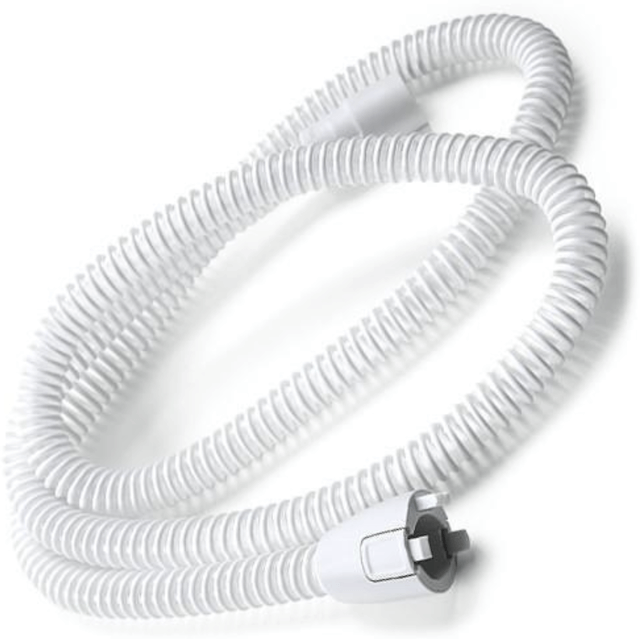
Sunset Standard CPAP Tubing — Budget Option
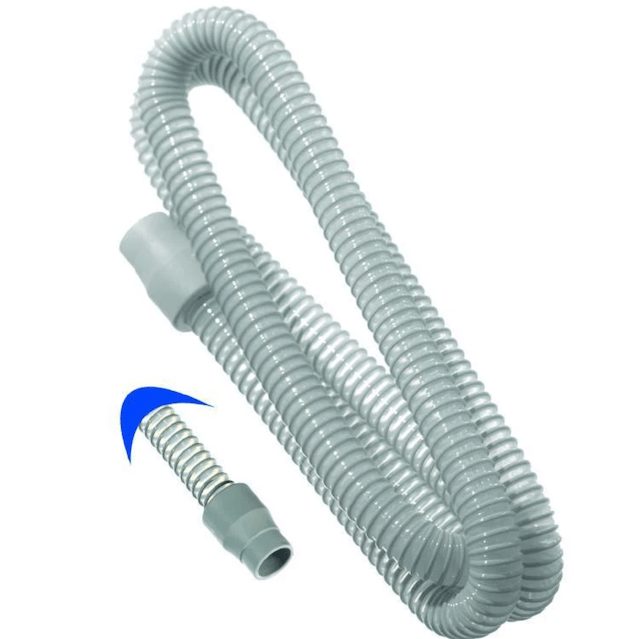
Not everyone needs heated tubing. If you live somewhere with a consistently warm bedroom, run your humidifier at low settings, or are on a budget and experiencing minimal condensation issues, a standard 22mm replacement hose is perfectly adequate for the therapy itself.
The Sunset is a universal 22mm hose that fits most CPAP and BiPAP machines without heated tube compatibility. It’s latex-free, flexible, and serves as either a reliable everyday hose or a travel spare. I keep a standard hose as a backup for travel situations where the ClimateLineAir’s electrical connections might be inconvenient, and the Sunset is the kind of no-frills option that earns its place in that role.
Rainout: Why It Happens and How Heated Tubing Fixes It
Rainout is what happens when warm, humidified air travelling through your hose meets a section of tubing that’s cooled by the ambient room temperature. The temperature drop causes moisture to condense on the inside of the tube — exactly the same process as a cold glass sweating on a warm day. Once enough water accumulates, it moves with the airflow and ends up gurgling into your mask.
The degree to which this happens depends on three variables: how high your humidifier is set, how cold your bedroom gets overnight, and how well insulated your hose is. All three can be managed. Lowering the humidifier setting reduces the moisture available to condense. Raising the room temperature reduces the temperature differential. A hose cover or wrap insulates the tube and slows the temperature drop.
But the most effective solution — and the one that worked for me — is a heated tube that actively maintains the air temperature along the full length of the hose, removing the cold spot where condensation forms. There’s no temperature differential to exploit if the tubing itself is warm.
ResMed’s guidance on Climate Control settings covers how to adjust your AirSense’s temperature and humidity settings to optimise comfort and minimise rainout if you want to fine-tune beyond the auto settings.
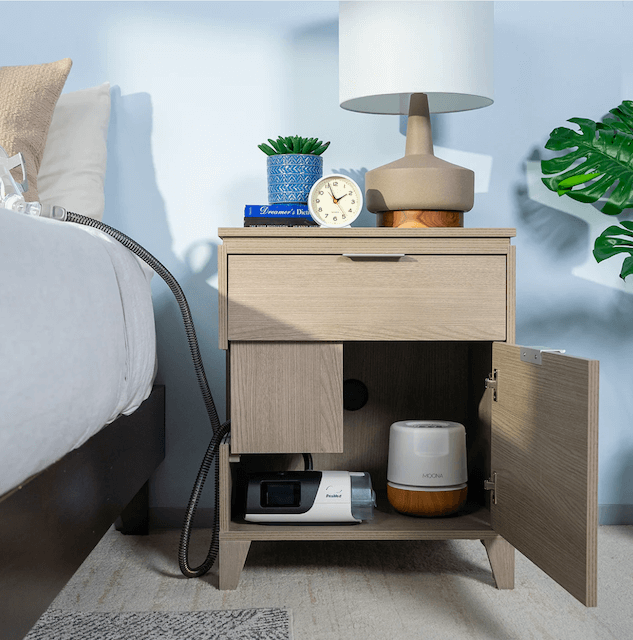
The other variable worth knowing about is machine placement. If your CPAP sits higher than your head, water that condenses in the hose will drain toward your mask rather than back into the machine. Keeping the machine at roughly the same level as or slightly below your head means gravity works in your favour. It’s a simple fix that makes a noticeable difference alongside whatever hose solution you use.
How Often to Replace Your Hose
Standard hoses should be replaced every three to six months. Heated tubes like the ClimateLineAir have electrical wiring integrated into the tubing wall, so they warrant inspection for kinks or damage more regularly — a kinked heated tube can develop problems over time in a way a standard hose won’t. I replace mine roughly every six months as part of the general CPAP replacement schedule I follow for all components.
Cleaning is weekly with warm water and CPAP cleaning soap, followed by hanging to air dry completely before the next night’s use. With a heated tube, keep water away from the electrical connectors at each end — clean the interior of the hose itself, not the connection points.
The American Academy of Sleep Medicine’s clinical guidelines emphasise equipment maintenance as a component of effective therapy — worn or poorly maintained hoses can contribute to pressure inconsistencies, leaks, and hygiene issues that affect both comfort and treatment outcomes. Keeping the hose on a regular replacement schedule is one of the simpler aspects of CPAP maintenance, but one of the more consequential ones over the long run.
⚠️ MEDICAL DISCLAIMER This blog provides general information only and is not a substitute for professional medical advice, diagnosis, or treatment. Sleep apnea is a serious condition, and CPAP equipment should be used under proper medical supervision. Always consult your doctor or sleep specialist before starting, stopping, or changing any therapy. I share personal experiences as a CPAP user, not as a medical professional. Individual results vary. For medical guidance, please consult a qualified clinician or the American Academy of Sleep Medicine (aasm.org).