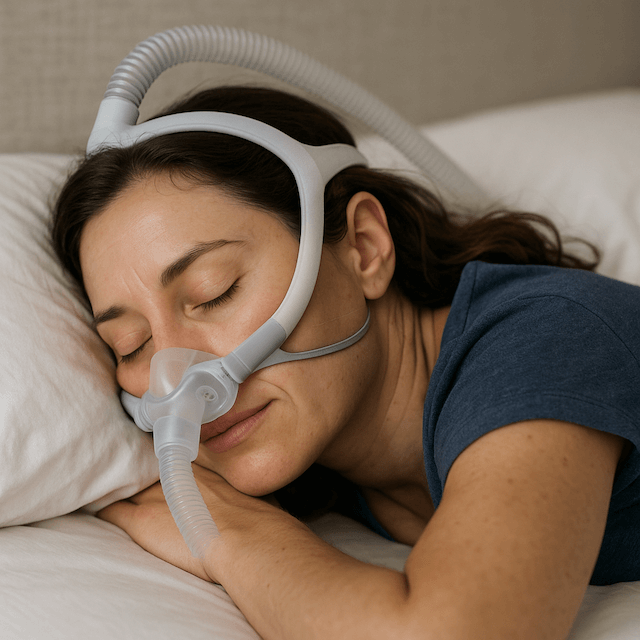
What are CPAP (HME) Heat Moisture Exchanger filters?

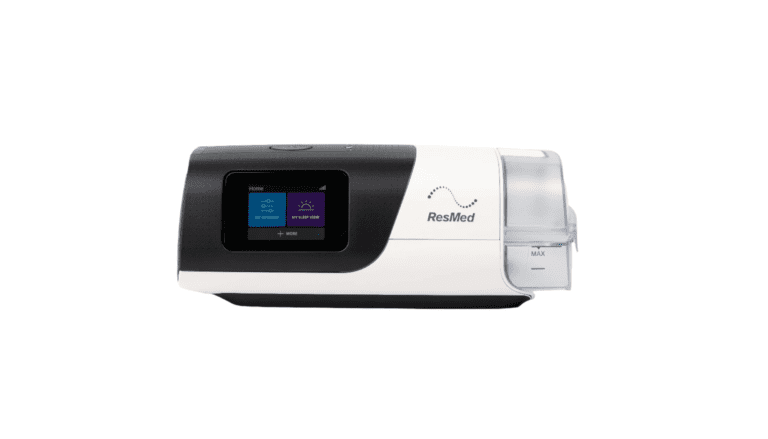
If you have ever traveled internationally with a CPAP machine, you already know the problem. My ResMed AirSense 10 is a fantastic bedside machine, but it is not built for a suitcase. It needs distilled water, the humidifier chamber adds bulk, and the carry case eats a meaningful chunk of luggage space. The first time I flew to Europe with that setup, I made it work, but it was clearly the wrong tool for the trip. Before my next trip overseas I bought a ResMed AirMini, and that is when I first ran into the small white cartridge that sits between the mask and the hose, the heat moisture exchanger.
For full transparency, my background is in computer science, not medicine. What follows is a plain language explanation of what HME filters are, how they work, and what I have learned from using one with my own travel rig over the better part of a decade with CPAP. None of it is a substitute for a conversation with your doctor or sleep specialist.
What an HME Filter Actually Is
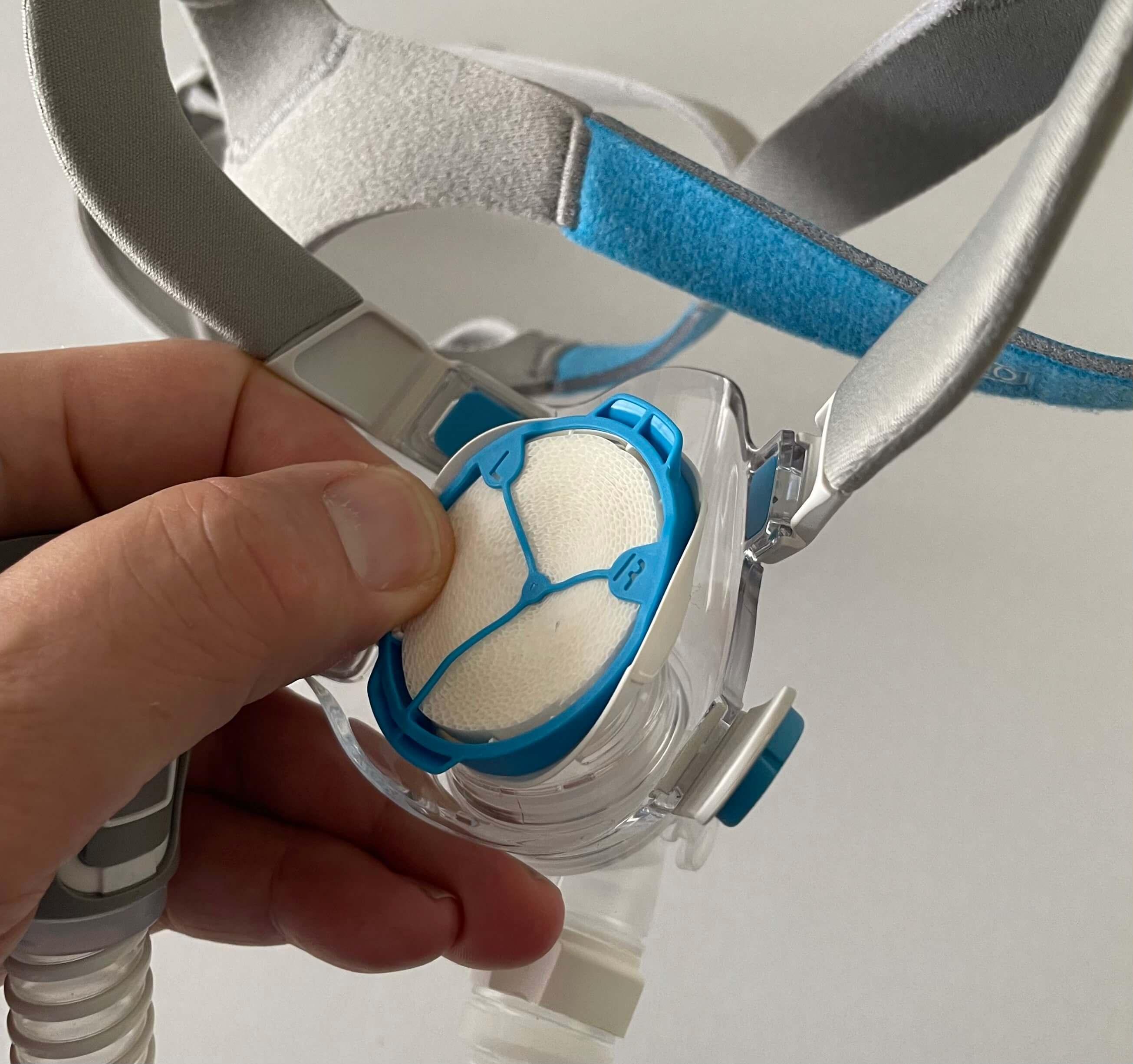
HME stands for heat and moisture exchanger. Hospitals have used the same basic technology in ventilator circuits for decades, and the version that ends up on a travel CPAP machine is essentially a miniaturized version of that idea. It is a small disposable cartridge, usually a plastic shell with a paper or foam matrix inside, that you place in line between your mask and the air outlet. There is no power, no water, and no settings. It just sits there and does its job.
The cartridge is sometimes called a passive humidifier, and that label is actually a useful one. A heated humidifier is active. It uses electricity to warm a chamber of water and load the air with moisture before it reaches you. An HME does not add anything new to the system. It simply catches some of the warmth and humidity that you produce yourself, holds onto it for a fraction of a second, and gives it back to you on your next breath. The technology is genuinely clever in how little it does to accomplish something useful.
If you want a deeper look at how CPAP humidification works as a category, the Sleep Foundation has a good overview of CPAP humidifiers that covers heated, passover, and waterless options. It is worth a read if you are weighing the trade offs for your own therapy.
How an HME Works on a Mechanical Level
The mechanism is simple physics. When you exhale, the air leaving your lungs is warm and humid because it has just spent time in contact with the moist tissues of your airway. As that exhaled air passes back through the HME on its way out the mask vent, the paper or foam matrix inside the cartridge captures a portion of the heat and a portion of the water vapor. A second or two later, when you inhale, the cooler and drier air from the CPAP machine flows through that same matrix, picks up the stored heat and moisture, and arrives at your airway slightly warmer and slightly more humid than it would have been otherwise.
The trade off is that an HME never adds more humidity than you put into it. A heated humidifier can dial humidity up well above ambient because it has its own water supply. An HME is essentially a recycler. That is why people who really struggle with dryness sometimes find an HME insufficient on its own, and why the cartridge is usually marketed for travel and short term use rather than as a full replacement for a heated humidifier at home.
There is also a small airflow consideration. Because air has to pass through a fibrous matrix, an HME introduces a small amount of resistance to the breathing circuit. Modern travel CPAP machines like the AirMini are designed with this in mind, so the difference is rarely noticeable, but it is worth knowing the cartridge is not invisible to the system.
Why an HME Matters for Travel CPAP
The single biggest reason I bought a travel CPAP plus HME setup was weight and bulk. A heated humidifier needs three things that are awkward on a plane or in a tent. It needs a water chamber that has to be emptied and dried before it goes in a bag, it needs distilled water that is not always easy to find at your destination, and it needs a power source that delivers consistent voltage. Strip those three out and a travel CPAP shrinks dramatically.
The first time I camped with a CPAP machine, I was using my AirSense 10 with a small inverter. It worked, but the water chamber was a constant nuisance. Switching to a travel rig that uses an HME instead of a water chamber meant I could throw the whole machine, hose, mask, and a few cartridges into a small bag and stop thinking about whether I had access to distilled water. For air travel the gain is even bigger, because TSA and international airport security do not particularly enjoy a partially full water chamber, and emptying and drying a humidifier in a hotel bathroom the morning of a flight is not a fun routine.
If your travel itinerary is built around hiking, road tripping, or long flights, the appeal of an HME is mostly logistical. It removes friction. It is not magic. It will not match the comfort of a heated humidifier in a dry hotel room. But for most travel scenarios, where the alternative is leaving the CPAP at home or hauling a full bedside setup into the field, the cartridge is the difference between using your therapy and skipping it.
The Compatibility Question Most Articles Skip
Here is the part I want to be very clear about, because it is where it is easy to buy the wrong product.
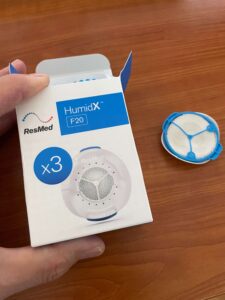
The HumidX cartridges that ResMed sells for the AirMini are not all the same. There are three relevant variants. The standard HumidX is intended for the AirFit P10, N20, and N30 nasal and pillow masks. The HumidX Plus is a stronger version of the same cartridge, also for those nasal masks, designed for dry climates and high altitude air travel. And then there is the HumidX F20, which is a separate product specifically for the AirFit F20 and AirTouch F20 full face masks.
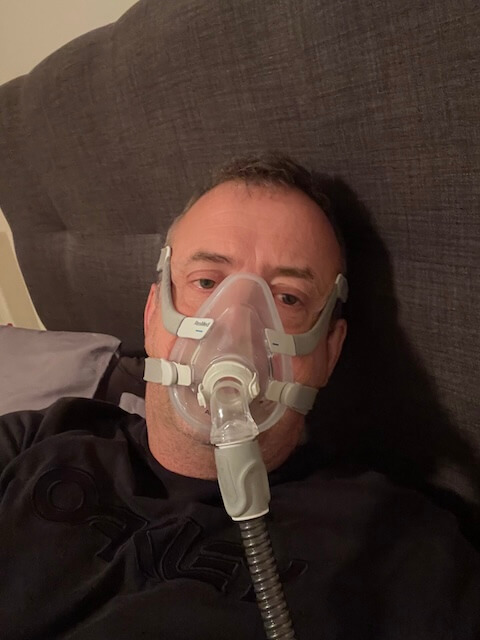
If you, like me, are a chronic mouth breather who uses an F20 full face mask, the HumidX Plus will not fit your setup. ResMed and every retailer states this explicitly. The F20 has a different mask connector geometry and uses a different cartridge form factor. Trying to force one to work with the other does not produce useful humidification, it just produces a poor seal.
This matters for two reasons. First, if you are buying replacements for yourself, the cartridge has to match the mask family you actually use. Second, if you are reading a recommendation online, check whether the writer’s mask matches yours before you take the recommendation at face value. A nasal mask user telling you the HumidX Plus is great in dry hotel rooms is giving accurate information for their setup, but it will not transfer to yours if you wear an F20.
The same general principle applies to other travel CPAP machines. The Transcend, Z2, and various Human Design Medical units have their own HME cartridges that are not interchangeable with ResMed’s. If you are setting up a travel kit from scratch, treat the machine, mask, hose, and HME as a single matched system rather than mixing parts across brands.
How to Connect an HME Filter
The mechanical setup is straightforward once you have the right cartridge for your machine and mask. The HME goes inline at the mask end of the circuit, not at the machine end. There is a reason for that placement. The matrix inside the cartridge needs to see your warm humid exhale before that exhale gets diluted with room air or dispersed through the hose. If you put it at the machine end, almost all of the moisture is lost before it can be captured.
In practice this means you remove your mask from the standard hose, push the HME into the mask connector, and attach the hose to the open side of the HME. Power on the machine, breathe through the mask normally, and that is it. There is nothing to adjust on the machine itself, and no settings to change.
A few practical notes. The cartridge should sit snugly without forcing it. A loose fit usually indicates the wrong cartridge for your mask family. Once you start using a cartridge, write the date on it with a marker so you know when to replace it. And do not run an HME while a heated humidifier is also active in the same circuit. The two systems work against each other and you can wet out the cartridge faster than it should be wetted out, which kills its effectiveness.
When an HME Makes Sense and When It Does Not
An HME is the right tool when portability is the dominant concern. Travel, camping, off grid sleeping, power outages, and scenarios where you simply cannot guarantee access to distilled water all favor the cartridge. It is also a reasonable choice if you live in a humid climate year round and find that a heated humidifier produces too much moisture for comfort.
It is the wrong tool when you have meaningful chronic nasal dryness, bleeding, or congestion that already pushes the limits of a heated humidifier. The cartridge cannot add what your body is not producing. If your home humidifier is on its highest setting and you still wake up dry, an HME on the road is going to feel worse, not better. Same goes if you are running pressures high enough that the airflow itself is the source of the dryness.
It is also a poor primary humidification choice if you are early in CPAP therapy and still trying to figure out what makes you comfortable. Get your home setup dialed in first. Then, once you know what works, decide whether a travel rig with an HME makes sense as a secondary kit. Adding a passive cartridge to an unsolved comfort problem is rarely the path forward.
HME Compared to a Heated Humidifier
The two systems exist for different reasons, and it is worth being honest about the trade offs rather than pretending one is universally better. A heated humidifier needs power, water, regular cleaning, and the bulk of a chamber and a heating plate. In return it gives you adjustable humidity, often in conjunction with heated tubing that prevents the condensation problem people call rainout. For nightly use at home, the heated unit is the standard of care for good reason. The American Academy of Sleep Medicine generally recommends humidification as part of routine CPAP therapy, and most of the comfort literature is built around heated systems.
An HME needs none of those things. No cord, no tank, no maintenance beyond replacing the cartridge when it stops feeling effective. The cost is range. The cartridge gives you whatever your body produces and no more. In a humid climate that is plenty. In the middle of a dry hotel room with the air conditioning blasting, it can feel underwhelming.
For me the choice is contextual. The AirSense 10 with its heated humidifier and heated tubing stays bedside at home. The AirMini with an HME F20 cartridge goes on the road. I am not switching one for the other, I am using each in the situation it was designed for.
Replacement and Care
Most HME cartridges are rated for somewhere between seven and thirty days of use depending on the specific product and the manufacturer’s guidance. ResMed’s HumidX line is rated for thirty days from opening. Other brands are stricter. The honest answer is that the rated life is a maximum, not a target. If the cartridge starts to feel less effective, smell odd, or visibly discolor, replace it, regardless of how many days have passed.
When traveling, store unused cartridges in a sealed bag or the original blister pack until you need them. Heat, humidity, and contamination during storage all shorten the usable life of the matrix inside. I keep my spares in a small zippered pouch inside the AirMini case so they live in the same dry environment as the machine itself.
A used cartridge is not designed to be washed. The paper or foam matrix is not built to survive immersion in water. Some users report rinsing and air drying their cartridges in a pinch when a replacement was not available. I have done this myself when the alternative was no cartridge at all. It is not what the manufacturer recommends, and the rinsed cartridge is unlikely to perform like a fresh one. Treat it as a stopgap rather than a routine practice.
What I Pack for a Trip

For anyone curious what a working travel kit looks like, here is mine, kept deliberately minimal. The AirMini itself, a short hose, the F20 setup pack with its dedicated connector, three or four HumidX F20 cartridges in their blisters, the AirMini’s filter, the power supply with the appropriate plug adapter for wherever I am going, and a small soft case that holds all of it. That is the entire travel sleep apnea kit. It fits in a corner of a carry on with room to spare.
I do not bring my heated humidifier or distilled water on trips. The whole point of the travel rig is that it removes those concerns. If you are interested in a more general look at packing CPAP gear for trips, I cover that on the travel with CPAP page.
Common Questions
Can you reuse an HME cartridge? Officially no. They are single-use disposables, and the matrix degrades and accumulates contaminants with use. In practice, a rinse and full air dry can extend a cartridge in an emergency, but it is not a maintenance plan, it is a workaround when you have no alternative.
Why does my HME whistle or feel restrictive? Some airflow noise through a cartridge is normal because the matrix introduces resistance. If the noise is new, the cartridge is probably near the end of its life or partially blocked. Try a fresh one. If the new cartridge whistles too, look at the mask seal first. A leak somewhere else in the circuit can change the airflow pattern through the HME.
How often should I replace it? Follow the manufacturer’s stated life as a maximum, and replace earlier if performance drops. For ResMed HumidX cartridges that is up to thirty days from opening. For other brands it can be as little as a week.
Can I use an HME instead of my heated humidifier full time? You can, but most users find the comfort gap noticeable, especially in dry environments. The cartridge is a travel and short-term tool, not a replacement for a properly set up bedside humidifier.
Is the cartridge the same as the bacteria filter? No. CPAP machines also use disposable particulate filters that sit at the air intake. Those are a different product with a different purpose. An HME is about humidity. A bacteria or particulate filter is about cleaning the air the machine pulls in.
The Honest Takeaway
An HME filter is one of the few CPAP accessories I have come to genuinely appreciate. It is small, cheap relative to the rest of the equipment, and solves a real problem for people who travel. It is not a substitute for a heated humidifier at home, and it is not a fix for serious dryness or congestion. Within the narrow band where it makes sense, mostly travel, camping, and off grid sleeping, it does its job quietly and reliably.
If you are considering one, the most important step is matching the cartridge to your machine and your mask. Get that right, and the rest is easy.
⚠️ MEDICAL DISCLAIMER This blog provides general information only and is not a substitute for professional medical advice, diagnosis, or treatment. Sleep apnea is a serious condition, and CPAP equipment should be used under proper medical supervision. Always consult your doctor or sleep specialist before starting, stopping, or changing any therapy. I share personal experiences as a CPAP user, not as a medical professional. Individual results vary. For medical guidance, please consult a qualified clinician or the American Academy of Sleep Medicine (aasm.org).