CPAP Pressure Settings: What They Mean and How to Get Yours Right


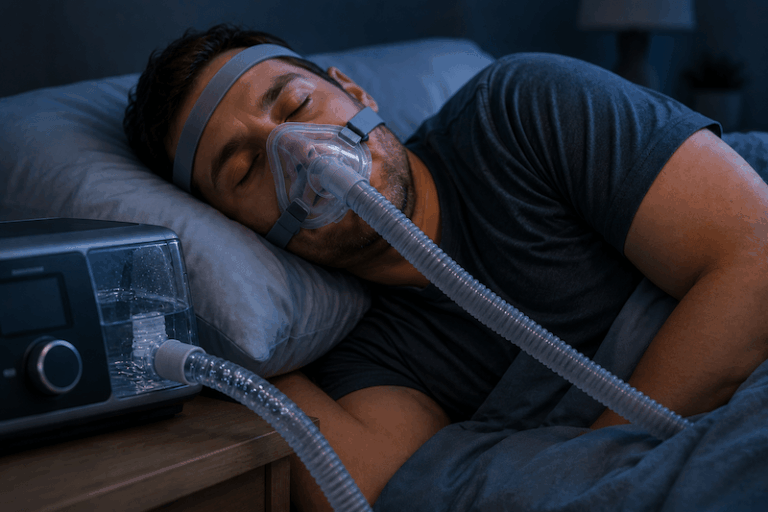
The first night I used my CPAP machine, I woke up convinced something had gone badly wrong. My chest felt like a bellows. My stomach was bloated. My heart was racing like I’d been jogging in my sleep. I lay there at two in the morning, mask half off, thinking: if this is the treatment, I’d rather have the disease.
I called the sleep clinic the next morning. My specialist listened to what I described, pulled up my data, and said she thought my pressure was slightly too high. She adjusted it down by a single unit — one centimetre of water pressure, which is about the smallest adjustment the machine allows — and that night was completely different. I slept through, woke up without the bloated feeling, and my AHI data showed my therapy was working just as well at the lower setting. One small tweak, and a treatment that had felt impossible suddenly felt manageable.
I’ve been on CPAP for over a decade now, and I still think about that first night when people tell me they’re struggling with their pressure. It’s one of the most common reasons people give up on therapy early, and in many cases the fix is simpler than they think.
What Pressure Settings Actually Are
CPAP stands for Continuous Positive Airway Pressure. The machine works by blowing a continuous stream of air through your mask, and that stream acts as a physical splint for your airway — keeping it propped open so it can’t collapse during sleep. The strength of that airstream is your pressure setting, measured in centimetres of water (cmH₂O).
| Range (cmH₂O) | Meaning |
|---|---|
| 4–6 | Gentle airflow — usually too low for most apnea cases |
| 7–12 | Most common range for moderate apnea |
| 13–20 | For severe apnea or special airway needs |
Most machines operate between 4 and 20 cmH₂O. The majority of people with obstructive sleep apnea end up somewhere between 8 and 12 in practice, though where you land depends on your anatomy, how severe your apnea is, your sleeping position, and a handful of other factors. There’s no universal right answer — which is why pressure is prescribed after a sleep study rather than guessed at from a chart.
My pressure when I was first set up was at the higher end given my AHI of 51 at diagnosis. The principle is always to find the lowest pressure that eliminates your apnea events. Higher isn’t better — it’s just louder, less comfortable, and more likely to cause the kind of side effects I experienced on that first miserable night.
How Your Pressure Gets Determined
The traditional route is an overnight titration study, where a sleep technician monitors your breathing and incrementally raises the pressure until your apnea events stop. Some people have this done as a split-night study — the first half diagnoses the apnea, the second half finds the right pressure. Either way, you go home with a prescribed setting based on real observed data about your airway.
The other increasingly common approach is an auto-adjusting machine, called an APAP. Rather than delivering a fixed pressure all night, an APAP works within a range — say, 6 to 14 cmH₂O — and adjusts breath by breath based on what it detects in your airflow. On nights where you’re sleeping on your side and your airway behaves, it runs lower. On nights where you’re on your back or congested, it ramps up. Your specialist then reviews the data after a few weeks to confirm the range is appropriate.
I use the ResMed AirSense 10, which operates in auto mode. My range was set by my specialist after my initial titration and has been reviewed and tweaked a few times over the years as my circumstances changed. The auto function means I don’t think about pressure much anymore — the machine does that work. If you’re still on a fixed-pressure machine and finding your therapy uncomfortable, it’s worth asking your specialist whether an APAP would suit you better. My guide to the best CPAP machines covers the current options if you’re at the point of considering an upgrade.
The Signs Your Pressure Is Wrong
This is the practical stuff, and it’s what most people actually want to know.
If your pressure is too high, you’ll likely feel it. Exhaling against the airstream feels like breathing out into a strong wind. You might wake up with a bloated stomach from swallowing air — a condition called aerophagia that’s unpleasant and disruptive. Dry mouth and throat are common, even with humidification running. Some people feel anxious or restless rather than relaxed when they put the mask on. That first night of mine ticked nearly all of these boxes.
If your pressure is too low, the signs are different. Your apnea events aren’t being controlled, so you wake up feeling like you haven’t really slept. Morning headaches — which for me were a major symptom before diagnosis — can persist. Your AHI data will show numbers above 5 consistently despite using the machine every night. Snoring can continue even with CPAP running, which is a fairly clear indication the airway isn’t being held open effectively.
The Sleep Foundation’s guide to CPAP pressure settings explains the mechanics of this well, including why sleep position affects how much pressure you need, which is something a lot of people don’t initially realise. Back sleeping requires more pressure because gravity is working against your airway. Side sleeping requires less. If you’re a back sleeper whose numbers aren’t great, that’s sometimes the first thing worth addressing before assuming the pressure itself is wrong.
Fixed vs Auto: Which Is Better?
This question comes up constantly, and the honest answer is that it depends on your situation.
| Feature | Fixed CPAP | Auto-Adjusting (APAP) |
|---|---|---|
| Pressure | Constant all night | Adjusts breath-by-breath |
| Comfort | May feel strong at first | Adapts automatically |
| Best for | Stable apnea patterns | Variable apnea or position-dependent |
| Cost | Lower | Slightly higher |
| Example | 10 cmH₂O | 6–15 cmH₂O range |
A fixed-pressure machine delivers the same pressure every minute of every night, regardless of what you’re doing or how your airway is behaving. It’s simpler, usually cheaper, and perfectly effective for people whose apnea is consistent and well-characterised. The limitation is that your airway doesn’t behave identically every night — alcohol, congestion, sleeping position, and REM sleep all affect how much support you need. A fixed machine can’t respond to any of that.
An APAP responds in real time. On a night when your airway needs less support, it backs off, and you sleep more comfortably. On a harder night, it increases to compensate. For people with variable apnea — position-dependent, REM-dependent, or simply inconsistent — this tends to produce better outcomes and better comfort.
The tradeoff is cost and, occasionally, complexity. Some people find auto machines less comfortable because the pressure variation is perceptible, though modern machines handle this very smoothly. If you’re not sure which category you fall into, your sleep specialist can look at your data and advise.
Should You Adjust Your Own Pressure?
The question I see more than almost any other in CPAP forums is some version of: “can I change my own pressure settings?” The answer is nuanced.
It’s not illegal. CPAP is a prescription device, but nothing physically prevents you from accessing the settings menus and making changes. What it is, however, is inadvisable without guidance — and not just for the usual cautious medical reasons. The problem is that you’re unlikely to be interpreting your data the same way a specialist would. What looks like a too-low pressure problem might actually be a mask leak. What feels like too-high pressure might resolve with an EPR adjustment rather than a pressure reduction. Making the wrong change can mask an ongoing problem or introduce a new one.
The Mayo Clinic’s CPAP guidance is clear on this: if your therapy feels wrong, the first call should be to your sleep specialist, not to the settings menu. Most modern machines offer remote monitoring, which means your clinic may already be seeing your data. A phone call or telehealth appointment is usually all it takes to get a proper assessment.
My own experience reinforces this. The fix on my first night was a one-unit adjustment that my specialist made after reviewing my data. If I’d tried to solve it myself, I might have gone too far in the other direction, or fixed the pressure but missed that my mask fit was also contributing. Having someone look at the whole picture matters.
Comfort Features Worth Knowing About
Even at the right pressure, a CPAP can feel uncomfortable at first, and most machines include features designed to help with this.
EPR — Expiratory Pressure Relief on ResMed machines, or Flex on Philips devices — reduces the pressure slightly when you exhale, making breathing out feel more natural rather than like you’re fighting the airstream. I have this active on my AirSense and it makes a meaningful difference to comfort, particularly in the first hour of sleep. If your chest feels tight when you exhale, this is worth asking your specialist to enable.
The ramp function starts the machine at a lower pressure and gradually builds to your prescribed level over a set period while you fall asleep. Some people find this helpful; others prefer the pressure to be where it needs to be from the start. It’s worth experimenting with.
Humidification is sometimes treated as an add-on comfort feature, but I’d argue it’s essential for most people. Pressurised air is dry air, and dry air against your airway all night causes dryness, irritation, and sometimes nosebleeds. The built-in humidifier on my AirSense runs every night, and the setting needs to be calibrated to your bedroom’s ambient humidity rather than just left at the default. If you’re getting rainout — condensation in the tube that ends up in your mask — a heated tube helps significantly. My guide to CPAP humidifiers covers the detail on getting this right.
Mask fit interacts with pressure in ways that aren’t always obvious. A mask that leaks loses effective pressure at your airway, which can mimic the symptoms of too-low a pressure setting. Before concluding that your pressure needs adjustment, it’s worth confirming your mask is sealing properly. If you’re regularly waking with red marks, a shifting mask, or air blowing toward your eyes, the mask is likely the issue rather than the pressure. A good-fitting CPAP mask that’s regularly maintained makes everything else work better.
When to Go Back to Your Specialist
Pressure needs change over time. Weight changes affect airway anatomy. Ageing affects muscle tone in the throat. Medications can affect how your airway behaves during sleep. A setting that was right two years ago may not be optimal now.
The clearest signals that a pressure review is due are a sustained increase in your events per hour over several weeks, new or returning symptoms like morning headaches or daytime fatigue despite consistent use, or persistent discomfort that comfort features haven’t resolved. These aren’t reasons to panic — they’re just reasons to make an appointment.
My pressure has been reviewed and adjusted several times over the decade I’ve been on therapy. Each time has involved my specialist looking at a month or more of data rather than just a single night, and each adjustment has been small. That’s how it’s supposed to work — incremental refinement based on real evidence, not guesswork. If something feels off, the answer is almost always to get someone to look at the data rather than to try to solve it yourself in the settings menu at midnight.
Further reading: CPAP, APAP, ASV: What’s the difference?
⚠️ MEDICAL DISCLAIMER This blog provides general information only and is not a substitute for professional medical advice, diagnosis, or treatment. Sleep apnea is a serious condition, and CPAP equipment should be used under proper medical supervision. Always consult your doctor or sleep specialist before starting, stopping, or changing any therapy. I share personal experiences as a CPAP user, not as a medical professional. Individual results vary. For medical guidance, please consult a qualified clinician or the American Academy of Sleep Medicine (aasm.org).