Best CPAP Travel Bag for 2026

“This post contains affiliate links. I may earn a commission if you buy through these links at no extra cost to you. Read my Disclaimer for more details.”
I have used a CPAP machine for more than a decade. The first time I tried to take one across Europe, I made every mistake you can make.
I dragged my full-size ResMed AirSense 10 through Italy with a humidifier chamber I had to refill with distilled water that I could not always find, a power cable that never quite reached the bed, and a mask packed in the same suitcase as my shoes. By the third hotel, I was untangling tubing in the dark while my wife pretended not to be awake. By the end of that trip, I had decided two things. I was not going to stop traveling because of sleep apnea. And I was not going to do it that way again.
When I got home, I bought a ResMed AirMini and a few weeks later took it through Abruzzo and on a longer stay in Vera Playa, Spain. The travel bag that goes with the AirMini is not glamorous. It is a small zippered case with a few padded compartments. But it is the difference between treating my CPAP like fragile medical equipment and treating it like an extra pair of shoes.
This post covers the bag I actually use, what to look for if you are choosing one yourself, and two options worth considering if you are keeping your full-size machine on the road.
What actually matters in a CPAP travel bag
A CPAP travel bag has a small job and it has to do it well. There are five things I pay attention to.
Protection. Your machine, your mask, and your humidifier chamber if you take one are all expensive and all fragile. The bag needs real padding around the device, not just a fabric sleeve. A crushed mask cushion at the wrong moment in a foreign country is a problem you do not want to solve from a hotel room.
Organization. Separate compartments matter more than they sound like they should. When you arrive somewhere late after a long flight, you do not want to dig around for a power cable in the same pocket as your hose. You want everything to live in one obvious spot so setup takes a minute, not ten.
Size. If the bag does not fit in your carry-on or under the seat in front of you, it ends up in the overhead, or worse, gets checked. Checked CPAP bags are bags that might end up in a different country. CPAP equipment is exempt from carry-on limits in most jurisdictions when packed in its own case, but only if it is a case you can actually carry comfortably.
Durability. Travel is rough. Train luggage racks, security bins, the floor of a tiny hotel room, the back of a rental car. Cheap zippers fail and thin nylon tears. Stitching and zippers are not glamorous specs but they are the ones that matter.
Easy at security. A bag that opens flat and shows everything in clear compartments saves time and stress. The TSA in the United States, for example, requires the CPAP itself to come out of its case for X-ray screening, while the mask and tubing can stay in. The full TSA guidance is available on their nebulizers, CPAPs, BiPAPs and APAPs page. If you are flying internationally, the same principle holds in most airports, but rules vary, so allow extra time on your first trip.
The bag I use: ResMed AirMini Travel Bag
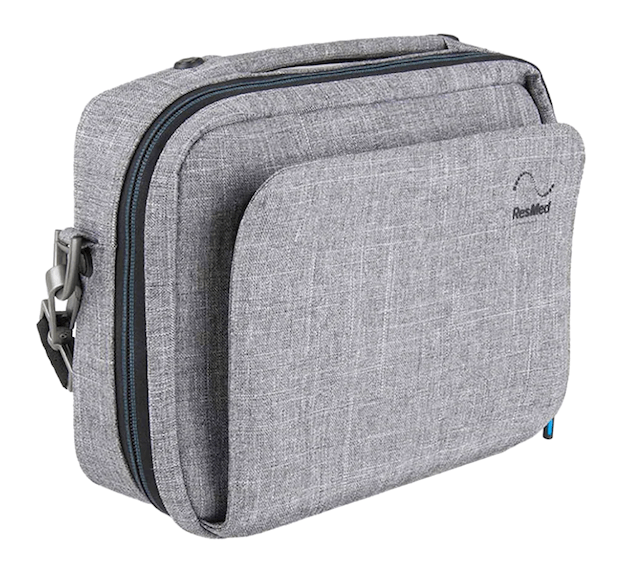
I bought the AirMini Travel Bag at the same time I bought the AirMini. The bag is sold separately. ResMed bundles vary depending on where and when you buy, and at the time, mine did not include the bag, so I added it.
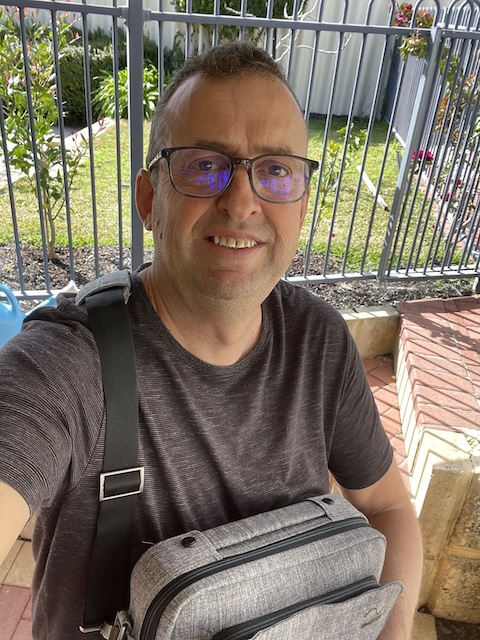
It is built for one job. The AirMini fits in the main compartment with the short hose attached. There is space for the power supply and a pocket for small accessories. I keep my HumidX F20 cartridges in there along with my AirFit F20 mask, since I use the AirMini F20 setup pack for travel. The bag has an adjustable shoulder strap, but most of the time I just carry it by hand or drop it into a larger backpack.
The case is small. That is the whole point. It tucks under the seat in front of me on every airline I have flown. It fits in the top of a carry-on with room to spare. It has been to Italy and Spain with me and back, in and out of airport security, in and out of train luggage racks, in and out of taxis. The zippers still work, and the padding is still intact.
A few honest things to know before you buy.
This bag only fits the AirMini. If you have a ResMed AirSense 10, an AirSense 11, or any other full-size machine, this is not your bag. Do not buy it expecting your AirSense to fit. It will not.
It is not waterproof. The fabric is durable but if you are walking through heavy rain you will want to put it in something else, or pack a packable rain cover.
There is no dedicated pocket for a CPAP battery. I carry a Medistrom Pilot-24 Lite for camping and longer trips, and that lives in my backpack rather than inside the AirMini case.
Who this is for. If you already own an AirMini and need a proper case for it, this is the obvious choice. It is purpose-built, and it works. If you are still using a full-size machine for travel and you are feeling the same pain I felt on my first trip, the bag will not solve that problem. The machine will. I have written more about why I switched in my AirMini travel CPAP review.
If you are traveling with a full-size machine
I want to be straight about this section. I have not personally used the bags below. I switched to the AirMini for travel because I found hauling my AirSense 10 across Europe genuinely miserable. So I cannot tell you what these bags feel like after three weeks abroad. What follows is research, not a review.
What I can tell you is what I would have wanted on that first trip. A bag that fits the AirSense 10 or 11 with the humidifier attached, has padded compartments so the humidifier does not crush the mask, has room for a power supply and a hose, and either clips to a rolling case with a luggage sleeve or has comfortable straps for hands-free carrying. That is a short list, and it rules out almost every generic duffel.
Two options that meet those requirements and have strong user reviews are the CURMIO CPAP Travel Bag and the CURMIO CPAP Travel Backpack. Read the reviews carefully and check the dimensions against your specific machine before buying. Manufacturers update machine sizes from generation to generation, and a bag that fit an older AirSense may be tight on a newer one.
CURMIO CPAP Travel Bag

The CURMIO CPAP Travel Bag is a soft sided case with a secure interior strap, mesh pockets for hoses and small parts, and a luggage sleeve. It is sized for the ResMed AirSense 11, AirSense 10, and the Philips DreamStation among others. It is the kind of bag I wish I had been using when I was stuffing my AirSense into a regular suitcase.
CURMIO CPAP Travel Backpack

The CURMIO CPAP Travel Backpack is the same idea in a backpack form factor with an additional padded laptop sleeve. If you travel hands-free, walk long distances between transport, or already pack light, a backpack is easier on the shoulders than a single strap shoulder bag. It fits the same range of full-size machines.
If you are committed to taking your full-size machine, either of these is a better starting point than a duffel. If you are traveling more than a few times a year, I would still gently suggest looking at a travel CPAP. Not because the bags are bad, but because the size and weight savings change what travel actually feels like once you are doing it. You can read more about my approach in my best way to travel with CPAP guide.
A few practical things I learned the hard way
A travel bag solves the carrying problem. It does not solve the rest of the travel problem. A few things worth knowing before your first trip.
Power. Outlets in foreign countries are often not where you want them. They sit across the room from the bed, behind a wardrobe, or simply do not exist near the headboard. A long extension cable in your bag is one of the cheapest upgrades you can make. A travel adapter that fits your destination is the second.
Backup power. If you camp, take a long flight, or stay anywhere the electricity is unreliable, a CPAP battery is a real comfort. I have written about the battery I use in a separate post. It has saved me at least one night so far when an outlet decided to stop working.
Distilled water. If you take a humidifier, you need distilled water. Some countries do not stock it the way the United States or Australia do, and you can spend an evening looking for it instead of relaxing. I now travel with the AirMini and HumidX F20 cartridges, which give a small amount of waterless humidification and remove the problem entirely.
Paperwork. A copy of your prescription is worth printing before you fly. Most countries do not ask. The one that does will not be the one you expected.
At the security line. Take the device out of the bag for X-ray as instructed. Open the bag flat so the rest of the gear is visible. The whole interaction is faster when officers can see what they are looking at.
If camping is part of your travel, I have a separate guide on camping with a CPAP machine that covers the gear and power planning in more detail.
A few words on choosing
Three things help most people make this decision quickly.
If you have an AirMini, get the AirMini Travel Bag. It is purpose built, it is the right size, and it is durable enough to hold up over years of trips.
If you have a full size machine and you are committed to traveling with it, choose between the CURMIO bag and the CURMIO backpack based on how you prefer to carry it. The bag is better for rolling luggage. The backpack is better for hands-free travel and longer walks between hotels and transport.
If you are about to take your first international trip with a full size CPAP and you have not yet packed it, I would gently suggest you also consider whether a travel CPAP makes sense for your travel patterns. The bag matters, but the size of the machine inside it matters more.
The point of all this
Sleep apnea has already taken plenty of nights from people who live with it. Travel does not need to be one of the things it takes too.
The right bag is not a luxury and it is not insurance. It is the small piece of gear that turns a CPAP from a thing you have to drag around into a thing that fits in your luggage like a toiletry kit. For me that is the AirMini Travel Bag. For someone keeping a full size machine, it is something like the CURMIO bag or backpack. Either way, the principle is the same. Pick one that protects the machine, organizes the gear, and fits in your carry-on. Then book the trip.
If you want the longer version of how I travel with CPAP, my best way to travel with CPAP guide covers the rest of the kit and the reasoning behind it.
The following year, I took my new kit for a trip around Europe. It felt great not having to worry about snoring on planes, finding a power outlet, and getting distilled water, and I felt great the next day.
Thanks for reading – and safe travels 🙂
⚠️ MEDICAL DISCLAIMER This blog provides general information only and is not a substitute for professional medical advice, diagnosis, or treatment. Sleep apnea is a serious condition, and CPAP equipment should be used under proper medical supervision. Always consult your doctor or sleep specialist before starting, stopping, or changing any therapy. I share personal experiences as a CPAP user, not as a medical professional. Individual results vary. For medical guidance, please consult a qualified clinician or the American Academy of Sleep Medicine (aasm.org).