Difference Between APAP, BiPAP, and CPAP: How They Differ

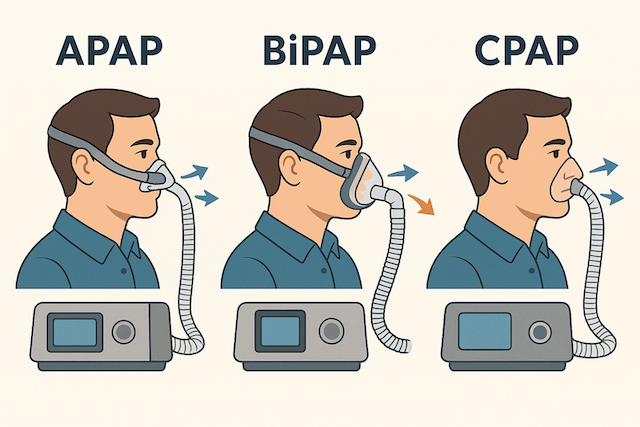
If you have been diagnosed with sleep apnea, three acronyms tend to come up fast: CPAP, APAP, and BiPAP. They sound alike, they look much the same sitting on a bedside table, and they all treat the same broad problem. They are not interchangeable, though, and the differences are worth understanding when you are trying to work out which one fits your situation.
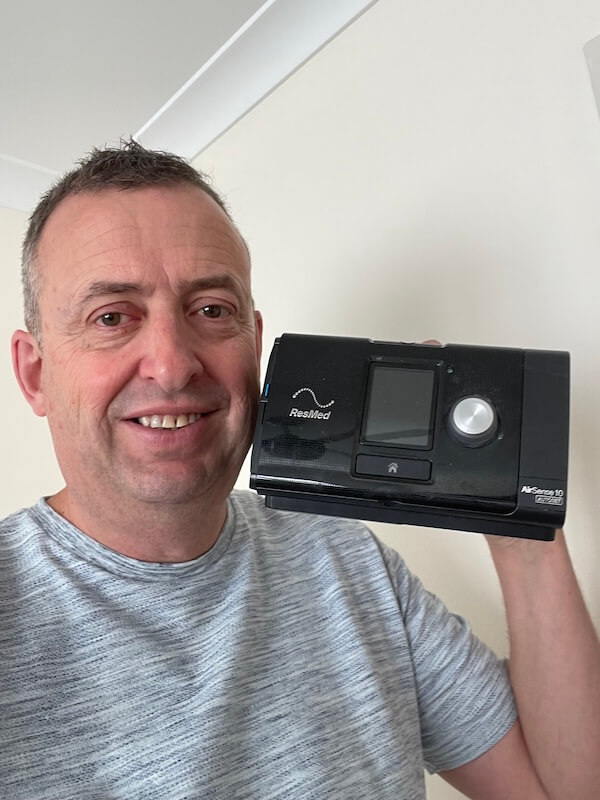
I have lived with sleep apnea for more than a decade. My background is in computer science rather than medicine, so what follows is a researched explainer, not medical advice. The aim is plain: to set out how these three therapies actually differ, who each one tends to be prescribed for, and what compromises come with each.
The Common Ground
All three belong to a family of treatments called positive airway pressure therapy, usually shortened to PAP. The shared idea is simple. A small machine pushes a steady stream of pressurized air through a hose and into a mask worn over the nose, the mouth, or both. That gentle pressure works like a splint, holding the upper airway open so the soft tissue at the back of the throat cannot collapse and interrupt breathing during sleep.
PAP therapy is widely regarded as the standard treatment for obstructive sleep apnea, the most common form of the condition, in which the airway is physically blocked during sleep. In some of its forms it is also used for central sleep apnea, where the trouble is not a blockage but a lapse in the brain’s signal to breathe. The Sleep Foundation offers a clear overview of how these therapies compare.
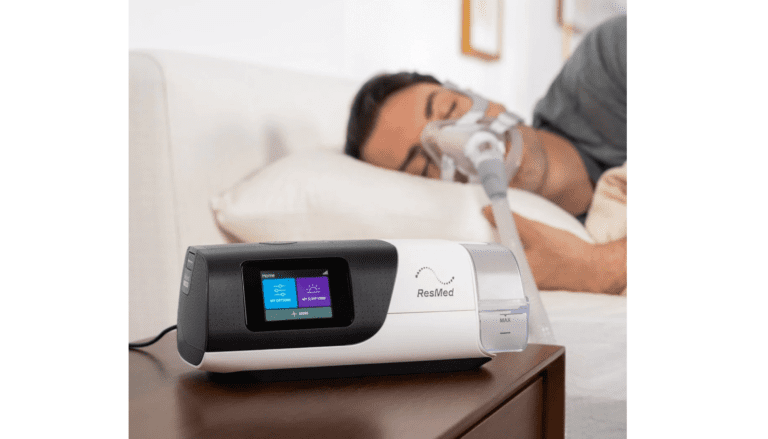
Every PAP setup shares the same basic parts: a machine that generates and regulates the air, a hose to carry it, a mask to deliver it, a filter, and usually a humidifier to stop the air from drying out the nose and throat. The masks are the same across all three therapies too. A nasal mask, a nasal pillow mask, or a full face mask can be paired with any of these machines, because the mask only delivers the air. It does not decide the pressure.
That last point is the heart of the matter. What separates CPAP, APAP, and BiPAP is not the hardware you can see on the nightstand. It is how the machine decides what pressure to deliver, and when.
CPAP: One Steady Pressure
CPAP stands for continuous positive airway pressure, and it is the oldest and most studied of the three. The word that matters is continuous. A CPAP machine delivers a single, fixed level of pressure, and it holds that level steady all night, whether you are breathing in or breathing out.
Pressure is measured in centimeters of water pressure, written as cm H2O, and most prescriptions fall somewhere in a range of roughly 4 to 20 cm H2O. The exact number is not a guess. It is worked out for each person, either during an overnight CPAP titration study in a sleep lab, where a technician raises and lowers the pressure until breathing interruptions stop, or through a period of automatic titration at home.
Because the pressure never changes, CPAP is mechanically simple, and that simplicity is its strength. Fewer settings and fewer moving parts mean fewer things that can go wrong. It is also the most affordable of the three and the most readily covered by insurance, which is part of why it is usually the first therapy a person with straightforward obstructive sleep apnea is offered. Decades of research stand behind it.
The simplicity comes at a price. Some people find it uncomfortable to breathe out against a constant incoming pressure, a sensation that can feel like exhaling into a breeze. That is the single most common complaint with CPAP, and it tends to be more noticeable at higher pressure settings. Modern machines soften it with comfort features. A ramp setting starts the night at a low pressure and builds up gradually as you fall asleep, and expiratory pressure relief, often shortened to EPR, briefly eases the pressure each time you exhale. These features help, but they do not change the underlying design. One pressure, held steady, all night.
APAP: Pressure That Adjusts Itself
APAP stands for automatic positive airway pressure, and it is sometimes called auto CPAP. It treats the same condition as CPAP and uses the same masks and hoses, but it handles pressure in a fundamentally different way. Rather than holding one fixed number, an APAP machine monitors your breathing continuously and adjusts the pressure up and down through the night, in real time.
The reason this is useful is that pressure needs are not constant. The amount of pressure required to keep an airway open can change with sleep position, since lying on your back often demands more than lying on your side. It can change between sleep stages, with REM sleep frequently calling for more. It can shift with nasal congestion from a cold or seasonal allergies. An APAP machine watches for the early signs of an airway starting to narrow, such as snoring, reduced airflow, and the opening shape of an apnea or hypopnea, and raises pressure only when those signs appear. When breathing settles again, it eases back down.
A prescription for an APAP machine is not a single number but a range. A clinician sets a minimum and a maximum, and the machine is free to move anywhere between them. Because the device can find the right pressure on its own, APAP can sometimes be set up after a home sleep test without a separate in lab titration. Most APAP machines can also be locked to a single fixed pressure, which means one device can serve as either an APAP or a plain CPAP depending on how it is configured.
The compromises are worth knowing. APAP machines generally cost more than basic CPAP units. The constant small adjustments, which most people never notice, can be distracting for lighter sleepers who are sensitive to changes in pressure. And different manufacturers use different algorithms, so two APAP machines do not necessarily behave identically. On the question that matters most, though, the research is reassuring. Studies comparing APAP and CPAP have generally found them equally effective at reducing the apnea hypopnea index, the standard count of breathing interruptions per hour, with no meaningful difference in how rested people feel. The appeal of APAP is comfort and flexibility, not better results.
BiPAP: Two Pressures Instead of One
BiPAP is where the design changes more noticeably. The name is a contraction of bilevel positive airway pressure, and bilevel is the word to hold onto. Instead of one pressure, a BiPAP machine delivers two: a higher pressure when you breathe in and a lower pressure when you breathe out.
The clinical terms for these are IPAP, the inspiratory pressure used during inhalation, and EPAP, the expiratory pressure used during exhalation. The higher inhale pressure does the work of holding the airway open and, in some cases, helping to move air into the lungs. The lower exhale pressure makes breathing out feel far more natural, because you are no longer pushing against the full force of the machine. For someone who has struggled to tolerate CPAP for exactly that reason, this difference can be what makes therapy bearable at all.
One note on the name. BiPAP is technically a trademark belonging to Philips Respironics, in much the same way a single brand name can come to stand in for an entire product category. The generic term is BPAP, or simply bilevel. In everyday conversation, most people say BiPAP regardless of who built the machine.
BiPAP machines also tend to offer a wider pressure range than CPAP, and they can run in different modes. A spontaneous mode simply follows your own breathing, switching between the two pressures as you inhale and exhale. A timed mode delivers a set number of breaths per minute. A combined mode lets you breathe on your own but steps in with a backup breath if you pause for too long.
That range of modes is the reason BiPAP is used for more than straightforward obstructive sleep apnea. It is often the next step for people who genuinely cannot tolerate CPAP or APAP despite adjustments, and for those whose pressure needs are unusually high. It is also used for central sleep apnea and for complex cases that mix obstructive and central events, because its backup breaths can support breathing when the brain’s own signal falters. Beyond sleep apnea, bilevel therapy is used for certain chronic lung conditions and other disorders that weaken the muscles of breathing.
The cost of that capability is, fittingly, cost. BiPAP machines are the most expensive of the three, and because they are usually considered only after simpler therapy has been tried, insurance coverage often requires documentation that CPAP did not work, along with a clear medical justification. For most people with uncomplicated obstructive sleep apnea, a BiPAP is more machine than the situation calls for.
A Side-by-Side Comparison
The table below summarizes the practical differences. It is a starting point for a conversation with a clinician, not a basis for choosing a device yourself.
| Feature | CPAP | APAP | BiPAP |
|---|---|---|---|
| Pressure delivery | One fixed level | One level that varies within a set range | Two levels, higher on inhale and lower on exhale |
| Adjusts through the night | No | Yes, automatically | Switches between two levels with each breath |
| Relative cost | Lowest | Moderate | Highest |
| Complexity | Simplest | Moderate | Most complex |
| Commonly prescribed for | Straightforward obstructive sleep apnea | Obstructive sleep apnea with changing pressure needs | CPAP intolerance, very high pressure needs, central or complex apnea |
So Which One Does a Person End Up On?
In practice, most people with obstructive sleep apnea start on either CPAP or APAP. Many sleep specialists now begin with APAP, since it can adapt to the patient rather than requiring a precise fixed number to be locked in from the outset, and research shows comparable outcomes. Others prescribe CPAP for its simplicity and cost. Both are reasonable starting points for ordinary obstructive apnea, and either can be effective.
BiPAP enters the picture later, and for specific reasons. It is generally reserved for people who cannot get comfortable on CPAP or APAP, who need pressures at the high end of the scale, or who have central or complex sleep apnea that calls for breathing support rather than a simple airway splint. It is not a better machine in some general sense. It is a different tool for a harder problem.
As Mayo Clinic explains, the right choice depends on the type and severity of your sleep apnea and on factors that are specific to you. That is genuinely a clinical decision. The type of device and the pressure settings are determined by a diagnosis, a sleep study, and a prescription, not by a chart on a website. It is also why you should never adjust your own pressure settings or switch device types on your own. The wrong setting can leave your apnea undertreated without you realizing it.
A Brief Word on ASV
There is a fourth therapy that sometimes enters this conversation: ASV, or adaptive servo ventilation. It is the most sophisticated of the group, adjusting its support breath by breath, and it is reserved for particular patterns of central and complex sleep apnea rather than ordinary obstructive apnea. ASV is genuinely a different tool for a different problem, and it carries its own clinical considerations, so it sits outside the scope of this comparison. If you want to see where it fits alongside the other three, I have covered that separately in ASV vs BiPAP vs CPAP.
The Bottom Line
Strip away the acronyms and the three therapies differ in one respect: how pressure is delivered. CPAP gives you one steady level. APAP gives you a level that rises and falls within a set range as your needs change through the night. BiPAP gives you two levels, a higher one for breathing in and a lower one for breathing out.
For most people with straightforward obstructive sleep apnea, CPAP and APAP are broadly comparable in how well they control the condition, and the choice between them comes down to comfort, cost, and clinical preference. BiPAP is the option held in reserve for higher pressure needs, for poor tolerance of the other two, and for central or complex apnea. None of these is universally best. The best machine is the one matched correctly to your diagnosis and your needs, and worked out with a clinician who has seen your sleep study.
If you are struggling on your current therapy, that is a reason to talk to your sleep specialist rather than to suffer through it. Switching device type is possible, and it happens regularly, but it is a decision to make together with the people who can see your data.
⚠️ MEDICAL DISCLAIMER This blog provides general information only and is not a substitute for professional medical advice, diagnosis, or treatment. Sleep apnea is a serious condition, and CPAP equipment should be used under proper medical supervision. Always consult your doctor or sleep specialist before starting, stopping, or changing any therapy. I share personal experiences as a CPAP user, not as a medical professional. Individual results vary. For medical guidance, please consult a qualified clinician or the American Academy of Sleep Medicine (aasm.org).