How to Get used to CPAP therapy: What the First Few Weeks Are Really Like


When the sleep clinic sent me home with a ResMed AirSense 10 after my diagnosis with severe obstructive sleep apnea, I expected the adjustment to take months. That is what almost every Reddit thread and Facebook group post said. My AHI at diagnosis was 51, well into the severe range. The longer version of that story lives on my living with sleep apnea page. For this piece, the only thing that matters is that the machine was not optional, and I had to make it work.
What actually happened was that I felt comfortable sleeping with it inside the first week. That is faster than most people, and I do not want to pretend otherwise. The Sleep Foundation puts the typical adjustment window at several weeks for many users, and notes that people who develop good compliance within the first few months are the ones who stick with it long term.
Adapting fast was lucky. The friction was still real. In that first week I had mask leaks waking me up, strap marks on my face every morning, a pressure setting that felt too strong, and at least two or three nights where I woke up with the mask sitting next to me in the bed with no memory of taking it off.
This is the page I wish someone had handed me on day one. Not a list of generic tips, but what to actually expect and what helps. It is based on my own experience over more than a decade with the same machine, plus what the major sleep medicine bodies recommend. I am not a clinician. My background is in computer science. If you are starting CPAP therapy this week, your sleep doctor or the supplier who fitted your mask is the right person to call first.
How long the adjustment actually takes
The honest answer is that it varies, and a week is fast. Most clinicians and patient resources put the typical adjustment window at two to three months for someone using the machine every night. Some people feel settled within days. Others fight it for a season. The single biggest predictor is consistency. People who use the machine every night, even badly, adapt faster than people who skip nights when they feel tired.
There is a specific number worth knowing. Insurance companies in the United States define CPAP compliance using the four hour rule: at least four hours of use per night, on at least seventy percent of nights, in any thirty day window. That is the floor for keeping coverage. It is also, more usefully, the threshold the data shows separates people who eventually adapt from people who quit. If you can hit four hours, you are inside the curve.
If you skip a night because the mask was uncomfortable, you do not just lose that night. You also reset some of the habit work your brain has been doing. The Sleep Foundation puts this plainly: skipping a night extends your adjustment period.
Before your first night, spend awake time with the machine
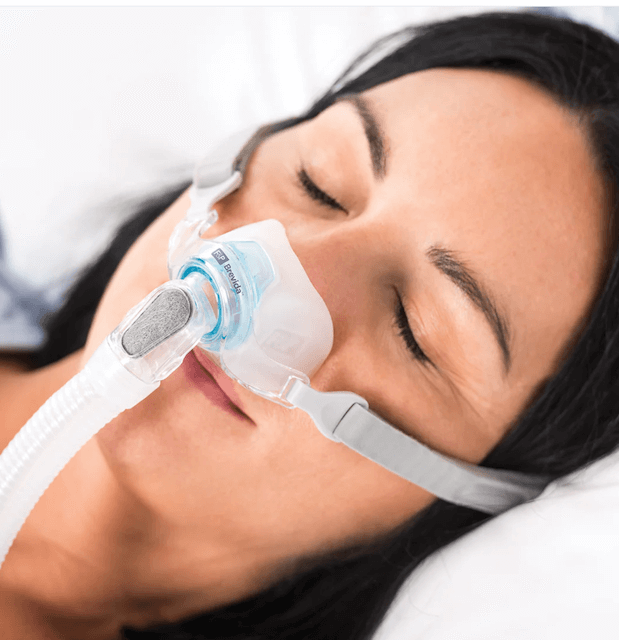
The single best preparation, and the thing I would do differently if I started over, is wearing the mask awake before you ever try to sleep in it. Sit on the couch, put the mask on with the machine running, watch television for half an hour. Both the Sleep Foundation and ResMed recommend this. It teaches your nervous system that the pressure on your face and the air on your nose and mouth are not a threat. By the time you lie down, your brain has stopped flagging the equipment as foreign.
I did not do this. Nobody told me to. I am a chronic mouth breather, so I went straight to a full face mask, switched the machine on, and tried to sleep. It worked out, but it could just as easily not have. If your supplier did not walk you through awake practice, do it yourself. Half an hour over a few evenings is enough.
While you are at it, get the ResMed myAir app, or whichever manufacturer app matches your machine, set up on your phone. Pair it before night one. The reason is not the gamification, although the green ticks and weekly score do nothing but help. The reason is that on the morning after a rough night, you will want to see what actually happened. Was the mask leaking? Did the pressure spike? The data is right there.
Mask leaks were my first real problem

Of everything I struggled with in the early days, mask leaks were the most disruptive. The seal would break in the middle of the night, a jet of air would hit my eye, and I would wake up disoriented and irritated. With a full face mask this is the most common failure point because the cushion has to seal against a much larger area of your face.
A few things help. First, fit the mask while lying down with the machine running, not standing up at the bathroom mirror. ResMed’s own guidance is explicit about this. The cushion changes shape under pressure, and the seal you set sitting up is not the seal you get when your face is flat on a pillow.
Second, if you are a side sleeper, the side of the mask compresses against the pillow, and that compression is what breaks the seal. A dedicated CPAP pillow with cutouts is a small purchase that fixed this for me. So did paying attention to how loose the headgear actually needed to be. My reflex was to tighten the straps to stop the leak, but a mask cinched too tight leaks worse, not better, because it deforms the cushion.
Third, if leaks are still waking you up after a week of careful fitting, the mask might not be right for your face shape. There is no shame in going back to your supplier and asking to trial a different size or model. I have written a longer piece on why CPAP masks leak that covers this in more detail.
Strap marks and skin irritation
Every morning in my first week, I had two red lines running down my cheeks from the headgear straps, and a deep groove across the bridge of my nose. The lines faded by lunchtime. The nose groove did not, for a while.
This is almost always a symptom of straps that are too tight. The pattern is predictable. The mask leaks, you tighten the straps to stop it, you sleep, you wake up creased. The fix is counterintuitive. You loosen the headgear in small increments and check the seal again while lying down. A properly fitted mask sits on your face with very little tension. The cushion does the sealing, not the straps.
For irritation on the bridge of the nose or the cheeks, a mask liner is worth trying. These are thin fabric covers that sit between the silicone cushion and your skin. They are cheap, they are washable, and for some people they make the difference between tolerable and unbearable. I have a guide to the best CPAP mask liners if you want specifics, and a separate piece on preventing the strap marks themselves.
If the skin under the cushion is breaking out, that is a hygiene problem, not a fit problem. The mask cushion picks up oil from your skin every night. Wash it daily with mild soap and water, let it dry fully, and the breakouts almost always clear up.
When the pressure feels too strong
My initial pressure setting was higher than it needed to be, and for the first few nights it felt like trying to breathe out against a wind tunnel. This is a normal early experience and it is also one of the most common reasons people quit. Both ResMed and the Sleep Foundation call out pressure intolerance specifically as a reason new users abandon therapy.
There are three useful responses.
The first is the ramp feature, which most modern machines including the AirSense 10 have built in. Ramp starts your pressure low and builds up over the first twenty to forty minutes, by which time you are usually asleep. I cannot remember whether I used ramp during my own adjustment, which probably tells you how mild a problem it was once I got past the first week. But it is a setting worth knowing about and worth turning on if exhaling feels difficult at the prescribed pressure.
The second is expiratory pressure relief, or EPR, which drops the pressure slightly each time you breathe out so you are not pushing against the full inhalation pressure. On the AirSense 10 it is in the comfort menu. Talk to your supplier before changing it.
The third, and the one that mattered for me, is that the pressure prescription itself can be wrong. After a couple of weeks of feeling like the pressure was set too high, I went back and asked for a review. They adjusted it, and I never thought about pressure again. If the setting feels wrong after a fair trial, it might actually be wrong. There is a piece I wrote on CPAP pressure settings with more detail.
The “I woke up without my mask on” problem
This one is strange and a little funny. In the first week, on at least two nights, I woke up and the mask was not on my face. It was on the pillow next to me. I had no memory of taking it off. My wife confirmed she had not done it.
This happens because some part of your sleeping brain treats the mask as a threat and gets rid of it. It happens to a lot of people, especially in the first month. The fix is not willpower, because you are asleep when it happens. The fix is more awake time with the mask on during the day, so that your brain learns the mask is safe. The same daytime practice I recommended for first night nerves also helps with mask removal. If it is still happening after a few weeks, talk to your clinic, because it can sometimes indicate the pressure is too high.
Build a routine that does not give you an out
By the end of week two, my mask was just part of getting ready for bed. Brush teeth, glasses off, mask on, machine on, lights out. The routine itself is what made it stick. If putting the mask on is a decision you have to make every night, some nights you will decide not to. If it is part of the routine, you do not decide. You just do it.
A small thing that helped me is keeping the machine permanently set up on the nightstand. It is plugged in, the hose is laid out, the humidifier is filled. There is no setup step at bedtime, because the setup is already done. The cost of starting therapy each night is as close to zero as I can make it.
Use the data
I check the myAir app most mornings. Not every morning. Most. The number I care about is the AHI, which is the residual apnea events per hour while the machine is running. Mine sits low, usually in the one to two range. When it ticks up, I know something has changed, usually a mask seal issue or a cold throwing off my breathing.
For the first month, I would recommend checking the app every morning. You are learning the signals. After that, you can drop to weekly or just when something feels off. The other useful number is mask seal. If that score is dropping, you have a fit problem brewing.
There is more advanced software called OSCAR that some users prefer for deeper analysis. I have considered installing it. I never have. The manufacturer app has been enough for me.
Humidification and the hose
One thing I did not anticipate is how much the humidifier matters. Without it, the air the machine pushes is extremely dry, and after a few hours your throat and nose feel like sandpaper. Most modern machines include heated humidification and a heated hose. Use them. Adjust the level if you wake up with a dry mouth or, conversely, with water pooled in the hose. Water in the hose is called rainout, and I have a separate piece on preventing CPAP rainout if you keep hitting it.
In Perth, where I live, summers are dry enough that I run the humidifier on a higher setting, and winters are wetter so I drop it. You will figure out your own pattern.
When to call your sleep clinic
There is a category of CPAP problems that you cannot fix on your own. Pressure that feels wrong after weeks of consistent use. A mask that leaks no matter what you do. Persistent headaches in the morning. Bloating that feels like trapped air. Any of those is a reason to call your sleep doctor or your equipment supplier. They have seen all of it, and they can adjust your prescription, swap your mask, or refer you for a re-titration study.
I have a piece on troubleshooting common CPAP problems that covers the most common ones in more depth. The piece on overcoming CPAP anxiety is the right one if the issue is psychological rather than mechanical.
A few questions I get asked
Is the CPAP machine loud?
No. The AirSense 10 in particular is essentially silent at sleeping distance. You can hear the air moving through the mask if the room is otherwise quiet, but it is not a noise problem. My travel machine, the ResMed AirMini, is a little louder because of how small it is, but still well under the level of a normal fan. I have a piece on the quietest CPAP machines if this is a concern.
Are CPAP machines bad for you?
No. They are net positive by a wide margin for anyone with diagnosed sleep apnea. Untreated sleep apnea is associated with serious cardiovascular and metabolic consequences. CPAP therapy is the most studied and most prescribed treatment for it. There are real comfort tradeoffs in the first weeks, which this entire page has been about, but the alternative is not treating the condition. I would rather sleep with the mask on than go back to what my mornings felt like before diagnosis.
Will I ever sleep without it again?
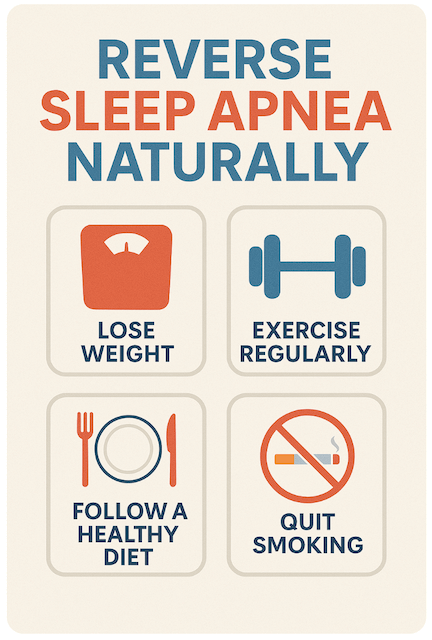
Probably not, and that took some getting used to mentally. For people with severe sleep apnea, CPAP is a long term treatment, not a phase. There are a small number of cases where significant weight loss or surgery changes the prescription, but for most of us this is the routine now. More than a decade in, I do not think about it.
The short version
Use the machine every night. Wear the mask awake before you sleep in it. Fit it lying down. Loosen the straps until they only just hold. Use the ramp feature if the pressure is hard at first. Check the app for the first month so you learn the signals. Call your clinic if anything still feels wrong after a fair trial. Most people adapt within ninety days. Some, like me, adapt faster. The variable is consistency, not willpower.
If you have not been formally diagnosed yet, a CPAP sleep study is the right place to start. If you are weighing equipment, I keep an updated list of the best CPAP machines and the best CPAP masks I have researched.
⚠️ MEDICAL DISCLAIMER This blog provides general information only and is not a substitute for professional medical advice, diagnosis, or treatment. Sleep apnea is a serious condition, and CPAP equipment should be used under proper medical supervision. Always consult your doctor or sleep specialist before starting, stopping, or changing any therapy. I share personal experiences as a CPAP user, not as a medical professional. Individual results vary. For medical guidance, please consult a qualified clinician or the American Academy of Sleep Medicine (aasm.org).