Genio for Sleep Apnea: A Researched Guide to the Nyxoah Implant

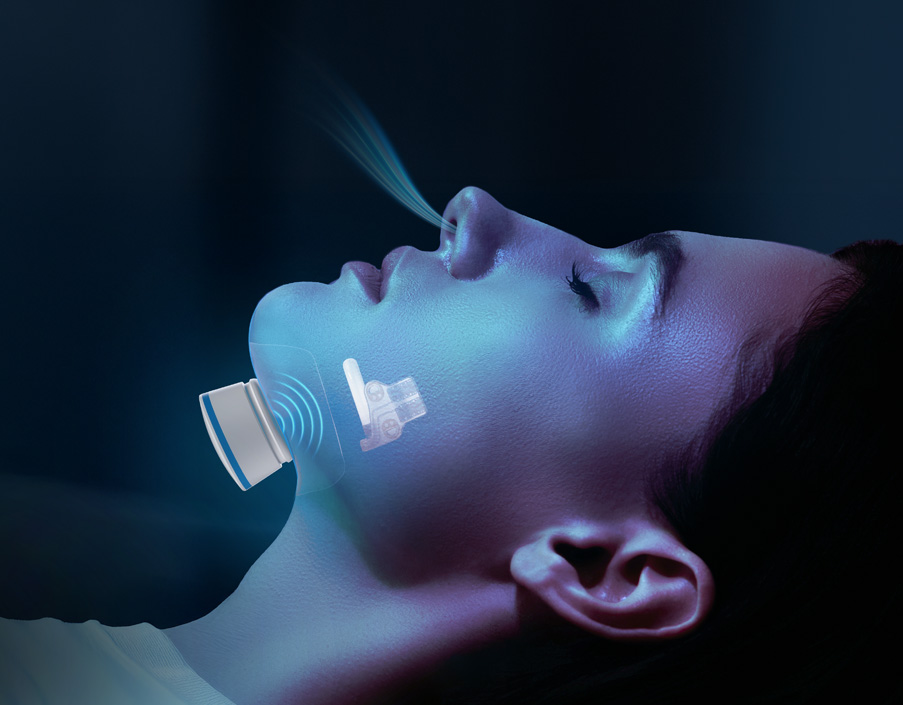
A quick word about who is writing this. I am a long-term CPAP user, not a doctor. My background is in computer science, and what I bring to a topic like this is the patient side of the experience and a habit of reading carefully before I form an opinion. I have used a ResMed AirSense 10 for the better part of a decade to manage severe obstructive sleep apnea, and that machine has worked for me. I have not had the Genio implant. This article is not a review of living with the device, because I have no firsthand experience of it to offer. It is a researched explainer, written for people who have started seeing the name Genio and want a clear, honest account of what it is.
The reason Genio is suddenly in the conversation is simple. In August 2025 the United States Food and Drug Administration approved the Genio system, made by the Belgian company Nyxoah, for a defined group of people with obstructive sleep apnea. It had already been in use in Europe for several years before that. An FDA approval tends to bring a treatment into wider view, and a lot of people who have struggled with CPAP are now asking whether this is something worth raising with their doctor.
If you want the story of how I came to sleep apnea treatment in the first place, that lives on my living with sleep apnea page. This article stays focused on Genio: what it is, how it works, who it is designed for, what the research shows, how it compares to the older implant most people have heard of, and what it is likely to cost.
What the Genio system actually is
Genio is a type of treatment called hypoglossal nerve stimulation. The hypoglossal nerve is the nerve that controls the movement of the tongue. In obstructive sleep apnea, the airway collapses during sleep, and a major part of that collapse is the tongue and surrounding soft tissue falling back into the throat. CPAP solves this by pushing a steady column of pressurized air down the airway to hold it open. Hypoglossal nerve stimulation takes a different route. Instead of forcing the airway open from the outside, it gently activates the muscles that should be holding it open from the inside. I have a broader explainer on the general approach on my hypoglossal nerve stimulation page, and this article is the device-specific companion to it.
Genio is made by Nyxoah, a medical technology company based in Belgium. The FDA approved it for adults with moderate to severe obstructive sleep apnea, specifically those with an apnea hypopnea index between 15 and 65. The apnea hypopnea index, usually shortened to AHI, is the number of times your breathing is interrupted per hour of sleep, and it is the standard measure of how severe sleep apnea is. If you are not familiar with that number, I explain it in more depth on my AHI page. The professional body for sleep medicine in the United States, the American Academy of Sleep Medicine, covered the approval and the supporting trial data, and that is a useful neutral source if you want to read further.
The single most important thing to understand about Genio, and the thing most people find confusing at first, is that it is a two part system. One part is implanted and stays in your body. The other part is external and is worn only at night. How those two pieces work together is worth seeing rather than just reading, so the diagram below shows the arrangement.
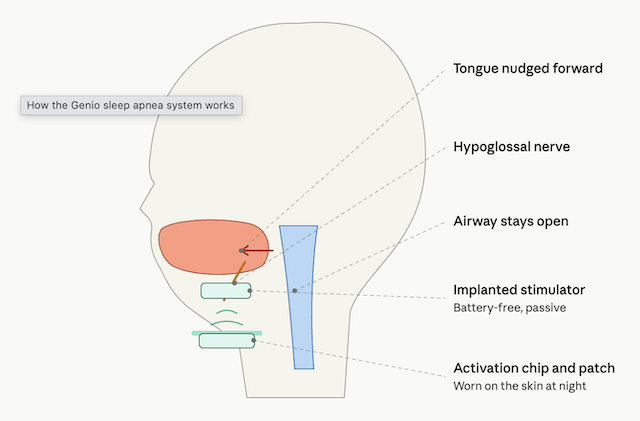
How Genio works
The implanted part is a small stimulator placed under the chin. The surgery is done under general anesthesia and requires only a single small incision in the area below the chin. The implant is positioned so that it sits against both branches of the hypoglossal nerve, which is why Nyxoah describes Genio as delivering bilateral stimulation. It treats both sides of the tongue at once.
What makes the implant unusual is what it does not contain. It has no battery and no leads running through the neck or chest. It is a passive device. On its own, it does nothing. That is where the second part comes in.
The external part is a small activation chip, around 12 grams in weight, attached to a disposable adhesive patch. Before sleep, you place the patch on the skin under your chin and connect the chip. While you sleep, the chip powers the implant wirelessly through the skin and delivers the stimulation. Each morning you remove the chip, discard the used patch, and put the chip on its charger for the day. The settings that control the stimulation are programmed by your doctor and stored in the chip, and there is a smartphone app that lets you turn the system on at bedtime, turn it off in the morning, and make small comfort adjustments within limits your doctor sets.
There is a waiting period built into the process. The implant is not switched on straight away. After the surgery, there is a healing period of roughly two months before the system is activated and the stimulation settings are fine-tuned, often with the help of a follow-up sleep study.
This British ENT Surgeon gives a great explanation of how Genio works.
When the system is working, the effect during sleep is a small, repeated forward movement of the back of the tongue. That keeps the tongue from sliding back and blocking the airway, which is the core mechanical problem in obstructive sleep apnea.
Who Genio is for
This is where honesty matters most, because Genio is not a first-line treatment and it is not for everyone with sleep apnea. CPAP remains the standard first treatment for obstructive sleep apnea, and for good reason. It is highly effective, it involves no surgery, and it can be stopped at any time. Genio sits further along the path, among the alternative treatments for sleep apnea that become relevant when CPAP has genuinely not worked out.
The approved group is people with moderate to severe obstructive sleep apnea, with an AHI between 15 and 65, who have failed, refused, or cannot tolerate positive airway pressure therapy such as CPAP. Beyond that, candidacy is decided by a specialist. Two gates matter. The first is a sleep study to confirm the diagnosis and severity. The second is usually a procedure called drug-induced sleep endoscopy, in which a doctor examines how your airway collapses while you are sedated. Hypoglossal nerve stimulation works best for certain patterns of collapse, and the endoscopy is how a surgeon checks whether your particular anatomy is a good fit. Body weight is also part of the assessment, since the therapy has been studied mainly in people who are not significantly overweight.
I will be direct about my own position here, because I think it is the honest thing to do. My AHI at diagnosis was 51, which sits inside the range Genio is approved to treat. But I have never had any practical reason to pursue an implant, because CPAP has worked for me. I am a chronic mouth breather, I settled quickly on a full face mask, and the therapy has done its job for years. That is the situation Genio is not aimed at. It is aimed at the people for whom that sentence is not true.
What the evidence shows
The FDA approval was based on a clinical study called the DREAM trial. The headline numbers are reasonably strong. The trial reported a median reduction in AHI of around 70 percent, and that 82 percent of participants brought their AHI below 15, which is the threshold between moderate and mild sleep apnea. It also reported a meaningful improvement in oxygen desaturation, and, notably, that the therapy was effective regardless of sleeping position, including when people slept on their back, which is usually the worst position for airway collapse.
Those are good results, and they are the basis on which the device was approved. They are not a promise. As with any sleep apnea treatment, including CPAP, results vary between individuals, and no implant guarantees that every apnea event disappears for every patient. If you want a grounded discussion of why sleep apnea is managed rather than cured, I cover that on my can sleep apnea be cured page. For a neutral, general overview of how hypoglossal nerve stimulation works and what recovery involves, the Sleep Foundation has a clear summary.
Genio compared to Inspire
If you have read anything about implanted sleep apnea treatments before, the name you probably know is Inspire. It is worth understanding the relationship because it explains a lot about where Genio fits.
Inspire is the older and more established device. Its form of upper airway stimulation was approved by the FDA back in 2014, which means it has more than a decade of real world use and a deeper body of long-term data behind it. I have a dedicated page on Inspire sleep apnea treatment if you want the detail. Genio is the newer arrival, and it was designed differently. Both devices stimulate the hypoglossal nerve, but the way they do it, and the way they sit in the body, are not the same.
A few differences are worth knowing. Inspire stimulates one side of the tongue, while Genio stimulates both. Inspire is a fully implanted system, with a generator placed in the chest, a sensing lead, and a stimulation lead, broadly comparable to having a small pacemaker-style device fitted. Genio has no implanted generator and no battery in the body at all, since the power comes from the external chip worn at night. That difference has a practical knock-on effect. An Inspire generator runs on an implanted battery that will eventually need a further surgical procedure to replace. Genio avoids that, because the part that holds the battery is the external chip, which is also designed to be upgradable. The placement differs too. Inspire involves a chest incision, while Genio uses a single incision under the chin. Inspire also senses your breathing and times each pulse to your breathing cycle, whereas Genio delivers a fixed pattern of stimulation rather than tracking each breath.
The fair and honest summary is this. There has been no large head to head trial directly pitting the two devices against each other, so it would be wrong to tell you one is simply better. Both are FDA approved, both have shown solid effectiveness in their own trials, and the right choice for any individual comes down to anatomy, lifestyle preferences, and the surgeon’s assessment. The trade off most people are really weighing is the convenience of having nothing to wear at night, in Inspire’s case, against the absence of an implanted battery and the bilateral approach, in Genio’s case.
What Genio costs
The cost question is the one I am most careful with, because there is no clean published price tag, and inventing one would not help anyone.
Genio is a covered medical procedure rather than a consumer product you buy off a shelf. For eligible patients it is covered by most major insurers in the United States, including Medicare. What is publicly documented is not a patient price but a reimbursement figure, which is the amount a hospital or surgery center is paid for the procedure. Recent Medicare figures put that facility reimbursement in the region of forty five thousand dollars for the hospital outpatient setting, and somewhat lower in an ambulatory surgery center. Those numbers are set by policy and are revised periodically, so treat them as a rough indication of scale rather than a fixed price.
What you would actually pay out of pocket is a different question entirely, and it depends on your insurance plan, your deductible, your coinsurance, and whether your surgeon and facility are in network. There is no way for me, or for any general article, to give you a personal number. The only reliable answer is to confirm coverage with your own insurer and to ask the surgical practice for a cost estimate specific to your plan before you commit to anything.
Where Genio fits if you already use CPAP
I want to close with a perspective rather than a recommendation, because a recommendation is not mine to give.
CPAP is still the most studied, lowest risk, and most flexible treatment for obstructive sleep apnea. It involves no surgery and nothing permanent, and if it does not suit you, you can stop. An implant is a genuine commitment. It involves an operation, a recovery period, and a device that stays in your body. None of that means it is the wrong choice, because for the right person it can change everything. It simply means the decision deserves more weight than swapping a mask or trying a new machine.
If you are struggling with CPAP, the honest first step is usually not to look for an alternative but to find out whether the struggle can be fixed. A great many CPAP problems, such as mask leaks, pressure that feels wrong, a dry mouth, or plain discomfort, are solvable, and people abandon therapy over issues that did not need to end it. I have written about getting through that difficult early stage on my getting used to CPAP therapy page, and choosing the right machine matters too, which is what my best CPAP machines guide is for. Genio becomes a sensible thing to explore when you have made a real effort with CPAP and it has genuinely not worked, not when you have hit the first rough patch.
The bottom line
Genio is a real, FDA-approved treatment for moderate to severe obstructive sleep apnea, built around a battery-free implant under the chin and an external chip worn at night. It is aimed squarely at people who cannot get on with CPAP, it has solid trial results behind it, and it joins Inspire as the second hypoglossal nerve stimulation option available in the United States. It is newer, designed differently, and worth understanding on its own terms.
What it is not is a decision you make from a blog post. If anything here has made Genio sound like it might be relevant to you, the right next move is a conversation with a sleep specialist or an ear, nose and throat surgeon who can look at your sleep study, your anatomy, and your history with CPAP, and tell you whether you are genuinely a candidate.
⚠️ MEDICAL DISCLAIMER This blog provides general information only and is not a substitute for professional medical advice, diagnosis, or treatment. Sleep apnea is a serious condition, and CPAP equipment should be used under proper medical supervision. Always consult your doctor or sleep specialist before starting, stopping, or changing any therapy. I share personal experiences as a CPAP user, not as a medical professional. Individual results vary. For medical guidance, please consult a qualified clinician or the American Academy of Sleep Medicine (aasm.org).