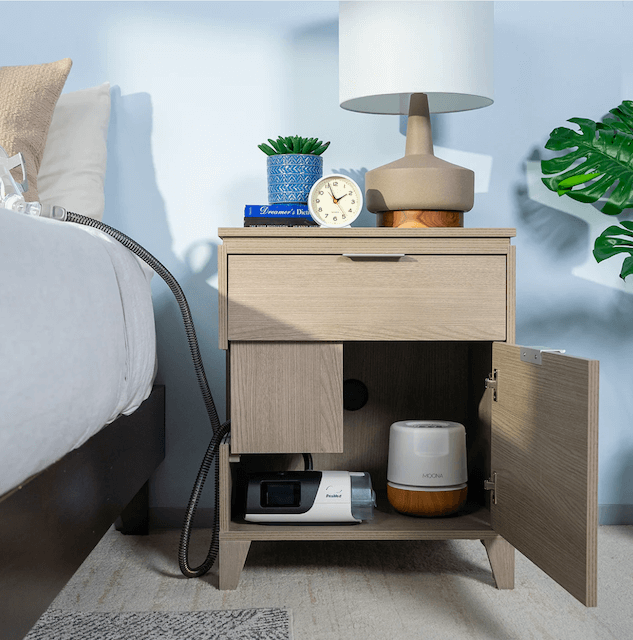
Best CPAP Battery: For Camping, Travel & Power Cuts

“This post contains affiliate links. I may earn a commission if you buy through these links at no extra cost to you. Read my Disclaimer for more details.”
That’s me on top of the bus, back right in the blue t-shirt, somewhere in Western Australia, 2001.

I’d joined a camping expedition across the state, and I was loving every minute of it — except the nights. Back then, I had no idea I had sleep apnea. I just knew I snored so badly that I’d made myself a social problem in any shared sleeping situation. I’d pitched my tent as far from everyone else’s as I reasonably could. I’d been doing that version of pre-emptive embarrassment management for years.
I remember a school camp years earlier where another kid threw a hiking boot at me in the night because my snoring was so loud. The memory is equal parts funny and mortifying, and it captures exactly the calculation I was making every time I booked a trip — how do I minimise the damage? Separate tent. Back of the bus. Far corner of the hostel dorm.
By the time I was diagnosed in 2014, camping felt like something that belonged to an earlier version of my life. Then I started CPAP therapy and realised the actual problem wasn’t that I was incompatible with the outdoors — it was that I’d been undiagnosed for years and now needed a machine that required mains power. A different, but solvable, problem.
My primary motivation for buying a CPAP battery wasn’t camping at first. It was long-haul flights to Europe. I’d done those trips before my diagnosis, trying nose strips and throat sprays and every other thing that doesn’t work for actual sleep apnea, arriving exhausted and spending the first day of every trip in recovery. I wanted to sleep on the plane properly, and that required portable power.
I bought the Medistrom Pilot-24 Lite at the same time as I bought my ResMed AirMini travel machine, and it’s been on every trip since — long-haul flights, camping, weekends in places where I couldn’t guarantee a power outlet near the bed. Getting back to sleeping outdoors without being a nuisance to anyone around me was something I hadn’t fully appreciated until it was actually possible again.
The other two options on this list are for Philips and Transcend users — I’ve researched them carefully but haven’t used them personally, and I’ll say so clearly in each section.
Quick picks:
| Your machine | My recommendation |
|---|---|
| ResMed (AirSense 10, 11, AirMini) | Medistrom Pilot-24 Lite |
| Philips DreamStation | Philips Respironics Travel Battery Kit |
| Transcend Micro | Transcend PowerAway Battery |
Medistrom Pilot-24 Lite — Best for ResMed Users
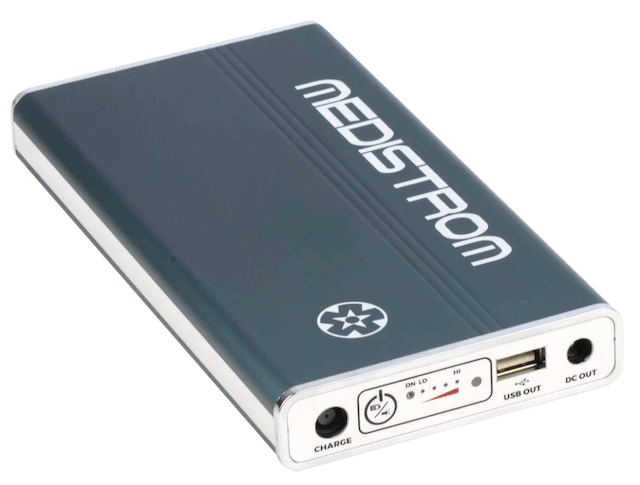
This is the battery I use and the one I’d recommend without hesitation to any ResMed machine owner.
The practical reality of the Pilot-24 Lite is that it gives you two full nights of sleep on one charge without the humidifier running, or a solid single night with humidification. For most travel scenarios, that’s exactly what you need. The 95Wh capacity is substantial without the battery being heavy — it weighs 1.3 pounds and fits neatly in the front pocket of my CPAP travel bag, sitting alongside the AirMini without adding awkward bulk.
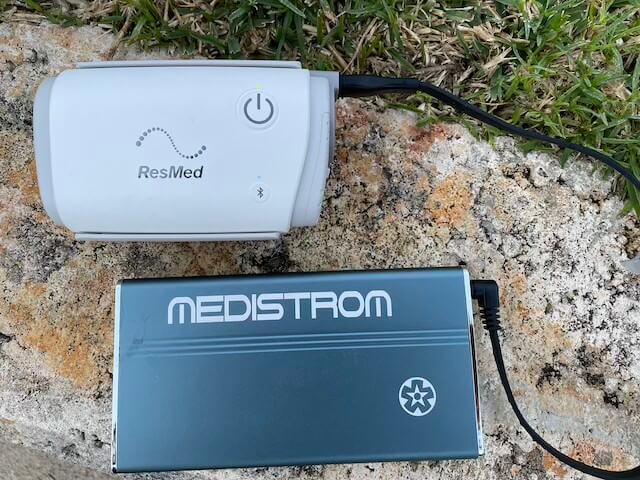
FAA compliance matters if you’re flying. You can use it on the plane, which is what I bought it for in the first place. There’s also a USB port that charges your phone overnight alongside the CPAP — a small convenience that turns out to be genuinely useful when you’re somewhere without easy power access. The built-in LED flashlight earns its place in a tent at 2 am when you don’t want to wake anyone by turning on a main light.
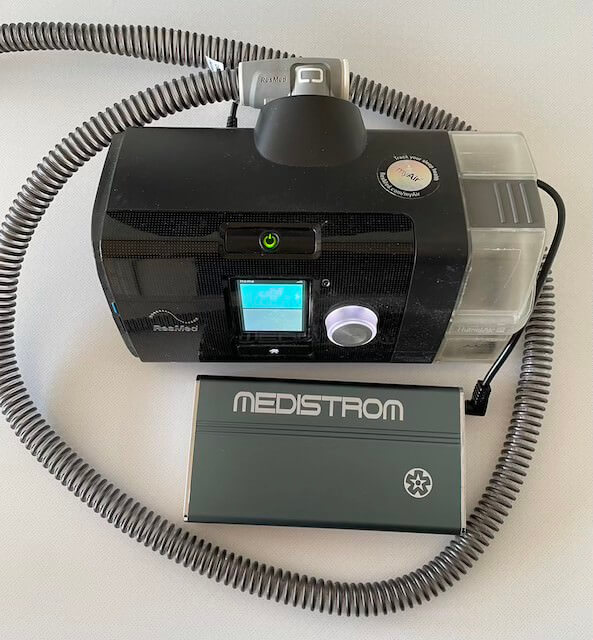
Compatibility covers the ResMed AirSense 10, AirSense 11, AirMini, and S9, along with several other brands, including the Philips DreamStation Go, 3B Medical Luna, and Apex Medical iCH. It’s not compatible with the ResMed AirCurve BiLevel and ASV machines — if you use one of those, you’ll need a different power solution.
One practical note worth knowing before you travel: it doesn’t come with its own charging cable. You charge it using the 20W AC charger that came with your ResMed device.
Philips Respironics Travel Battery Kit — Best for Philips Users
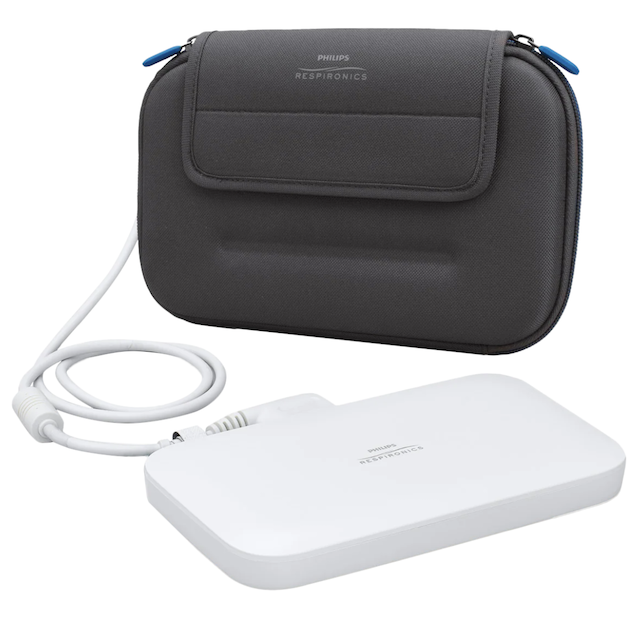
I don’t use a Philips machine, but if you do, the manufacturer’s own battery kit is the natural starting point — it’s designed specifically for the machine it powers, which avoids the compatibility questions that come with third-party options.
The kit covers the DreamStation and DreamStation 2 and functions both as a portable battery and as an uninterruptible power supply, meaning it keeps your machine running through a home power cut without any manual switching. The FAA approval means it travels without issue, and the LED charge indicators show your remaining power at a glance.
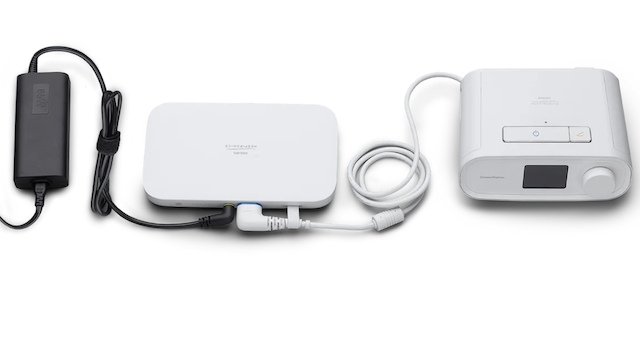
Runtime sits at around 14 hours on standard settings without humidification, which comfortably covers a full night. It’s slightly heavier than the Medistrom at 2.25 pounds — worth knowing if you’re watching pack weight — but within a reasonable range for the capacity it provides.
Transcend PowerAway Battery — Best for Transcend Micro Users
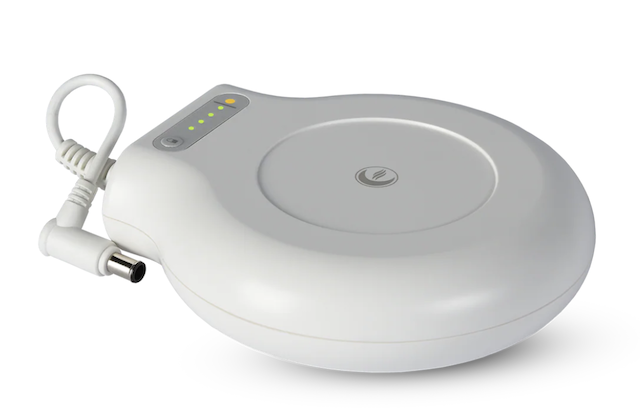
The PowerAway is the dedicated battery solution for the Transcend Micro travel CPAP, and the integration between the two is the main selling point. It uses your existing Transcend Micro power supply to charge, which means no additional cables to pack — everything works from what you already carry.
Runtime of up to 17.5 hours without humidification is strong for the size and weight, and solar charging compatibility is the distinguishing feature for serious off-grid campers. If you’re taking a portable solar panel, this battery connects to it directly — which for longer camping trips where recharging daily is part of the plan, is a genuinely useful capability. The 1,000-cycle battery life is notably higher than many alternatives, which matters for the long-term cost calculation if you travel or camp regularly.
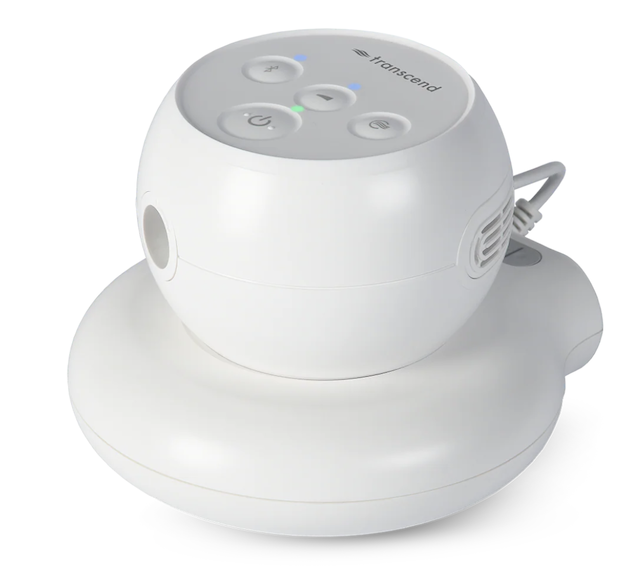
One important note: the battery doesn’t come with its own power supply. You need to use the one included with the Transcend Micro, or purchase a spare separately if you want a dedicated charging setup just for the battery.
What to Consider When Choosing a CPAP Battery
Compatibility is the most important starting point and the one most worth checking carefully before buying. CPAP batteries are designed around specific voltage requirements, and not every battery works with every machine. The safest approach is matching the battery to your machine brand — which is exactly how this list is structured.
Runtime matters differently depending on your use case. For camping you want at least two nights per charge without humidification, because recharging daily defeats much of the purpose. For flights and hotel stays where power is available but inconvenient, a single night’s runtime is sufficient. Most batteries deliver noticeably less with humidification running — typically 30 to 50 percent less — so if you rely on a heated humidifier, factor that into your expectations before buying.
FAA compliance is non-negotiable for air travel. All three batteries on this list are FAA approved, meaning they can be carried in hand luggage and used in flight. The FAA’s guidelines for portable medical electronic devices are worth bookmarking if you travel frequently — they cover the watt-hour limits and in-flight usage rules in plain language.
Weight is meaningful for camping and backpacking in a way it isn’t for hotel travel. The Medistrom and Transcend are both under 1.5 pounds. The Philips kit is heavier at 2.25 pounds, which is worth knowing if you’re packing light.
One thing I didn’t anticipate before buying the Medistrom was how much the battery would change my relationship with travel more broadly. The anxiety I used to carry about sleeping in shared spaces — rooted in years of undiagnosed sleep apnea making me a disruption to everyone around me — has gradually been replaced by something closer to confidence. I sleep on planes now. I take camping trips without pitching my tent in a far corner. The machine and the battery together make that possible, and the freedom is worth more than the cost of either.
For the fuller picture on travelling with CPAP — TSA screening, international power adapters, what to do when hotel rooms have no outlet near the bed — I’ve covered it in detail in my complete guide to travelling with CPAP. The battery is one piece of that puzzle, and the piece that opens up everything that mains power can’t reach.
⚠️ MEDICAL DISCLAIMER This blog provides general information only and is not a substitute for professional medical advice, diagnosis, or treatment. Sleep apnea is a serious condition, and CPAP equipment should be used under proper medical supervision. Always consult your doctor or sleep specialist before starting, stopping, or changing any therapy. I share personal experiences as a CPAP user, not as a medical professional. Individual results vary. For medical guidance, please consult a qualified clinician or the American Academy of Sleep Medicine (aasm.org).