CPAP Machines for Women: A Researched Guide

Roughly one in eight to one in seven women in the United States has obstructive sleep apnea, yet most CPAP equipment was originally designed and tested with male patients in mind. That gap matters. Women tend to experience sleep apnea differently from men, and a machine tuned around a larger man with classic loud snoring may not serve a smaller woman whose disordered breathing looks more like fatigue, insomnia, and morning headaches.
This guide walks through what actually changes when you choose a CPAP machine with a woman’s physiology in mind, what the “for Her” branding does and does not deliver, and which current models are worth a real look. It is researched rather than firsthand. I have used a ResMed AirSense 10 for the better part of a decade and have read a lot of the underlying clinical literature, but the “for Her” algorithm and smaller masks are not what I personally use, so I will not pretend to review them. What follows is what the research, the manufacturers, and a thoughtful sleep clinic conversation tend to surface.
Why women often need a different CPAP setup
Obstructive sleep apnea is the same basic disease in any body. The airway collapses or narrows during sleep, breathing stops or shallows, oxygen drops, and the brain rouses just enough to restart respiration. What changes between sexes is how the disease tends to express itself and what a polysomnograph picks up on the night of the study.
Peer reviewed research has consistently shown that women tend to have lower average apnea hypopnea index scores than men, shorter apneic events, and a higher proportion of partial airway closures called hypopneas rather than full pauses. Many women also experience what sleep clinicians call upper airway resistance episodes, where breathing becomes effortful and disrupts sleep without crossing the formal threshold that defines an apnea or hypopnea. The Sleep Foundation summarizes this pattern in its overview of sleep apnea symptoms in women, noting that snoring and daytime sleepiness, the symptoms men most often report, may be quieter or absent in women, while insomnia, morning headaches, mood changes, restless legs, and frequent nighttime urination are more common.
Hormones matter too. The National Heart, Lung, and Blood Institute notes that risk rises during pregnancy and around menopause, and that women with polycystic ovary syndrome have a higher baseline risk. Sleep apnea in pregnancy can become more severe in the third trimester and often improves after delivery. None of this is a niche detail. It changes who gets diagnosed, when they get diagnosed, and what equipment actually serves them once therapy begins.
For a deeper look at how the disease presents in women, see the companion post on sleep apnea in women. The rest of this page focuses on equipment.
What the “for Her” label actually means
When ResMed launched the AirSense 10 AutoSet for Her in 2013, the marketing came in a softer color and a softer name. The actual difference sat in the firmware. The standard AutoSet algorithm responds to airway events with a fairly aggressive pressure rise. The AutoSet for Her algorithm responds more gently, raises pressure in finer increments, and is tuned to handle the higher proportion of flow limitations and hypopneas that show up in female sleep studies. It also responds more readily to upper airway resistance events that the standard algorithm might miss or undertreat.
That is the real story. The lavender accents and the marketing language were always secondary. The clinically meaningful difference is a pressure response curve calibrated for the way many women’s airways tend to misbehave during sleep. ResMed has published evidence that the For Her mode improves REM sleep quality in female patients compared to the standard auto algorithm.
The newer ResMed AirSense 11 carries this forward in a cleaner way. There is no separate AirSense 11 For Her model on the shelf. Instead, both the standard AutoSet algorithm and the AutoSet for Her algorithm are built into every AirSense 11 AutoSet machine, and the user or their clinician can select the appropriate mode in setup. For most patients this is a more sensible arrangement than buying a gendered SKU. It also means a couple sharing a household can each set their machine to the algorithm that suits their physiology without buying two different products.
The current recommendation: ResMed AirSense 11 AutoSet
If you are shopping right now, the AirSense 11 AutoSet is the machine I would point a woman toward as a default starting place. It is the current ResMed flagship, it includes the For Her algorithm built in, and the broader feature set including the integrated humidifier, the myAir app, the touchscreen, and over the air firmware updates is genuinely better than the older AirSense 10. For my full notes on the machine itself see the ResMed AirSense 11 AutoSet review. It sits at the top of my best CPAP machines list for a reason.
The AirSense 10 AutoSet for Her is still a good machine and still in service in many bedrooms. If your clinician offers you one, it is not a downgrade. The AirSense 11 simply consolidates the lineup, drops the explicit pink branding, and adds polish.
A note on how the algorithm choice gets set in practice. Most patients do not pick the algorithm themselves. The clinician or durable medical equipment provider does, based on the sleep study and the prescribed pressure range. If you are a woman starting CPAP and your provider hands over an AirSense 11 set in standard AutoSet rather than AutoSet for Her, it is worth asking why. Sometimes there is a good clinical reason, often there is not, and the decision is usually trivially reversible from the clinician menu. Knowing this exists is half the battle. You can ask for the For Her mode by name and most clinicians will know exactly what you mean. There is more general background on how machines deliver therapy on the CPAP machines overview page, and on how to read the data the machine produces on the AHI explainer.
Mask choice carries most of the comfort load
A machine sets the pressure curve. A mask decides whether you wear it for 30 nights or 30 minutes. For many women, the friction is not the machine at all. It is a full face mask sized for a larger jaw, headgear that catches and pulls hair, or a nasal mask that leaves marks across the bridge of the nose because the cushion was designed around a wider male nasal anatomy.
The good news is that the current generation of masks has thoughtful smaller sizes and softer headgear options that work well for many women. I have written a separate buyer’s guide that goes through the specifics in detail at best CPAP masks for women. The short version, with the standard caveat that fit is individual, looks something like this.
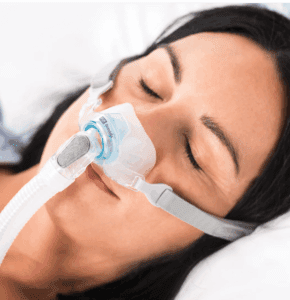
A nasal pillow mask such as the ResMed AirFit P10 for Her gets recommended by clinicians often, and for good reason. It is genuinely light, it has a smaller pillow size range from extra small through medium, and it does not press against the bridge of the nose. Many side sleepers prefer it for that reason alone. For women who breathe through their mouth at night, a full face mask is still the right tool, and current options like the ResMed AirFit F30 fit smaller faces better than the older Quattro line. If you are not sure whether you need a full face mask in the first place, the nasal versus full face mask comparison walks through how to decide based on whether you breathe through your mouth and how your jaw sits at night.
The single most useful thing to do here is push back if a fitting feels wrong. CPAP masks come in size ranges precisely because faces vary. A mask that leaks or leaves pressure marks on night one is not a mask you have to keep. Most equipment providers in the United States and Australia run a fit guarantee or a swap window in the first 30 days, and even after that period a different mask cushion is far less expensive than a new machine.
Travel, the AirMini, and a portable option
Many women travel for work or family more than they sleep in their own bed. A bedside CPAP with a full water chamber is not the right machine for that life. The ResMed AirMini is the same brand’s travel device, the size of a small paperback, and it pairs with the same kind of masks women already use, including a dedicated AirMini version of the AirFit P10. I use mine for trips where the AirSense 10 is too bulky to bring, and it has held up across a European holiday and several camping weekends. I have a longer write up at my AirMini travel review and a more general piece on traveling with CPAP if that is on your mind.
The AirMini does not have a built in For Her algorithm in the same form as the bedside machines, but it does run an auto adjusting mode and most prescribed pressure ranges translate cleanly. For women who already have a known therapy pressure range from a bedside AirSense, the AirMini becomes a sensible second device for travel rather than a primary therapy device.
What to ask your clinician at the first follow up
Equipment is only as good as the prescription that drives it, and the first appointment after a sleep study is the moment most people miss the chance to ask the questions that matter. A few worth raising.
What was my AHI on the sleep study, and how were hypopneas counted? Different scoring rules produce different numbers, and the answer matters for women whose disease often shows up as hypopneas rather than full apneas. A 4 percent desaturation rule will read lower than a 3 percent rule, sometimes meaningfully so.
Is the machine running the standard AutoSet mode or the AutoSet for Her mode? If you are female, ask specifically. The default at most clinics is the standard mode unless a patient or clinician requests otherwise.
Is the mask the smallest practical size? Sizing up because a larger size happened to be on the shelf is a poor trade. If the fitting kit only included a medium and a large, ask for a small to try as well.
Are we using EPR or pressure relief? Many women find that a small drop in pressure on the exhale makes therapy more tolerable in the first weeks. It is a comfort setting, not a therapy compromise, and it can usually be enabled without changing the prescribed pressure range.
What does my data look like after 30 nights, and which two or three numbers are worth tracking? Most users do well with a focus on AHI, mask leak rate, and usage hours. Anything more than that tends to be noise unless something specific is going wrong.
Adherence is the real game
Whichever machine and mask combination you end up with, the goal is the same. Use the device most nights, for most of the night, for years. The For Her tuning, the smaller mask sizes, and the gentler pressure response curves all exist because adherence is genuinely harder if the equipment does not fit your physiology. A machine that occasionally gets used is a machine that is not treating your sleep apnea, and untreated sleep apnea quietly accumulates cardiovascular and cognitive risk over time.
If the first setup is not working, the answer is rarely to push through. It is to call the clinic, swap the mask, adjust the algorithm, lower the ramp pressure, and try again. Most CPAP users who eventually do well with therapy failed at it once or twice in the first month. That is normal, not a sign that CPAP is wrong for you. The first few weeks are about troubleshooting, and the women I have heard from over the years who succeeded all had a clinician or supplier they could ring without it being a production.
Final word
The CPAP for women question is real, but most of the answer is not in pink trim. It is in algorithm choice, mask fit, and a clinician who takes the difference seriously. The current ResMed AirSense 11 AutoSet, with the AutoSet for Her algorithm enabled, paired with a properly sized mask such as the AirFit P10 for Her or a smaller full face option, is a sensible default for many women starting therapy. The harder part, which no buyer’s guide can do for you, is the fitting and the follow-up.
For a broader context on the wider machine landscape, see the main CPAP machines overview or the curated best CPAP machines shortlist. For mask specifics, the best CPAP masks for women page is the right next stop.
⚠️ MEDICAL DISCLAIMER This blog provides general information only and is not a substitute for professional medical advice, diagnosis, or treatment. Sleep apnea is a serious condition, and CPAP equipment should be used under proper medical supervision. Always consult your doctor or sleep specialist before starting, stopping, or changing any therapy. I share personal experiences as a CPAP user, not as a medical professional. Individual results vary. For medical guidance, please consult a qualified clinician or the American Academy of Sleep Medicine (aasm.org).