Should You Use Distilled Water for a CPAP?Lessons From Venice!

“This post contains affiliate links. I may earn a commission if you buy through these links, at no extra cost to you. Read my Disclaimer for more details.”
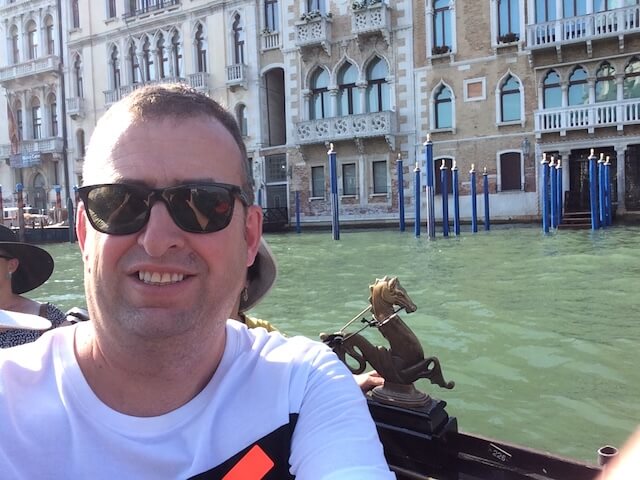
The hotel front desk in Venice didn’t have distilled water. It was eleven at night, I was tired, and the clerk wanted to help. He waved me toward the minibar and its row of green bottles instead.
San Pellegrino. Sparkling. Full of minerals. Carbonated. Just about the exact opposite of what goes in a CPAP humidifier.
I looked at the bottles, then out the window at the canal below, and figured the San Pellegrino was at least the cleaner of the two options on offer.
I didn’t use either one. I didn’t need to. After more than a decade of CPAP therapy and a lot of trips spent hunting for distilled water in unfamiliar cities, I’d already solved the problem before I ever landed in Italy. More on how in a moment.
This guide covers what you actually need to know about water for your CPAP: what counts as distilled water, what happens when you use the wrong type, how to handle it while traveling, and the one decision that took water out of my packing list for good.
Why Distilled Water Matters (More Than You Think)

(I did not use the San Pellegrino. Or the canal water.)
When I started CPAP therapy, nobody really explained the water. The clinic handed me a prescription and sent me on my way, and I assumed tap water would be fine. It’s safe to drink, after all.
That assumption misses the point. The reason has nothing to do with whether the water is safe in your stomach and everything to do with where it ends up.
When you drink tap water, your stomach acid handles most bacteria and your digestive system deals with the minerals without complaint. A CPAP humidifier works differently. It warms water and you breathe the moisture into your airway all night. Anything carried along with that moisture, minerals or microorganisms, takes a route into your body that your gut defenses never see.
This is not a fringe worry. The CDC has flagged how common, and how misunderstood, the habit is. In one national survey, about a quarter of people reported using tap water in their humidifiers or CPAP machines, largely because they didn’t realize tap water isn’t sterile. The same researchers noted that water quality directly affects the quality of the air a humidifier or CPAP aerosolizes, which is the whole argument for using distilled or sterilized water in these devices.
What Makes Distilled Water Different
Distilled water is made by boiling water into vapor and then condensing that vapor back into liquid in a separate container. The minerals, microorganisms, and dissolved solids stay behind. What you collect is close to pure H2O, with a total dissolved solids reading under one part per million. Ordinary tap water usually runs somewhere in the hundreds of parts per million.
That purity heads off three problems at once. It prevents the mineral scaling that clouds a humidifier chamber and shortens the life of your equipment. It denies bacteria the minerals and residue they feed on. And it keeps you from inhaling whatever chemical additives your local tap water happens to carry.
The Confusing One: Vapor Distilled Water
Walk into a store and you’ll see bottles labeled “vapor distilled water,” which sounds ideal, because vapor distillation is exactly how distilled water is made.
Here’s the catch. Some brands add minerals or electrolytes back in after distillation, for taste. That undoes the entire reason you wanted distilled water in the first place.
So the answer to “can I use vapor distilled water in a CPAP” depends on the label. If it’s pure vapor distilled water with nothing added, it works fine. If the label mentions added electrolytes or minerals, skip it. Those are precisely the dissolved solids that build up in your chamber.
When you’re checking a bottle, read the whole label, not just the front. Watch for phrases like “electrolytes added,” “minerals for taste,” or “enhanced with.” If a total dissolved solids figure is listed, you want it under one part per million. When the label leaves you guessing, plain distilled water is the safe call.
Alkaline Water Is a Bad Fit
I get asked about alkaline water often, and the short answer is no.
Alkaline water is close to the opposite of distilled. Distilled water has everything stripped out. Alkaline water has minerals deliberately added, things like calcium, magnesium, potassium, and bicarbonate, to raise the pH. Those additions may have a place in a drinking glass, that debate is for somewhere else, but in a humidifier they cause the same scaling and buildup as tap water.
Premium bottled waters marketed with added electrolytes fall in the same bucket. Good for hydration, wrong for your machine. As a rule, if water is labeled alkaline, enhanced, mineralized, or pH balanced, keep it out of your CPAP even if it started life as distilled water.
What Actually Happens With the Wrong Water
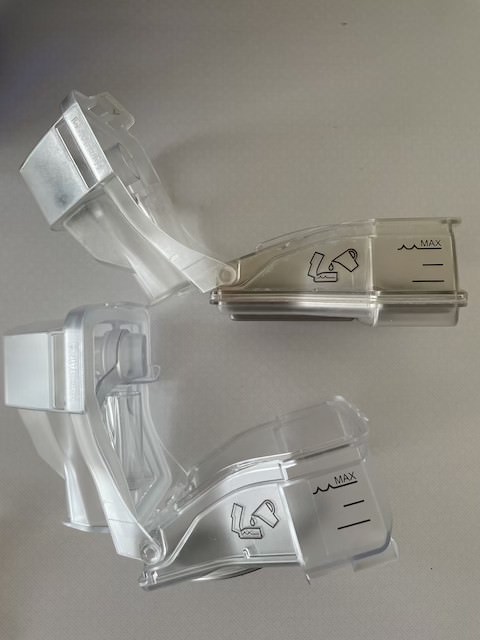
Use the wrong water and the consequences show up on a fairly predictable timeline.
In the first several days you’ll often see a thin white film forming in the chamber, sometimes a drop in humidity output as minerals coat the heating plate, and occasionally an odd taste or smell. Push it further, into the weeks, and the chamber turns genuinely cloudy in a way normal washing won’t fix, with visible scale on the heating elements and a machine that simply doesn’t humidify the way it used to. Over months and years the same minerals can shorten the life of your equipment, and many manufacturers are explicit that using anything other than distilled water can void a warranty.
The financial side is lopsided. Distilled water is one of the cheapest consumables in your whole setup. A scaled chamber, or worse a machine damaged early, costs many times more. There’s no real saving in cutting this particular corner.
Making Your Own Distilled Water
You can absolutely make distilled water at home, with caveats worth knowing.
The stovetop method needs only a large pot, an oven safe glass bowl that floats, ice, and tap water. You float the bowl in a partly filled pot, set the lid upside down on top, pile ice on the inverted lid, and bring the water to a boil. Steam rises, hits the cold lid, condenses, and drips off the center into the bowl. It works, but it’s slow, yielding only a cup or two an hour.
If you go through a lot of water, a countertop electric distiller is more practical, producing a gallon over several hours with little supervision. The output is comparable to what you’d buy.
The honest catch with homemade distilled water is consistency. Commercial water goes through quality control you can’t replicate at home, where you can’t easily test purity, your storage container might introduce its own contaminants, and a small slip can compromise the batch. Given how inexpensive store bought distilled water is, making your own rarely pays off unless you have a specific reason, like poor water access, to do it.
Distilled Water in the UK and Elsewhere
A common question is where to find distilled water for a CPAP in the UK, and the answer comes with an interesting wrinkle.
Some European suppliers take a more relaxed line, suggesting tap water can be acceptable where local water quality is high and cleaning is rigorous. The reasoning is that UK tap water is tightly regulated, with low bacterial counts and controlled mineral content, and that a properly working heated humidifier mostly aerosolizes vapor rather than the dissolved contents of the water.
There’s genuine debate here, and the research isn’t unanimous. My own view, after more than a decade, is that distilled water is simply the conservative choice. Even where tap water is clean, mineral scaling is still a real concern, and the cost of avoiding it is trivial.
If you’re shopping in the UK, distilled water turns up in pharmacies like Boots, in larger supermarkets, often shelved with ironing or steam appliance supplies, and through online retailers. It’s frequently labeled for irons or steamers rather than for medical use, but it’s the same product.
What About Cruises?
Cruise travel raises this question constantly, and the news is good. Most cruise lines will provide distilled water for CPAP users, often at no charge, as long as you arrange it ahead of time.
The process is usually the same across lines. You fill out the special needs or accessibility form on the cruise line’s website, well before you sail, note that you’ll be bringing a CPAP machine, and request distilled water. Some lines also let you request an extension cord, which is genuinely useful, since stateroom outlets tend to sit nowhere near the bed. The water is typically waiting in your cabin when you board, and if it isn’t, your stateroom attendant can usually sort it out.
You can bring your own as well, though rules vary by line. Most treat it as a medical necessity, generally want it in factory sealed containers, and prefer it in your hand luggage rather than checked. Given that many lines supply it for free, hauling your own often isn’t worth the effort.
Traveling With Distilled Water by Air
Air travel is where water gets genuinely awkward, thanks to liquid limits.
In your carry-on, you’re capped at the standard small container size that fits the quart bag, which is effectively useless for a night of therapy. Larger quantities have to go in checked luggage, sealed against leaks, ideally inside a plastic bag and padded with clothing. Even then, lugging full jugs through an airport is a chore.
There are saner ways to handle it. For domestic trips, the simplest is to skip packing water entirely and just buy a jug at a pharmacy or grocery store once you arrive, then leave whatever’s left when you go. For shorter trips, pre-sealed travel bottles of distilled water are easy to carry through security. For an extended stay in one place, some people ship distilled water ahead to their hotel or rental, though it’s worth calling first to confirm they’ll hold the package.
⭐ Top Pick: Snugell Distilled Water — 12-Pack (20 oz bottles)
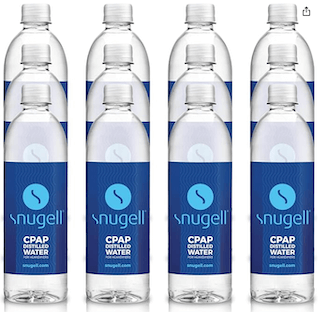
Perfect for travel or everyday use, these pre-sealed 20 oz bottles of distilled water are TSA-friendly, easy to pack, and ideal for keeping your CPAP machine safe from mineral buildup.
Buy on AmazonIf you’d rather buy pre-sealed bottles, Snugell sells distilled water in small travel-sized bottles that are easy to pack and don’t need measuring. I haven’t used these myself, because I stopped traveling with water altogether, which brings me to what I actually do.
How I Travel Now: No Water at All
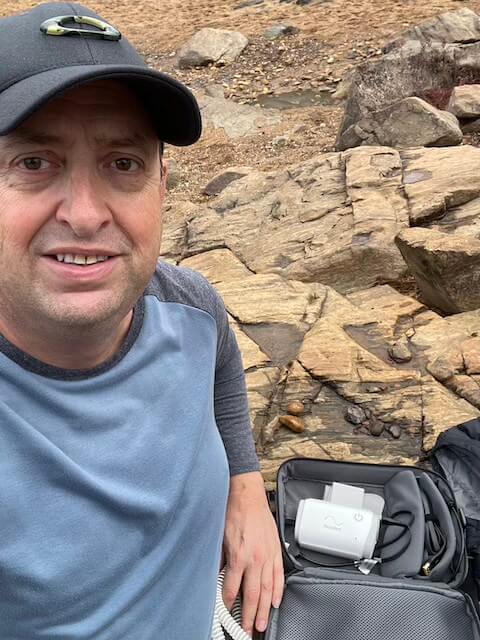
After enough trips spent tracking down distilled water in unfamiliar places, I changed my approach entirely. For travel, I switched to the ResMed AirMini, and it doesn’t use a humidifier. No water, no bottles, no late-night pharmacy runs, no standing in a Venice hotel lobby weighing San Pellegrino against the canal.
That’s the real punchline to the story at the top. The reason I could find the minibar suggestion funny instead of stressful is that my travel machine doesn’t ask anything of me on the water front. I pack it and go.
The honest tradeoff is dry air. Without a humidifier, the first couple of nights feel drier than you’re used to. My body adjusted within a few nights, and for travel I find it an easy trade. If you want the full reasoning behind running CPAP without a humidifier, I went into it separately in can you use a CPAP without water.
So my rule of thumb is simple. For a quick domestic trip, buying distilled water at the destination or carrying a few presealed bottles is fine. For anything longer, and certainly for international travel, going waterless with a travel machine takes the whole problem off the table.
Can You Use Bottled Water in a Pinch?
Sometimes you’re stuck, so it helps to know the rough order of preference.
Distilled water is the standard. Plain purified water, the bottled drinking kind, is a tolerable stand-in for a night or two, though it still carries trace minerals. Reverse osmosis water is better than tap but not as clean as distilled. Bottled spring or mineral water is a no, because high mineral content is exactly the problem you’re trying to avoid, and tap water is genuinely a last resort.
If you do have to improvise, look for labels that say purified or distilled, steer clear of anything marked spring, mineral, or alkaline, keep it to a night or two at most, and give your chamber a thorough clean, with a vinegar soak, once you’re back to your normal supply.
Cleaning the Humidifier Properly
Good water is only half the job. A humidifier is warm and damp, which is what bacteria want, so cleaning matters regardless of what you put in it.
Every morning, empty whatever water is left rather than topping it off, rinse the chamber with warm water, and let it dry fully before the next use. Standing water grows bacteria within hours, distilled or not, so this daily habit does more than people expect.
Once a week, wash the chamber with warm water and a mild, unscented dish soap, rinse it well to clear any residue, and let it air dry.
A periodic vinegar soak, say once a month, handles anything the routine washes miss. A solution of roughly one part white vinegar to three parts water, left to sit for twenty to thirty minutes and then rinsed with distilled water and dried, lifts mineral deposits, biofilm, and odors. If you’ve always used distilled water there may be nothing to lift, but it’s cheap insurance.
Components wear out on their own schedule too. Humidifier chambers, mask cushions, tubing, and filters all have replacement windows worth tracking, and using the wrong water tends to shorten them. I keep the full rundown in my CPAP replacement schedule guide and my notes on CPAP cleaning supplies.
A Few Common Questions
Can I just boil tap water instead? No. Boiling kills bacteria but leaves the minerals behind, and in fact concentrates them as water evaporates. You’ll still get scaling.
What about filtered or pitcher water? Not recommended. Home filters improve taste and remove chlorine, but most aren’t designed to strip minerals, so the buildup problem remains.
Is rainwater safe? No. Rainwater picks up dust, airborne pollutants, and organic matter, and isn’t suitable for a CPAP even after filtering.
What if I used tap water once? Don’t panic over a single night. Empty and clean the chamber the next morning, give it a vinegar soak, rinse with distilled water, dry it fully, and go back to your usual water. The trouble comes from making it a habit, not from one slip.
Does insurance cover distilled water? Generally no. It’s treated as a consumable, like soap or toothpaste. The upside is that it’s one of the least expensive things you’ll buy for your therapy.
Can I run my CPAP with no water at all? Yes. Turn off or remove the humidifier and the machine still delivers full therapeutic pressure. You’ll likely notice dryness in your mouth, throat, and nose, which is why most people keep the humidifier for home use. It’s also exactly how my travel machine works, and I cover the full picture in can you use a CPAP without water.
Why I Bother With Any of This
Distilled water can feel like a footnote next to everything else CPAP therapy asks of you. You’re already wearing a mask every night, adjusting to pressurized air, cleaning gear, and working to keep your therapy consistent. It’s easy to treat the water as the one corner you can cut.
What more than a decade has taught me is that the small things compound. “Just this once” with tap water becomes a habit, the chamber clouds, the machine starts to sound a little different, and the comfort that keeps you using therapy quietly erodes. The whole point of CPAP is to make sleep, and the day that follows, better. Mine carried an AHI of 51 at diagnosis along with brutal migraines, and therapy is what gave those nights back. Anything that protects that, even something as small as the water I pour into the chamber, is worth the trivial effort.
Is distilled water strictly medically required in every case? The evidence is genuinely mixed, and recommendations differ from one country to the next. But it’s the conservative, equipment-preserving choice, and it costs almost nothing. That’s an easy decision.
Keep your therapy effective, keep it comfortable, and let Venice keep its San Pellegrino.
⚠️ MEDICAL DISCLAIMER This blog provides general information only and is not a substitute for professional medical advice, diagnosis, or treatment. Sleep apnea is a serious condition, and CPAP equipment should be used under proper medical supervision. Always consult your doctor or sleep specialist before starting, stopping, or changing any therapy. I share personal experiences as a CPAP user, not as a medical professional. Individual results vary. For medical guidance, please consult a qualified clinician or the American Academy of Sleep Medicine (aasm.org).