Myofunctional Therapy for Sleep Apnea: What the Evidence Shows

Every few months a reader sends me some version of the same question. They have read about tongue and throat exercises that are supposed to strengthen the airway, and they want to know whether they can skip the CPAP machine and fix their sleep apnea with a daily routine instead. The exercises have a name, myofunctional therapy, and the promise behind them is appealing. No mask, no hose, no humidifier to refill. Just a few minutes of practice each day.
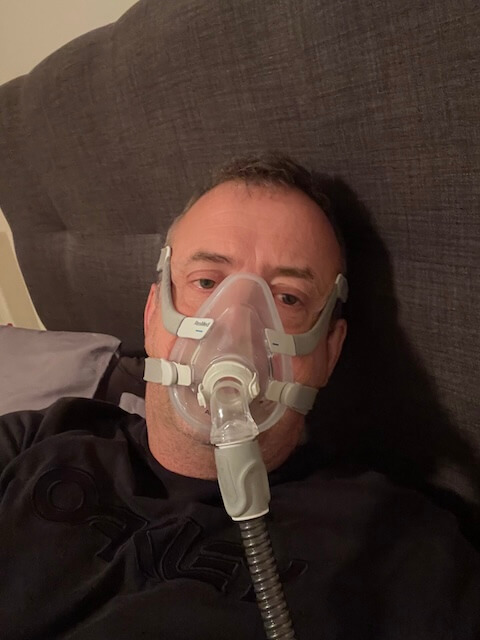
I want to be honest with you from the start about what I am and what I am not. My background is in computer science, not medicine, so nothing here is a treatment plan and none of it replaces a conversation with your own doctor. I have also never worked with a myofunctional therapist or followed one of these exercise programs myself. My sleep apnea was severe at diagnosis, with an apnea-hypopnea index of 51, and for someone in that range myofunctional therapy was never going to be the answer on its own. I have spent more than a decade on CPAP, and I still use my machine every night. So I cannot tell you what the exercises feel like over months of practice. What I can do is read the research carefully, lay out where it points, and tell you plainly where this therapy fits and where it does not.
That honesty matters more than usual on this topic, because the people writing about myofunctional therapy often have something to sell, whether it is a course, a clinic visit, or the idea that you can avoid CPAP entirely. I have no exercise program to push and no horse in that race. What I care about is that you understand what these exercises can realistically do.
What myofunctional therapy actually is
Myofunctional therapy, sometimes called orofacial myofunctional therapy or oropharyngeal exercise, is a structured set of exercises for the muscles of the tongue, lips, cheeks, soft palate, and throat. The goal is to improve the tone, strength, and resting posture of those muscles so the airway is more stable during sleep. It is usually taught by a trained myofunctional therapist, often a speech language pathologist or a dental professional with extra training, who assesses how your tongue and lips sit at rest, how you breathe, and how you swallow, then builds a routine around what they find.
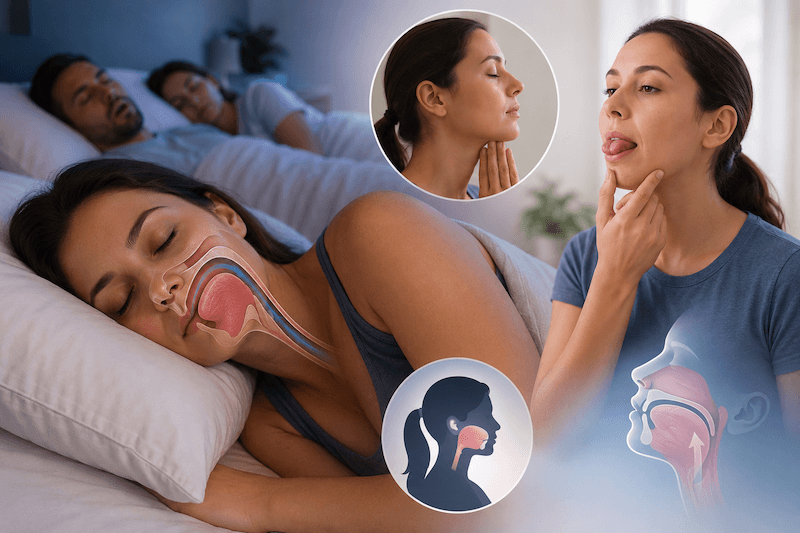
The logic is straightforward once you understand what goes wrong in obstructive sleep apnea. During sleep the muscles that hold your airway open relax. In people prone to apnea, the airway narrows or collapses, breathing stops or becomes shallow, and the brain briefly rouses you to restart it. This can happen dozens of times an hour. The tongue is a major player here, because when it loses tone it can fall back and block the throat. The soft palate at the back of the roof of the mouth can sag and vibrate, which is where a lot of snoring comes from. The thinking behind myofunctional therapy is that if you can train these muscles to be firmer and to sit in a better resting position, the airway is less likely to collapse.
Two ideas sit at the center of the therapy. The first is tongue posture, training the tongue to rest gently against the roof of the mouth rather than sitting low and back. The second is nasal breathing, encouraging you to breathe through your nose with your lips sealed instead of breathing through your mouth. If you have read my pages on mouth breathing and CPAP or mouth taping, you will recognize the theme. Mouth breathing and poor tongue posture come up again and again in sleep-disordered breathing, and myofunctional therapy is essentially an attempt to retrain both.
What the research shows
This is where I want to be careful, because the headline numbers get repeated everywhere without the qualifications that come with them.
The most widely cited piece of evidence is a systematic review and meta-analysis that pooled the available adult studies and concluded that myofunctional therapy reduced the apnea-hypopnea index by roughly 50 percent in adults and about 62 percent in children. In that analysis, the average AHI fell from the moderate range into the lower part of the moderate range, and measures of snoring, daytime sleepiness, and overnight oxygen levels improved as well. You can read a plain summary of the practical exercises and the evidence behind them at the Sleep Foundation, which is a more reliable place to start than most of the dental clinic pages that dominate search results.
A 50 percent reduction sounds dramatic, and it is a real effect. But notice what it does not say. Cutting a moderate AHI roughly in half often still leaves a person with measurable sleep apnea, just less of it. The therapy reduced severity. It did not, in most cases, eliminate the condition. That distinction is the whole story.
Newer work complicates the picture further. A more recent network meta-analysis found clear improvements in subjective measures, meaning people reported less daytime sleepiness and better sleep quality, but it did not find a statistically significant change in the apnea-hypopnea index from the exercises alone. The same analysis noted something I think is the most useful takeaway of all. When myofunctional therapy was combined with CPAP, the reduction in AHI was more pronounced, even though the exercises did not make the CPAP itself work better. In other words, the most consistent role for these exercises in the research is as an addition to treatment, not a replacement for it.
The studies also have real limitations worth knowing about. Many are small. The exercise programs differ from one trial to the next, which makes them hard to compare. Compliance is a constant problem, because the benefit depends on doing the exercises faithfully for many minutes a day over a long stretch of time, and most of us are not good at sticking to a routine like that. When researchers describe myofunctional therapy, the word that keeps appearing is adjunct. It is a supporting player, useful alongside other treatment, with the strongest case in milder disease.
Who it tends to help, and who it does not
Put the evidence together and a fairly clear pattern emerges about where myofunctional therapy belongs.
It has the best case in mild to moderate obstructive sleep apnea, in habitual snoring without significant apnea, and in children, where the effect sizes in the research are larger. It also makes sense for people whose main problem is chronic mouth breathing and low tongue posture, since those are exactly the habits the therapy targets. For someone with mild apnea who is motivated, willing to practice daily, and working under proper guidance, it is a reasonable thing to explore with a doctor.
Where it falls short is in severe disease. If your apnea-hypopnea index is high, cutting it in half is not enough. Halving an AHI of 51, which is roughly where mine sat at diagnosis, would still leave a number deep in the moderate range, with all the strain on the heart and the daytime exhaustion that comes with untreated apnea. That is not a hypothetical for me. It is the reason I have never treated these exercises as an option for myself. The math simply does not work for severe cases, and no honest reading of the research suggests otherwise.
This is also the part where the marketing around myofunctional therapy can become genuinely risky. When a page implies that exercises can let you abandon CPAP, the people most likely to be hurt are those with the most to lose, the severe cases who feel the daily burden of the mask and badly want a way out. I understand that pull. The mask is not fun. But trading effective treatment for a therapy that, at best, reduces severity is a bad trade when your numbers are high.
Why it was never going to be my path
I am a chronic mouth breather, which is a big reason I use a full face mask rather than a nasal mask or nasal pillows. In theory, mouth breathing and poor tongue posture are exactly what myofunctional therapy aims to retrain, so you might think I would be the ideal candidate. The problem is severity. My apnea was advanced by the time it was caught, and the exercises were never plausibly going to bring an AHI of 51 down to a safe level on their own.
There is one more wrinkle from my own history that is worth mentioning, because it is a useful caution. Before my sleep apnea was ever diagnosed, I had a septoplasty to correct my nasal airway. It improved my breathing during the day, which I was glad of, but it did nothing to prevent the obstructive sleep apnea that was developing further back in my throat. The lesson I took from that, and the one I would pass on here, is that fixing one part of the airway, whether through surgery or through exercise, does not necessarily fix the collapse happening somewhere else. The airway is a system. Strengthening the tongue does not guarantee the soft palate and the throat will hold.
So I do what the research actually supports for someone in my position. I use CPAP every night, I keep an eye on my numbers, and I treat my sleep apnea as the serious condition it is. If you want the full story of how I got there, including the role my wife played in pushing me to get tested, it lives on my page about living with sleep apnea rather than here.
How it can fit alongside CPAP
If the strongest evidence is for myofunctional therapy as an adjunct, the obvious question is whether it could help a CPAP user like me, not by replacing the machine but by working with it. This is the part I find genuinely interesting, even though I have not tried it.
The most plausible benefit is the one tied to mouth breathing. A great deal of CPAP frustration comes from breathing through the mouth at night, which leads to air leaks, a dry sore mouth in the morning, and pressure that feels like it is escaping rather than splinting the airway open. I have written separately about stopping mouth breathing on CPAP and about the persistent problem of dry mouth. If a course of myofunctional therapy genuinely helped retrain someone to keep their lips sealed and breathe through the nose, it is reasonable to think it could make the machine more comfortable and reduce some of those side effects. A person who trains out of mouth breathing might even find they tolerate a nasal mask, which is something a confirmed mouth breather like me has never managed. I want to be clear that this is a reasonable inference from how the therapy works, not a proven outcome, and not something I can vouch for from experience.
There is also a comfort angle for people early in treatment. The first months on CPAP are hard, and a lot of people quit before they adapt. I have written about that struggle in my piece on CPAP anxiety. If exercises that build airway awareness and better breathing habits help someone feel more in control during that adjustment period, that has value even if it never moves their AHI by a single point. Feeling more at ease with your own breathing is not nothing.
What the exercises involve and how to do this properly
I am deliberately not going to print a prescriptive exercise routine here, for two reasons. The first is that I have not done these exercises and have no business coaching you through them. The second, and more important, is that the research consistently emphasizes that myofunctional therapy works best when it is assessed and guided by a trained professional who can tailor it to how your particular muscles are behaving. A generic list of tongue presses pulled off the internet is not the same thing as a program built around an actual evaluation of your tongue posture, your breathing, and your swallow.
Broadly, a program works the muscles of the tongue, lips, and throat and retrains how you breathe and rest your tongue, but the specifics are meant to be matched to your own assessment rather than copied from a generic list. The Sleep Foundation page linked above gives a sense of what the movements look like if you are curious. The honest path, if you are serious, is to find a qualified myofunctional therapist, often a speech-language pathologist or a dentist with specific training, and to do it under guidance rather than guessing.
Crucially, none of this should happen instead of getting properly diagnosed and treated. If you suspect you have sleep apnea, the order of operations is a sleep study and a conversation with a doctor first, then a discussion of whether myofunctional therapy makes sense as part of your plan. Starting exercises while leaving moderate or severe apnea untreated is the version of this that worries me.
Where it sits among the alternatives
People usually arrive at myofunctional therapy because they are looking for something other than CPAP, so it is worth placing it honestly among the other options. Oral appliances, positional therapy, weight management, surgery, and nerve stimulation all occupy different niches, with different evidence behind them and different trade-offs. I have pulled these together on my overview of alternative treatments for sleep apnea, and for the more invasive end of the spectrum I have a separate look at sleep apnea surgery. If your underlying issue is mainly snoring rather than apnea, my page on how to stop snoring is a better starting point, since that is where myofunctional therapy actually shines.
Compared to those options, myofunctional therapy is appealing precisely because it is noninvasive, has no real downside beyond the time it takes, and addresses an underlying functional problem rather than just managing symptoms. Those are genuine strengths. The catch, again, is that its measurable effect on apnea severity is modest and works best as a complement to other treatment, not as a standalone fix for anything beyond mild disease.
The honest bottom line
Myofunctional therapy is real; it is backed by research, and it has a legitimate place in the treatment of sleep-disordered breathing. For mild apnea, for snoring, for children, and as an addition to other treatment, the evidence supports giving it serious consideration with your doctor. As a way to retrain chronic mouth breathing, it is one of the few approaches that targets the habit directly, and that alone makes it worth knowing about.
What it is not is a way out of treatment for moderate or severe obstructive sleep apnea. Halving a high AHI still leaves a dangerous number, and the research does not support abandoning effective treatment in favor of exercises. For someone like me, diagnosed with severe apnea and reliant on CPAP, it was never a realistic alternative, and I would not pretend otherwise just because the idea of ditching the mask is attractive. If you are drawn to myofunctional therapy, the right move is to get properly diagnosed first, then ask a qualified professional whether it belongs in your plan, most likely alongside whatever else is keeping your airway open at night.
⚠️ MEDICAL DISCLAIMER This blog provides general information only and is not a substitute for professional medical advice, diagnosis, or treatment. Sleep apnea is a serious condition, and CPAP equipment should be used under proper medical supervision. Always consult your doctor or sleep specialist before starting, stopping, or changing any therapy. I share personal experiences as a CPAP user, not as a medical professional. Individual results vary. For medical guidance, please consult a qualified clinician or the American Academy of Sleep Medicine (aasm.org).