Micro CPAP: What It Is, What It Isn’t, and the Smallest CPAP Available


If you have been searching for a micro CPAP device, you have probably landed on a mix of crowdfunding pages, cheap Amazon listings, and articles that leave you more confused than when you started. I get it. When I was first diagnosed with severe obstructive sleep apnea more than a decade ago, I would have done almost anything to avoid sleeping with a full face mask strapped to my head every night. The idea of a tiny, maskless device that does the same job sounds genuinely appealing.
So let me save you some time. The version of micro CPAP that most people are imagining: a small, hoseless, maskless device that sits under your nose and treats sleep apnea. That product does not exist yet as an FDA-approved device. What does exist is a category of genuinely small, highly portable travel CPAP machines that use the word “micro” in a different, more accurate sense. The Transcend Micro is the best example: a legitimate, FDA-approved CPAP machine that fits in the palm of your hand and still uses a standard mask.
This article covers both. I’ll explain what the maskless micro CPAP concept actually is, why it isn’t available, and what your real options are if you want the smallest functioning CPAP machine on the market right now. My background is in computer science, not medicine, and I write as a long-term patient rather than a clinical authority, so talk to your doctor before making any changes to your therapy.
What people mean when they search “micro CPAP”
The term took off around 2015 when a startup called Airing launched an Indiegogo crowdfunding campaign for what it described as the world’s first hoseless, maskless micro CPAP. The pitch was simple and genuinely exciting: a small, disposable device that sits just under your nostrils, uses tiny internal fans called microblowers to generate positive airway pressure, and requires no machine, no hose, and no mask. It raised nearly two million dollars in crowdfunding.
Years later, the product still does not exist. Airing has never delivered a working prototype to consumers, and no in-nose micro CPAP device has received FDA approval for treating obstructive sleep apnea. The Sleep Foundation notes that micro CPAP prototypes remain experimental, with no thorough patient testing completed and no clear timeline for FDA review.
In the meantime, a wave of cheap imitation devices has appeared on Amazon and similar marketplaces. These products borrow the micro CPAP name, claim to reduce snoring, and list specifications that sound impressive. None of them are FDA-approved for treating sleep apnea. None of them generate the kind of sustained positive airway pressure that CPAP therapy requires. If you have been diagnosed with obstructive sleep apnea, these products are not a treatment. They are a distraction.
Why the maskless concept is harder than it sounds
The fundamental engineering problem with the in-nose micro CPAP concept is pressure. A traditional CPAP machine uses a motor roughly the size of a small book to generate continuous positive airway pressure, typically somewhere between 4 and 20 cm H2O depending on the patient’s prescription. That pressure needs to be sustained, consistent, and precisely controlled throughout the night.
Fitting that kind of pressure-generating capability into a device small enough to rest under your nostrils, powered by a battery small enough to be disposable, while keeping it quiet and comfortable enough to sleep with. That is an enormous engineering challenge. The microblower technology Airing has been developing uses electrostatic charge to push air through tiny displacement pumps, but the technology has not yet demonstrated the ability to replicate what a conventional CPAP motor does.
This matters if you have moderate or severe sleep apnea. The consequences of inadequate therapy (repeated oxygen drops through the night, disrupted sleep architecture, strain on the cardiovascular system) are not trivial. Using an unproven device in place of prescribed CPAP therapy is a real risk, not just a minor inconvenience. See my longer piece on sleep apnea and cardiovascular health if you want to understand why untreated or undertreated apnea has consequences beyond feeling tired.
What “micro CPAP” actually means in practice today
The confusion partly comes from the fact that “micro” has been adopted by legitimate manufacturers to describe genuinely small travel CPAP machines, devices that are dramatically smaller than a standard home unit, but still FDA-approved, still use a mask, and still generate proper therapeutic pressure.
The clearest example is the Transcend Micro. The name is accurate in the sense that it is micro in size: under half a pound, less than four inches across, roughly the size of a baseball. But it is a fully functioning auto-adjusting CPAP machine with a real motor, a standard 22mm hose connection, and compatibility with virtually any CPAP mask on the market. It is not maskless. It is not the device you might have seen in that Indiegogo campaign. But it is real, it works, and it is the smallest FDA-approved CPAP machine currently available.
If you want to understand the broader landscape of CPAP machine types before going further, that page covers the differences between fixed CPAP, auto CPAP, BiPAP, and ASV in plain language.
The Transcend Micro: the smallest real CPAP machine available
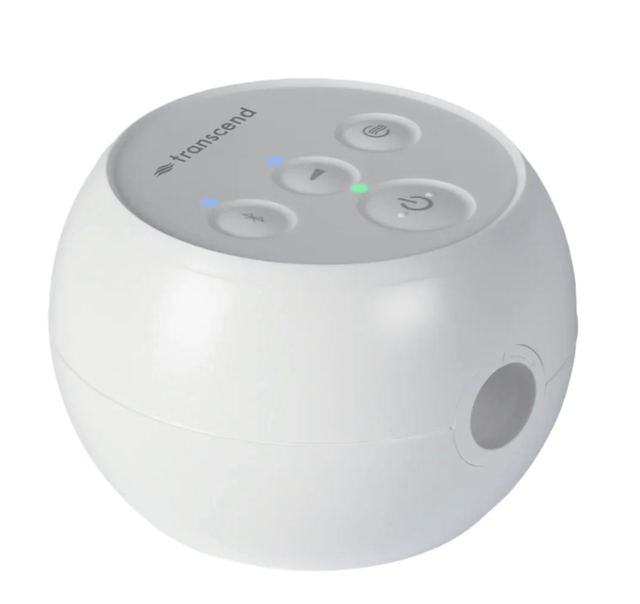
The Transcend Micro is manufactured by Somnetics and is the smallest and lightest CPAP machine currently on the market. It weighs 0.48 pounds, less than a can of soda, and measures under four inches wide. For context, that makes it roughly 32% smaller and 26% lighter than the ResMed AirMini, which was itself considered a breakthrough in portable CPAP design when it launched.
Critically, it is an auto-adjusting machine, not just a fixed-pressure travel device. It operates in both standard CPAP mode and APAP mode, meaning it can automatically adjust pressure breath by breath within a prescribed range, the same way a home auto CPAP does. The pressure range is 4 to 20 cm H2O, which covers the full therapeutic range for most people with obstructive sleep apnea.
A few features worth knowing about:
The machine includes a WhisperSoft muffler and built-in sound and vibration dampening. Transcend rates it at 27 decibels, quieter than a whisper, which is genuinely impressive for a device this size. Travel CPAPs are typically louder than home units because the motor has to work in a smaller enclosure, so the engineering behind the noise reduction here is notable.
It handles humidification through an optional AirMist Heat Moisture Exchange cartridge rather than a water-based humidifier. This is the same waterless approach used by the ResMed AirMini’s HumidX system: the cartridge captures moisture from your exhaled breath and recycles it back into the incoming air. You do not need to pack distilled water, which is a meaningful advantage for travel. I travel with the AirMini myself and the waterless humidification trade-off is something I’ve written about in detail at my mini CPAP travel machine and at distilled water and your CPAP.
The Transcend Micro connects to a companion app called MySleepDash, available on iOS and Android, which tracks therapy hours, leak summaries, and AHI data. You can share that data with your care team. For users who want to go deeper into their therapy data, the machine also connects to a Windows desktop application via USB-C for more detailed settings access, though changing pressure settings requires clinical authorisation, as it does on any CPAP.
It is FAA-approved for in-flight use and, because it is a medical device, does not count against your carry-on allowance on most airlines. The optional PowerAway battery extends its usefulness off-grid: useful for camping, long-haul flights, or anywhere a power outlet isn’t guaranteed. I’ve covered CPAP battery options in a separate guide if that’s relevant to your situation, and the Transcend Micro comes up there as well.
One limitation worth naming: the machine does not include a built-in humidifier in the traditional sense, and the AirMist HME is not compatible with all mask types. Specifically, it does not work with masks that connect to tubing above the head, such as the ResMed AirFit N30i or DreamWear styles, or with short hose masks like the AirFit F40 or P10. If you use one of those mask styles, you would either need to switch masks for travel or go without humidification, which some people manage fine and others find uncomfortable.
How the Transcend Micro compares to other small CPAP options
The two main competitors in the small travel CPAP space are the ResMed AirMini and the Luna TravelPAP. Both are legitimate machines worth considering, and the right choice depends on your mask, your priorities, and your travel habits.
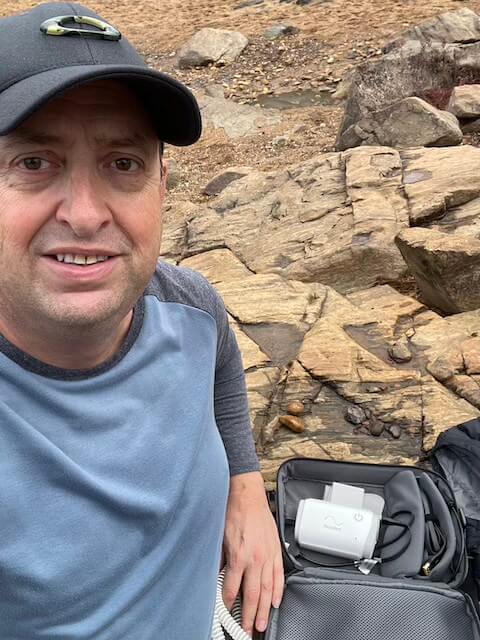
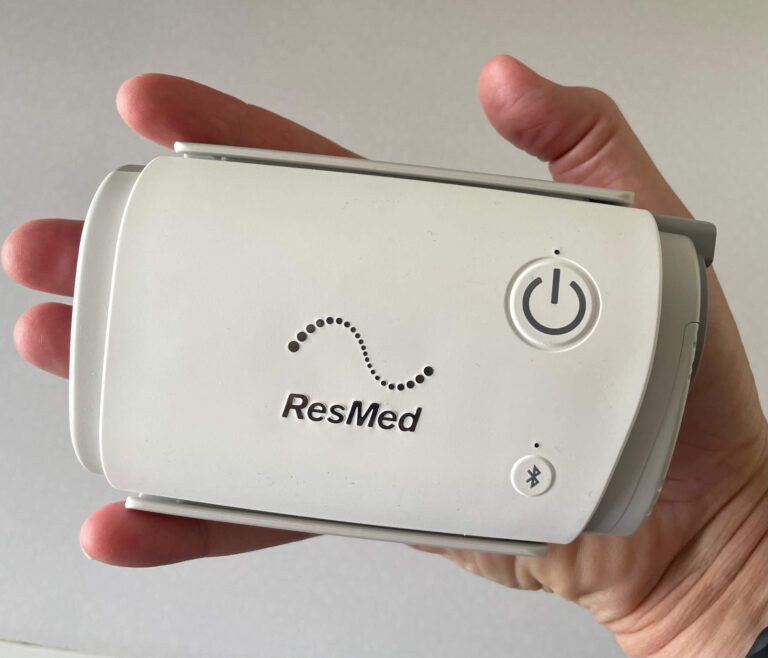
The ResMed AirMini is the most widely known travel CPAP and has a strong track record. It is slightly larger and heavier than the Transcend Micro but has one significant advantage: it is made by ResMed, the same company behind the AirSense 10 and AirSense 11 home machines that most people are prescribed. If you are already using a ResMed machine and ResMed mask at home, the AirMini works well with your existing setup, particularly if you use the AirFit F20, which is my own mask and the one I use with the AirMini when I travel. I’ve written about the AirMini extensively at my mini CPAP travel machine.
The Luna TravelPAP sits between the two in terms of size and is worth looking at if you want an alternative to the two dominant brands. The best CPAP machines guide covers several of these options with more detail on features and suitability.
If size and weight are your absolute priority and you are willing to switch masks for travel, the Transcend Micro is the smallest option available. If ecosystem continuity matters more, the AirMini makes more sense. It keeps your mask, app, and machine family consistent.
What about the machines showing up as “micro CPAP” on Amazon?
Worth addressing directly, because these products appear prominently in search results and look superficially convincing. There is a category of cheap, in-nose anti-snoring devices, sometimes called micro CPAP, sometimes “nasal dilators with fans” or similar, that are available without a prescription for relatively little money.
These are not CPAP machines. They do not generate therapeutic positive airway pressure. They are not FDA-approved for treating obstructive sleep apnea. Some may have marginal effects on mild snoring in people without diagnosed apnea, but the claims made about them are not clinically validated. Using one in place of prescribed CPAP therapy means leaving your airway untreated through the night, particularly if you have moderate or severe apnea.
If you have been diagnosed with sleep apnea and are looking for a more comfortable or portable alternative, the answer is a legitimate travel CPAP like the Transcend Micro or AirMini, combined with a mask that fits well. The mask is still part of the picture. I know that’s not what some people want to hear, but it’s where the evidence is.
If you haven’t been diagnosed yet and are wondering whether your snoring or daytime fatigue might be sleep apnea, a home sleep test is a far better first step than buying any device. I went through the home sleep study process myself, and wrote about what that looks like at home sleep apnea test.
What does the future of micro CPAP actually look like?
It’s worth being fair to the concept. The underlying engineering goal is a legitimate clinical ambition: a wearable, low profile treatment for sleep apnea that requires no bedside machine and no masked hose. CPAP therapy has an adherence problem. Many people who are prescribed it don’t use it consistently, and mask discomfort, noise, and the general inconvenience of the setup are frequently cited reasons. A device that removed those barriers could genuinely improve outcomes for a large number of patients.
The question is whether the microblower technology can generate adequate and consistent pressure at a scale small enough to be wearable. That hasn’t been demonstrated yet. Until it is demonstrated, tested in clinical trials, and reviewed by the FDA, the maskless micro CPAP remains a concept rather than a treatment.
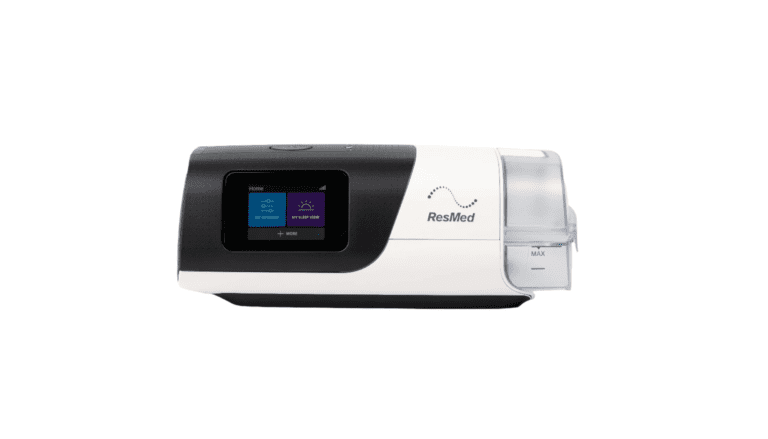
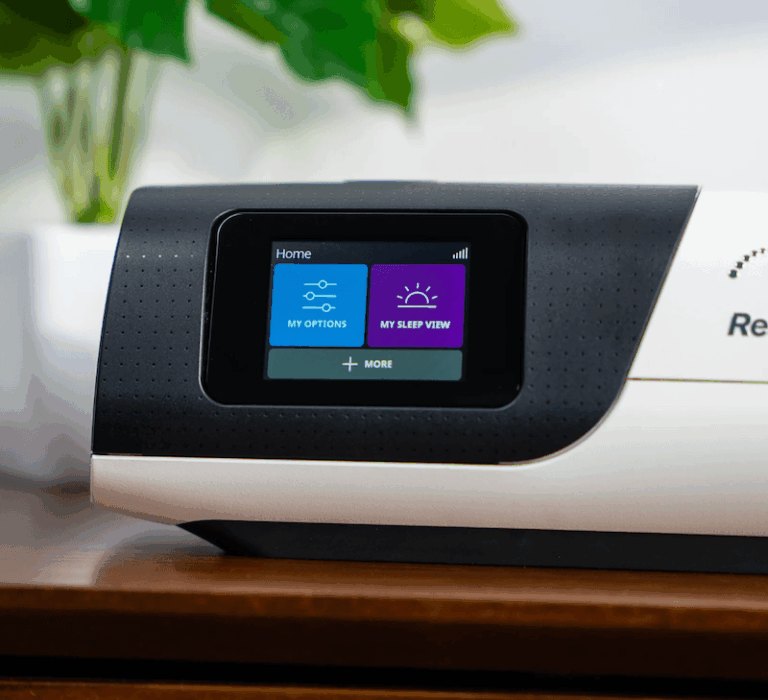
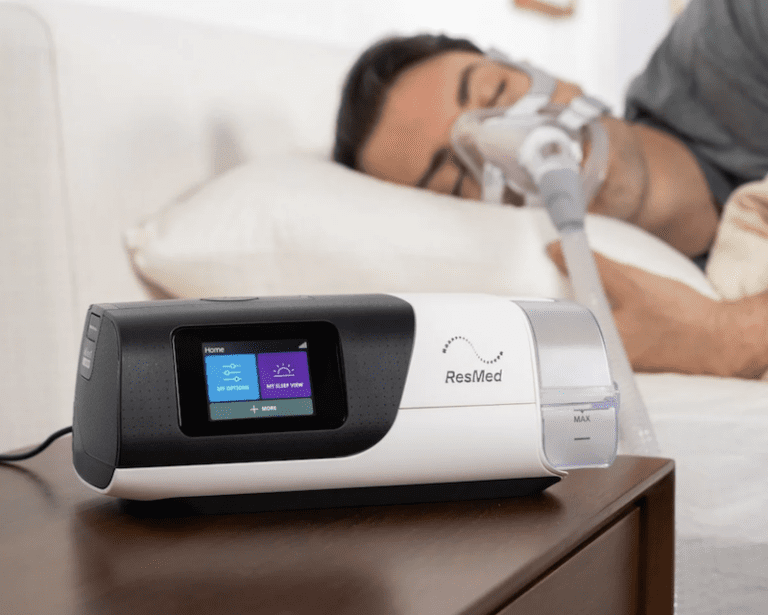
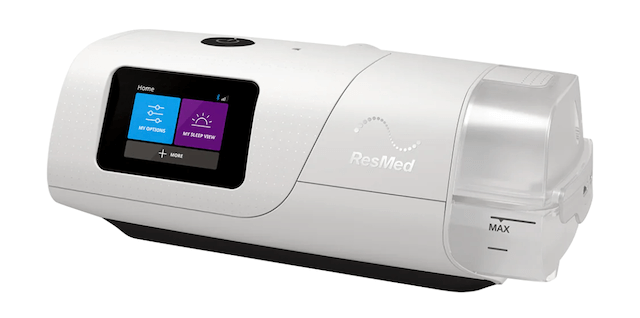
The other direction the field is moving is in reducing the footprint of existing CPAP technology rather than replacing it entirely. The Transcend Micro is an example of how far that has come. A fully functioning auto CPAP under half a pound is remarkable compared to where the technology was even a decade ago. The ResMed AirSense 12 shows a similar trajectory in the home machine space, with meaningful improvements in connectivity and comfort in a comparable physical footprint.
Should I use the Transcend Micro as my primary home machine?
Technically you can. The Transcend Micro is capable of running as a full time CPAP machine. Some people do use it as their only machine, particularly those who travel frequently and don’t want to maintain two separate setups.
That said, it has trade-offs compared to a home machine like the AirSense 10 or AirSense 11. Home machines have built-in heated humidifiers, larger water chambers, more sophisticated data reporting, and typically longer warranties. The waterless HME humidification on the Transcend Micro is convenient for travel but doesn’t replicate what heated tubing and a full water chamber deliver on a cold night. If you have ever dealt with CPAP rainout, you know that humidity management matters. The heated CPAP tubing page covers this further.
The more typical use case is as a travel companion to your home machine. You keep your AirSense or equivalent on the nightstand at home, and the Transcend Micro goes in your bag. That’s how most people in the CPAP community approach it, and it’s the configuration that makes the most sense given what each machine is optimised for.
If you are weighing whether to travel with a dedicated machine or just take your home unit on the road, best way to travel with CPAP covers the practical considerations, and how to camp with a CPAP machine gets into the off grid specifics including battery options.
The bottom line on micro CPAP
If you came here hoping to find a maskless, hoseless micro CPAP that actually works, the honest answer is that it doesn’t exist yet as an approved medical device. What does exist is a legitimately small, FDA-approved travel CPAP machine (the Transcend Micro) that fits in your coat pocket, weighs under half a pound, and delivers real therapeutic pressure through a standard mask and hose.
For anyone with diagnosed sleep apnea who wants the most portable legitimate machine available, the Transcend Micro is worth a serious look. It won’t replace the mask, but it will fit in a bag you would otherwise have left at home. And for many people managing sleep apnea on the road, that’s exactly the problem worth solving.
If you are still working out which machine suits you, best CPAP machines is a good starting point, and Troubleshooting CPAP problems covers the common issues that come up when you’re adjusting to any new device.
⚠️ MEDICAL DISCLAIMER This blog provides general information only and is not a substitute for professional medical advice, diagnosis, or treatment. Sleep apnea is a serious condition, and CPAP equipment should be used under proper medical supervision. Always consult your doctor or sleep specialist before starting, stopping, or changing any therapy. I share personal experiences as a CPAP user, not as a medical professional. Individual results vary. For medical guidance, please consult a qualified clinician or the American Academy of Sleep Medicine (aasm.org).