ResMed AirCurve 11 ASV Review: A Researched Buyer’s Guide

“This post contains affiliate links. I may earn a commission if you buy through these links, at no extra cost to you. Read my Disclaimer for more details.”
A quick note before we start, because honesty matters more than a tidy headline. I do not use an ASV machine. My own sleep apnea is obstructive, and I have managed it with a ResMed AirSense 10 for the better part of a decade. So this is not a hands-on review in the way my CPAP write-ups are. It is a researched guide, written for the readers who land here because a sleep physician has raised adaptive servo-ventilation, or because they are trying to understand whether the ResMed AirCurve 11 ASV is the right machine for someone in their life.
My background is in computer science, not medicine. What I can do well is read the technical material carefully, separate marketing language from what a device actually does, and explain it in plain terms. What I cannot do is tell you whether ASV is appropriate for you. That decision belongs to a sleep specialist who has seen your sleep study. With that out of the way, here is what the AirCurve 11 ASV is, who it is built for, and the safety issue that anyone considering ASV should understand before going further.
What ASV Is, and Who Actually Needs It
Most people who use positive airway pressure therapy have obstructive sleep apnea. The airway collapses during sleep, the body keeps trying to breathe against the blockage, and a CPAP machine holds the airway open with a steady stream of pressurized air. That is the world I live in, and for the large majority of patients a CPAP machine is the right tool.
Adaptive servo-ventilation treats a different problem. With central sleep apnea, the airway is not blocked. Instead, the brain intermittently fails to send the signal to breathe, so the effort to breathe simply pauses. The Sleep Foundation describes central sleep apnea as a breakdown in the body’s breathing signals rather than a mechanical obstruction, and notes it is often linked to underlying conditions such as heart failure or neurological disorders. You can read their overview of central sleep apnea for the clinical background.
There is also complex or mixed sleep apnea, where obstructive and central events both appear, sometimes only after CPAP therapy begins. And there is Cheyne-Stokes respiration, a cyclical waxing and waning breathing pattern most often seen alongside heart conditions.
ASV is designed for these central and complex patterns. It is a specialized therapy, prescription only, and it is not something a person chooses off a shelf because it sounds more advanced. If your sleep study showed straightforward obstructive apnea, ASV is not the answer, and a standard CPAP machine is the simpler and appropriate choice. If you want a fuller explanation of the underlying technology, I have a separate piece on what ASV is and another on how ASV works.

Where the AirCurve 11 ASV Sits in the ResMed Range
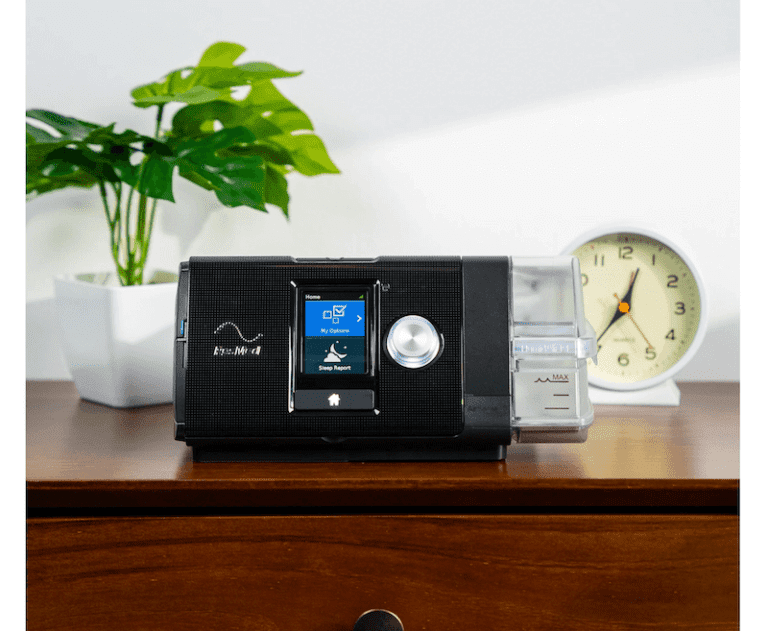
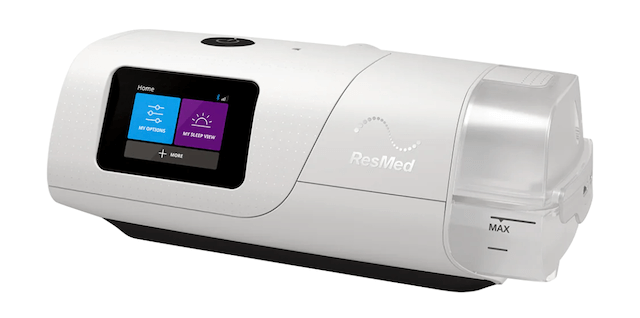
The AirCurve 11 ASV PaceWave is ResMed’s current adaptive servo-ventilation device, and it succeeds the long-serving AirCurve 10 ASV. It belongs to ResMed’s Air11 family, which is the same generation as the ResMed AirSense 11 CPAP machine. If you have seen an AirSense 11, the AirCurve 11 will look familiar, because ResMed built the whole Air11 range around a shared design and a shared digital ecosystem.
It is worth being precise about what kind of machine this is. The AirCurve 11 ASV is a bilevel device, meaning it delivers a higher pressure as you breathe in and a lower pressure as you breathe out. ASV adds an adaptive layer on top of that bilevel foundation, adjusting the support it provides from one breath to the next. That makes it a more sophisticated machine than the CPAP unit I use, and also a more narrowly targeted one.
According to ResMed’s own product documentation, the AirCurve 11 ASV PaceWave is indicated for the treatment of obstructive sleep apnea in patients over 30 kg, as well as central and mixed apneas and periodic breathing. So the machine can address obstructive events. The point is not capability. It is prescription logic. You are placed on ASV because central or complex apnea is part of your picture, not because ASV is a fancier way to treat ordinary OSA.
How PaceWave Works
PaceWave is the name ResMed gives the adaptive algorithm at the heart of this machine, and it is the proven algorithm carried forward from the AirCurve 10 ASV rather than a brand-new approach.
The core idea is minute ventilation targeting. The machine continuously measures how much air you are moving and sets a target based on your own recent breathing, calculated as a moving average over the last few minutes. When your breathing slows or pauses below that target, as it does during a central event, the machine raises the inspiratory pressure to provide backup support and, in effect, helps carry the breath for you. As your own breathing stabilizes and returns toward the target, the pressure eases back down to the minimum needed. The aim is to keep your breathing as close to your natural rhythm as possible, smoothing out both the pauses and the overshoots that can follow them.
The AirCurve 11 ASV offers two modes. In standard ASV mode, the expiratory pressure that holds the airway open is set manually by the clinician. In ASVAuto mode, the machine adjusts the expiratory pressure automatically in response to obstructive events such as apneas, flow limitation, and snoring. Which mode you use, and every pressure setting within it, is determined by your prescriber. This is not a machine you tune yourself.
ResMed also includes continuous leak management, which keeps therapy pressure reliable even when your mask seal is not perfect. Leaks are the single most common comfort problem in any PAP therapy, and a machine that compensates for them well makes a real difference to how rested you feel.
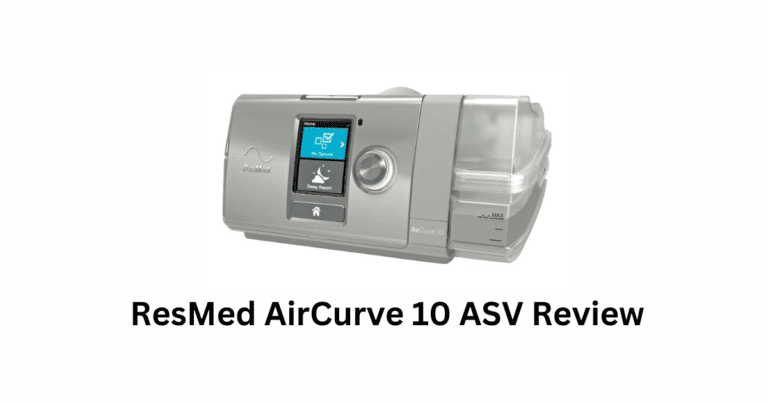
What Changed From the AirCurve 10 ASV
If you are comparing the two generations, it helps to know that the therapy itself has not been reinvented. PaceWave is the same proven algorithm, so in clinical terms the AirCurve 10 ASV and the AirCurve 11 ASV deliver the same style of adaptive support. The differences are in the experience around the therapy.
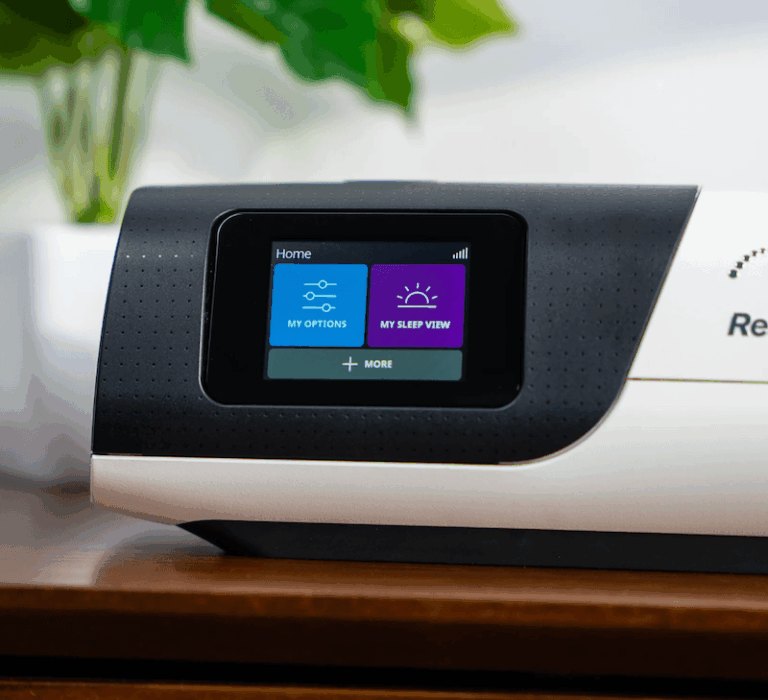
The most visible change is the interface. The AirCurve 11 uses a color touchscreen in place of the older button and small display layout, which makes navigating menus and adjusting comfort settings more intuitive. The machine has also been redesigned to match the cleaner, more modern look of the Air11 range.
The larger change is the digital side. The AirCurve 11 is part of ResMed’s Air11 ecosystem, which includes a Personal Therapy Assistant delivered through the myAir app. This offers voice-guided video setup and check-in features intended to help new users get started and stay consistent in the first weeks, which is often the hardest stretch of any new therapy. The machine connects to the myAir app so you can see your nightly data, and it links to AirView so a clinician can review that data and make remote adjustments without you traveling to an appointment.
Connectivity itself is the other practical upgrade. Older machines in the AirCurve 10 generation relied on cellular networks that included 3G, and as 3G networks have been switched off in many regions, some of those older units lost their automatic data reporting. The Air11 generation moves to current connectivity, which matters if remote monitoring by your care team is part of your treatment plan.
For a closer look at the previous model, my AirCurve 10 ASV review covers it in detail, and my broader ASV machines guide compares the small field of devices in this category.
The Heart Failure Safety Warning Every ASV Patient Should Know
This is the part of the conversation that marketing pages tend to skip, and it is the part that matters most.
A large clinical trial called SERVE-HF studied adaptive servo-ventilation in patients who had chronic heart failure with reduced ejection fraction, defined as a left ventricular ejection fraction at or below 45 percent, together with predominantly central sleep apnea. The trial did not find the benefit researchers had hoped for. More seriously, it found that both all cause and cardiovascular mortality were higher in the group treated with ASV. The American College of Cardiology summarized the SERVE-HF findings when the results were first presented.
In response, ResMed updated the user guides and clinical manuals for its ASV devices to add a contraindication. Adaptive servo-ventilation is now contraindicated for patients with symptomatic chronic heart failure with reduced ejection fraction at or below 45 percent and moderate to severe predominant central sleep apnea. ResMed’s own materials direct clinicians to assess every patient for heart failure before starting ASV, and where signs of heart failure are present, to objectively evaluate left ventricular ejection fraction.
A few points are worth keeping in proportion. The finding was specific. It applies to that particular group of heart failure patients with reduced ejection fraction and predominant central apnea, and it cannot simply be extended to every person who might use ASV. There was no fault found with the devices themselves. They operated correctly. And patients with heart failure who use CPAP for obstructive sleep apnea were not the subject of this warning.
None of that is something you should weigh on your own. The reason to raise it here is simple. If a clinician is discussing the AirCurve 11 ASV with you, and heart involvement is anywhere in your medical history, this is a direct and specific question to ask: has my heart function been assessed, and is ASV still the right therapy given the SERVE-HF results. A good sleep physician will already be thinking about it. You should still feel free to ask.
Setting Up and Living With the AirCurve 11 ASV
Since I do not use this machine, I will not pretend to describe nights on it. What I can tell you, from the documentation and from the structure of ASV therapy generally, is how the process is shaped.
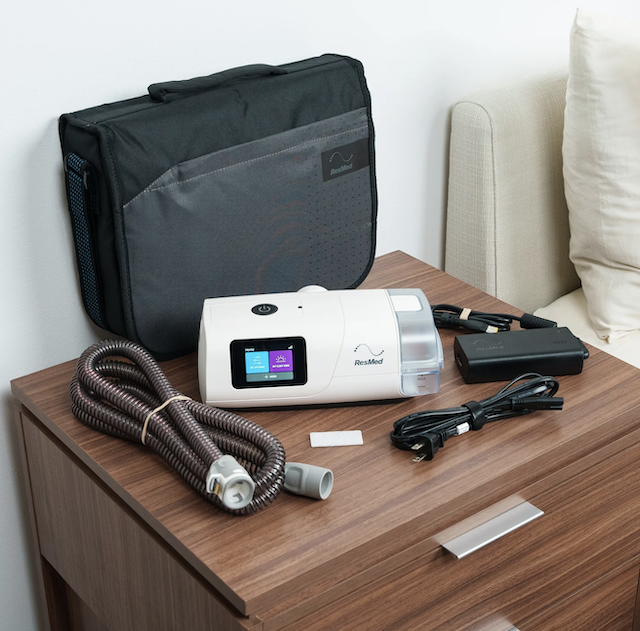
An ASV machine is not configured by the user. Your prescriber or your equipment supplier sets the therapy mode and the pressure values based on your sleep study, and those settings are part of your prescription. The day to day handling is straightforward and similar to any modern ResMed machine. You connect the tubing, the humidifier chamber, and your mask, you fill the humidifier with distilled water rather than tap water, and you start therapy. The Air11 ecosystem then layers on guided setup and the myAir app for nightly feedback, with AirView available so your care team can review your data remotely.
One honest expectation to set. ASV can feel different from CPAP, especially for anyone switching across from a steady pressure machine. The pressure on an adaptive device changes more dynamically because it is responding to your breathing in the moment. People who make this switch are usually advised to give themselves a couple of weeks to adjust before judging it. If something feels wrong during that window, that is information for your clinician, not a problem to push through quietly. If you are weighing the broader differences between device types, my guides on CPAP versus BiPAP and ASV versus BiPAP versus CPAP lay them out.
As for how long the machine lasts, device lifespan depends heavily on care and use, but a figure of around five years of regular use is commonly cited for machines in this class. Following the manufacturer’s cleaning instructions and using distilled water in the humidifier are the simplest things you can do to protect both the device and any warranty coverage.
Who Should Consider the AirCurve 11 ASV
The honest summary is that this is a machine for a narrow group of people, and that is by design.
It may be the right device if a sleep specialist has diagnosed you with central or complex sleep apnea, if you have Cheyne-Stokes respiration that a clinician is treating with ASV, or if you are an existing AirCurve 10 ASV user moving to the current generation for the updated interface, the digital ecosystem, and current connectivity.
It is not the right device if your diagnosis is purely obstructive sleep apnea. For obstructive apnea, a CPAP machine is simpler, appropriate, and what almost all of us actually need. It is also not a device you can buy without a prescription, because the therapy is specialized and the settings must be configured for you. And as the section above explains, it carries a specific contraindication for certain heart failure patients, which is one more reason this is a clinician’s decision rather than a consumer one.
If you are not sure which category you fall into, that uncertainty is itself the answer. It means the next step is a conversation with a sleep physician who can review your sleep study, not a purchase.
Cost and Where to Buy
The AirCurve 11 ASV is a premium device and it requires a valid prescription. Because of that prescription requirement, you cannot simply add it to a cart the way you might a mask or a hose. You order it through a supplier who verifies your prescription.
I have partnered with Sleep Doctor, who are an established online supplier of CPAP and PAP equipment. If ASV has been prescribed for you and you are ready to source the machine, you can see current pricing and availability for the AirCurve 11 ASV through the link below.
Frequently Asked Questions
Does the AirCurve 11 ASV treat obstructive sleep apnea? Yes, it can. ResMed’s indication for the AirCurve 11 ASV PaceWave includes obstructive sleep apnea in patients over 30 kg, alongside central and mixed apneas and periodic breathing. The reason a person is placed on ASV, though, is the presence of central or complex apnea. If your diagnosis is purely obstructive, a CPAP machine is the appropriate prescription.
Do I need a prescription? Yes. ASV is a specialized therapy, and both the device and its settings are prescription-based. A clinician or equipment supplier configures the machine for you.
Is the AirCurve 11 ASV quiet? Modern ResMed machines run quietly, and the AirCurve 11 is no exception in normal use. Because an adaptive machine changes pressure in response to your breathing, you may notice the air movement shift through the night more than you would on a steady pressure CPAP.
Can it connect to my phone? Yes. It works with the myAir app for nightly feedback and links to AirView so your care team can review your data and make remote adjustments.
How is it different from a BiPAP machine? A BiPAP delivers two fixed pressures, one for breathing in and one for breathing out. ASV builds on that bilevel design with an algorithm that adjusts support from breath to breath to stabilize central and complex breathing patterns. My ASV versus BiPAP versus CPAP guide explains the distinctions in more detail.
Final Thoughts
The ResMed AirCurve 11 ASV is a capable, well designed machine, and for the specific group of patients who genuinely need adaptive servo-ventilation, it represents the current generation of that therapy. The updated touchscreen, the Air11 digital ecosystem, and current connectivity are real and useful improvements over the AirCurve 10, even though the underlying PaceWave algorithm is the same proven approach.
I research these machines because the technology is genuinely interesting, and because readers arrive here trying to make sense of a therapy they did not choose and may not fully understand yet. If that is you, I hope this guide gave you a clearer and more honest starting point than a glossy product page would. But the decision itself, including the heart failure question that SERVE-HF raised, is one to make with a sleep specialist who knows your history.
If you would like to read about my own experience with sleep apnea and CPAP, you will find it on my living with sleep apnea page.
⚠️ MEDICAL DISCLAIMER This blog provides general information only and is not a substitute for professional medical advice, diagnosis, or treatment. Sleep apnea is a serious condition, and CPAP equipment should be used under proper medical supervision. Always consult your doctor or sleep specialist before starting, stopping, or changing any therapy. I share personal experiences as a CPAP user, not as a medical professional. Individual results vary. For medical guidance, please consult a qualified clinician or the American Academy of Sleep Medicine (aasm.org).