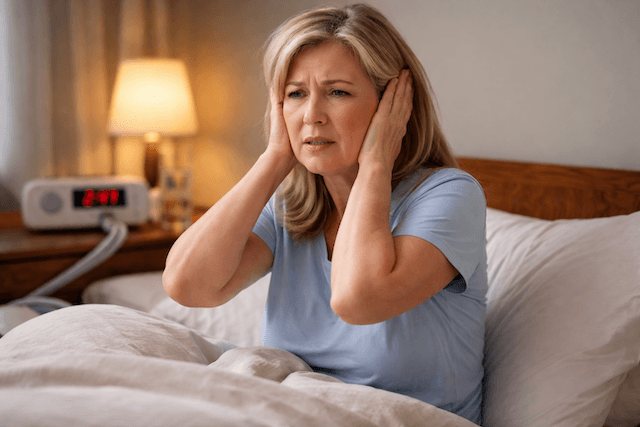
What is a CPAP Titration Study?


Here is something that might surprise you: I have used CPAP every night for more than a decade, and I have never had a CPAP titration study.
When I was diagnosed with severe obstructive sleep apnea, it happened through a home sleep test, not an overnight stay in a lab. And the machine I have used ever since, a ResMed AirSense 10 AutoSet, adjusts its own pressure automatically throughout the night. So the formal lab titration that many newly diagnosed patients go through simply never happened for me. My machine has been quietly titrating itself, one breath at a time, for more than a decade.
That makes this article different from most of what I write. I cannot tell you what it feels like to spend a night in a sleep lab while a technologist dials in your pressure, because I have never done it. What I can do is explain what a titration study is, why your sleep doctor might order one, what happens during the night, and how it fits into the bigger picture of starting CPAP therapy. Everything here comes from published clinical guidance, primarily from the American Academy of Sleep Medicine, filtered through the perspective of someone who has lived on the receiving end of CPAP pressure every night for a very long time.
One more thing before we start. I am a patient, not a doctor or a sleep technologist. Treat this as a well-researched orientation, not medical advice, and take your actual questions to your sleep physician.
The short answer
A CPAP titration study is an overnight sleep test with one job: finding the right air pressure for your CPAP machine.
It usually takes place in a sleep lab, in a private room set up to feel more like a hotel than a hospital. You sleep wearing a CPAP mask while a sleep technologist in another room watches your breathing, oxygen levels, heart rhythm, and sleep stages in real time. Over the course of the night, the technologist gradually adjusts the air pressure, starting low and stepping it up in small increments, until your breathing stays stable across different sleep stages and body positions.
By morning, your sleep specialist has the data needed to prescribe a specific pressure setting, and your machine gets programmed with a number that was tested on you, in your sleep, rather than estimated from a formula.
It is worth being clear about what titration is not. It is not a diagnostic test. Your diagnostic sleep study, whether in a lab or at home, already answered the question of whether you have sleep apnea and how severe it is. Titration assumes the diagnosis and moves on to calibration. The question is no longer “does this person stop breathing at night” but “exactly how much air pressure keeps this person’s airway open.”
Why the pressure number matters so much
CPAP works by holding your airway open with a continuous stream of pressurized air. The pressure is measured in centimeters of water, written as cm H2O, and the difference between a setting that works and a setting that does not can be surprisingly small.
Too little pressure and the therapy fails at its only job. Your airway still collapses, apneas and hypopneas continue, and your oxygen still drops, just perhaps less often than before. Too much pressure brings a different set of problems: air leaking out around the mask, swallowed air and bloating, dry mouth, and the general sensation of trying to sleep in a wind tunnel. Either failure mode pushes people toward abandoning therapy, and abandonment is the real enemy. A CPAP machine in the cupboard treats nothing.
The clinical target is straightforward. Effective therapy should bring your apnea hypopnea index down below 5 events per hour while keeping your blood oxygen in a healthy range through the night. Titration is the process of finding the lowest pressure that achieves that, because the lowest effective pressure is generally also the most comfortable and the easiest to live with night after night.
I will say this from experience even though my pressure was found by an algorithm rather than a technologist: the difference between therapy that works and therapy you tolerate grudgingly comes down to details like this. Pressure, mask fit, and humidity are the three levers that decide whether CPAP becomes a habit or a battle. Titration exists to get the first of those levers right from day one.
The three ways titration happens
Not everyone gets the same kind of titration, and some people, like me, never get a formal study at all. There are three broad pathways.
Attended titration in a sleep lab
This is the traditional approach and still considered the gold standard, particularly for complicated cases. You spend a full night at a sleep center wired up with the same sensors used in a diagnostic study: electrodes on your scalp tracking brain waves, sensors near your eyes and on your chin, heart rhythm leads, belts around your chest and abdomen measuring respiratory effort, and a pulse oximeter on your finger watching your oxygen.
The technologist starts the CPAP at a low pressure, typically around 4 cm H2O, which most people barely notice. As you fall asleep and move through sleep stages, they watch for apneas, hypopneas, snoring, flow limitations, and oxygen dips. Each time events appear, the pressure goes up a small step. The process is methodical because pressure needs genuinely vary across the night. REM sleep usually demands more pressure because your muscles are at their most relaxed. Sleeping on your back typically requires more than sleeping on your side. A good titration maps all of it.
The real advantage of the attended study is the human in the loop. If your mask leaks, the technologist comes in and adjusts it. If the mask style is wrong for your face, they can swap it. If the pressure feels intolerable, they can enable comfort features on the spot. The American Academy of Sleep Medicine’s patient guide to titration studies walks through this process in detail and is worth reading if you have a study scheduled.
Attended titration is most strongly recommended for people with severe disease, significant heart or lung conditions, suspected central sleep apnea or complex sleep apnea, and for anyone who tried automatic CPAP at home and did not get good results.
The split night study
Some patients get diagnosis and titration in a single night. The first portion of the night runs as a standard diagnostic study. If the data shows clear and severe obstructive sleep apnea early enough, the technologist switches gears, fits a CPAP mask, and spends the rest of the night titrating pressure.
The appeal is obvious: one night in the lab instead of two, a faster path to treatment, and lower overall cost. The tradeoff is that both halves of the night get compressed. There is less diagnostic data and less titration time, and if your apnea is concentrated in REM sleep or only shows up late in the night, a split study can miss it. When the titration half does not produce a clear answer, a follow-up full-night study is sometimes needed anyway.
Split night studies are generally reserved for cases where severe sleep apnea is unmistakable within the first couple of hours of recording.
Automatic titration at home
The third pathway is the one closest to my own story. Auto-adjusting CPAP machines, usually called APAP, do not run at a single fixed pressure. They operate within a prescribed range and use onboard algorithms to detect apneas, hypopneas, snoring, and flow limitation in real time, raising and lowering pressure breath by breath as conditions change.
For uncomplicated obstructive sleep apnea, a doctor can prescribe an APAP machine, set a wide pressure range, and let the patient sleep on it at home for a few weeks. The machine records everything. The doctor then reviews the data and either locks in a fixed pressure based on what the machine learned or simply leaves the machine in automatic mode permanently.
That second option describes my entire CPAP life. My AirSense 10 AutoSet has been in automatic mode since the beginning, which means in a sense I get titrated every single night. When I have a head cold, when I have had a late dinner, when I sleep on my back instead of my side, the machine notices and adapts. I check the results each morning in the myAir app, and over the years I have learned to read my own data the way some people read the weather. If you want to get better at that yourself, I have a guide on interpreting your CPAP data.
Home titration with APAP is not suitable for everyone. It is not appropriate for central sleep apnea, and people with serious heart or lung disease need the supervision of an attended study. The constantly shifting pressure also bothers some sleepers, who do better on a fixed number. But for straightforward obstructive sleep apnea, research summarized by the Sleep Foundation’s overview of titration studies supports automatic titration as a legitimate alternative to the lab, and it has clearly worked for me.
What to expect if you have a lab titration scheduled
If your doctor has ordered an attended study, here is roughly how the night unfolds.
You arrive in the evening, usually a couple of hours before your normal bedtime. On the day of the study, skip naps and cut off caffeine by early afternoon so you are genuinely sleepy. Bring whatever makes you comfortable: your own pillow, comfortable sleepwear, toiletries, something to read, and any regular medications, though you should confirm with your doctor in advance whether to take them as usual.
A technologist greets you, shows you to your room, and spends twenty to thirty minutes attaching sensors. You will end the process looking somewhat like an astronaut, but most people stop noticing the wires within minutes of lying down.
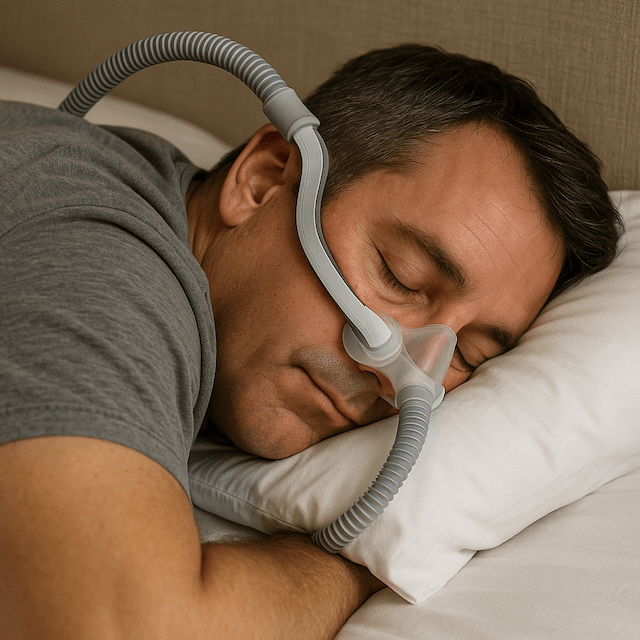
Then comes what I consider the most important part of the entire night, even though it happens before any titration begins: the mask fitting. The technologist will help you find a mask style that seals properly on your face. Broadly, the options are nasal pillows that sit at the nostrils, nasal masks that cover the nose, and full face masks that cover nose and mouth. As a lifelong mouth breather I have always used a full face mask, and if you breathe through your mouth at night you will likely need one too. The fit matters enormously: too loose and air leaks ruin both your sleep and the study data, too tight and you wake with sore pressure marks. Take your time here and speak up if anything feels wrong. If you want to think this through before the study, my guide on how to choose a CPAP mask covers the tradeoffs.
Once the lights go out, the technologist’s work begins. You do not need a perfect night of sleep. Most people sleep lighter and shorter in a lab than at home, and that is fine. A few hours of sleep that covers the major sleep stages and a stint on your back usually gives the team enough data to work with. If a problem comes up during the night, a leak, discomfort, difficulty exhaling against the pressure- the technologist can intervene, adjust, and continue.
In the morning, the sensors come off, and you go home. Within a week or two, your sleep specialist reviews the night and issues a prescription: a specific pressure or pressure range, often a recommended mask type, and any comfort settings such as ramp time or expiratory pressure relief.
Reading the results
A successful titration produces a clear answer. The report will show your residual AHI at the final pressure, ideally below 5 events per hour, your oxygen saturation through the night, and notes on your sleep architecture, meaning whether you actually reached deep sleep and REM at the tested pressure. The technologist’s observations about mask fit and your comfort feed into the equipment recommendation.
Occasionally a study comes back labeled inadequate. That usually means you slept too little for the data to be conclusive, leaks were too severe to trust the numbers, or no tested pressure controlled your breathing events. An inadequate study is frustrating but not a dead end. It typically leads to a repeat night after the underlying problem is addressed, or sometimes to a different therapy entirely, such as a BiPAP machine that uses separate pressures for inhaling and exhaling.
After titration: the part nobody warns you about
Here is where my experience becomes directly relevant again, because whatever path your pressure number took to reach your machine, the weeks that follow are the same for all of us.
The titration study gets the setting right, but it does not make the first weeks easy. Your brain still has to learn to fall asleep with a mask on your face and air flowing into it. Almost everyone hits some friction early on: dryness, a mask that shifts when you roll over, the strange feeling of exhaling against pressure, or plain old CPAP anxiety. This is normal, it is temporary, and it is survivable. I have written about what the first night is actually like and how to get used to CPAP therapy if you want a realistic picture.
The other thing to understand is that titration is not a one-time event, even when it happens in a lab. Your pressure needs can drift over the years. Significant weight change in either direction, new medications, developing allergies or nasal congestion, and ordinary aging can all shift the number. This is one reason your sleep doctor reviews your machine data at follow-up appointments, and it is a reason to keep an eye on your own numbers between visits. If your events per hour creep upward despite a good mask seal and consistent use, that is a conversation to have with your doctor. The answer might be a pressure adjustment, a switch to automatic mode, or in some cases a repeat titration. My CPAP troubleshooting guide covers the common problems worth ruling out first, since a leaking mask can masquerade as a pressure problem.
What titration costs
Costs vary widely depending on where you live, what kind of study you have, and what your insurance or health system covers, so I will not pretend to quote you numbers. As a general rule, an attended overnight study in a lab is the most expensive option, a split night study costs less than two separate nights, and an automatic titration at home is the cheapest path since it requires no lab time at all. In many countries, including the United States, insurers and public health programs cover titration when it is medically necessary following a sleep apnea diagnosis, though prior authorization is often required. Your sleep center’s billing staff deal with this every day, so ask them directly before assuming anything.
Common questions
Do I absolutely need a titration study? Not necessarily, and I am living proof. For uncomplicated obstructive sleep apnea, many doctors now start patients on an automatic machine and review the data instead of ordering a lab night. For severe or complicated cases, an attended study remains the standard of care. This is your doctor’s call, and it is worth asking them to explain the reasoning for whichever path they recommend.
What if I cannot fall asleep in the lab? This worry is nearly universal and rarely a real problem. You do not need a full night of sleep for the study to succeed, and if you genuinely cannot sleep at all, the lab will reschedule.
Can the titration study double as my mask trial? To a degree. The technologist can swap masks during the night if the first choice fails. But the night will go more smoothly if you have already tried on a few mask styles at a CPAP supplier beforehand and arrive knowing roughly what suits your face and your breathing style.
What is the difference between CPAP and BiPAP titration? BiPAP delivers two pressures, one for inhaling and a lower one for exhaling, so a BiPAP titration has to find both numbers. It is a more complex study, typically used for central sleep apnea, certain respiratory conditions, or patients who cannot tolerate CPAP at the pressures they need.
Does my auto-adjusting machine mean I am being titrated every night? Essentially yes, within the range your doctor prescribed. That is how my therapy has worked for more than a decade. The machine finds the pressure I need on any given night, and my doctor and I review the data trail it leaves behind.
The bottom line
A CPAP titration study answers one question: how much pressure does your airway actually need? For some people, that answer comes from a night in a lab with a technologist fine-tuning the machine in real time. For others, like me, it comes from an automatic machine doing the same job algorithmically, every night, at home.
Either way, the principle underneath is the same, and it is the thing I most want newly diagnosed readers to take from this page. CPAP therapy succeeds or fails on calibration and comfort, not willpower. The right pressure, a mask that fits, and a few weeks of patience will carry you much further than gritting your teeth at settings that are wrong for you. If you have a titration study scheduled, go in informed and speak up about comfort. If you are on an automatic machine, learn to read your data. And if your therapy is not working and you have never had your pressure properly evaluated by either method, that is the first question to put to your sleep doctor.
⚠️ MEDICAL DISCLAIMER This blog provides general information only and is not a substitute for professional medical advice, diagnosis, or treatment. Sleep apnea is a serious condition, and CPAP equipment should be used under proper medical supervision. Always consult your doctor or sleep specialist before starting, stopping, or changing any therapy. I share personal experiences as a CPAP user, not as a medical professional. Individual results vary. For medical guidance, please consult a qualified clinician or the American Academy of Sleep Medicine (aasm.org).