Best Sleeping Position for Sleep Apnea

When I was first diagnosed with severe obstructive sleep apnea over a decade ago, my sleep doctor handed me a CPAP machine and mentioned almost as an afterthought, “Oh, and try sleeping on your side instead of your back.”
At the time, I didn’t think much of it. I had an AHI of 51, meaning I stopped breathing more than 50 times every single hour. Changing my sleeping position seemed trivial compared to strapping a mask to my face every night for the rest of my life.
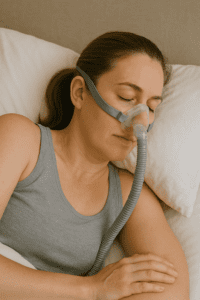
But here’s what I’ve learned after 10 years of living with severe OSA: sleeping position matters. A lot. Even with CPAP therapy, the position I sleep in affects how well my treatment works, how comfortable I am, and how rested I feel in the morning.
For some people with mild to moderate sleep apnea, simply changing sleeping positions can reduce symptoms dramatically enough that they might not need CPAP at all. For others, it’s a key piece of the puzzle that makes their treatment more effective.
Let me share what research says about sleeping positions for sleep apnea, what I’ve experienced personally, and what actually works in real life.
Understanding How Sleep Position Affects Your Airway
Before we dive into which positions are best, you need to understand what’s happening in your throat when you have obstructive sleep apnea.
OSA occurs when the muscles in your throat relax during sleep and allow your airway to partially or completely collapse. This blocks airflow, drops your oxygen levels, and forces your brain to wake you up just enough to restore breathing. This cycle repeats over and over throughout the night.
Here’s the crucial part that surprised me: gravity plays a massive role in whether your airway stays open or collapses.
When you’re lying on your back, gravity pulls your tongue, soft palate, and the soft tissues in your throat backward toward your spine. This narrows your airway significantly. Think of it like a tube being pinched from the outside. The narrower the tube, the harder it is for air to flow through.
Research using acoustic reflection techniques has shown that the pharyngeal airway becomes measurably smaller when OSA patients change from sitting to lying supine. Studies have documented increases in uvular width and narrowing of the retroglossal airway in the supine position.
When you sleep on your side, gravity pulls those same tissues sideways instead of backward. This keeps your airway more open. The upper airway actually changes shape, transitioning from a more elliptical configuration in the supine position to a rounder shape laterally.
It sounds simple, and honestly, it is. But the effects can be dramatic.
The Research on Sleep Position and Sleep Apnea
I’m not making this up or relying on anecdotes. There’s solid scientific evidence that sleep position significantly affects sleep apnea severity.
A landmark study published in the Journal of Clinical Sleep Medicine analyzed polysomnography data and found that patients’ apnea index was twice as high when sleeping on their backs compared to sleeping on their sides. Read that again. Twice as high. That’s a 100% increase in breathing interruptions just from sleeping position.
Even more remarkably, five patients in that study who met diagnostic criteria for sleep apnea when considering all positions fell within normal limits when looking only at their side sleeping data. Their sleep apnea essentially disappeared when they weren’t on their backs.
More recent research confirms these findings. Studies show that between 56% and 75% of people with OSA have what’s called positional sleep apnea, meaning their breathing problems are significantly worse in certain positions (usually supine) compared to others.
The American Academy of Sleep Medicine published a systematic review showing that positional therapy reduces AHI by an average of 54%. That’s a massive improvement from something as simple as not sleeping on your back.
Here’s what really caught my attention: approximately 20% of OSA patients experience complete resolution of their upper airway obstruction when sleeping laterally. One in five people might be able to control their sleep apnea just by changing position.
Now, I’m not one of those lucky 20%. With an AHI of 51, I still need CPAP regardless of how I sleep. But the research shows that sleep position is worth taking seriously.
Why Sleeping on Your Back Makes Sleep Apnea Worse
Let me explain what happens physiologically when you sleep supine with OSA.
First, your tongue falls backward due to gravity. In people without sleep apnea, the muscles that support the tongue maintain enough tone to prevent this. But if you have OSA, those muscles relax too much during sleep, and your tongue becomes a floppy obstruction.
Second, your soft palate and uvula drop back toward your throat. Research shows that OSA patients have significantly longer and wider uvulas than people without sleep apnea, with a shorter distance between the uvular protrusion and pharyngeal wall. When you’re on your back, that oversized uvula hangs down right into your airway.
Third, the tissues surrounding your airway press in from all sides. Lying supine increases the pressure on your throat from surrounding tissues, especially if you carry extra weight in your neck and upper body.
Studies have documented that overweight individuals experience a proportionally greater impact from supine sleeping than normal-weight individuals. The more excess tissue you have around your airway, the worse back sleeping becomes.
One fascinating finding is that people tend to sleep more on their backs during sleep studies than they do at home. The unfamiliar environment and monitoring equipment seem to make people shift to the supine position more often. This means your sleep study might actually overestimate your AHI if you naturally sleep on your side at home.
For me personally, I notice that my CPAP machine has to work harder when I’m on my back. I can hear it ramping up the pressure to keep my airway open. When I roll to my side, the machine quiets down because it doesn’t need as much force.
Side Sleeping: The Gold Standard Position
After reviewing all the research and living with sleep apnea for a decade, I can tell you that side sleeping is hands down the best position for most people with OSA.
When you sleep on your side, several good things happen. Your tongue and soft palate move sideways instead of falling backward. The lateral position allows your airway to maintain a rounder, more stable shape. The reduced pressure from gravity means your airway is less likely to collapse.
For people using CPAP therapy like me, side sleeping often means you need less pressure to keep your airway open. My CPAP machine automatically adjusts pressure throughout the night, and I’ve noticed through my CPAP data that it runs at lower pressures when I’m on my side.
Lower pressure means less air leaking from your mask, less aerophagia (air swallowing), and generally more comfortable therapy. It’s a win all around.
Side sleeping also tends to reduce snoring significantly. Even if you don’t have diagnosed sleep apnea, if you’re a snorer, side sleeping will probably make you quieter. Your partner will thank you. Trust me on this one.
Making Side Sleeping Actually Work
Here’s the problem: knowing you should sleep on your side and actually doing it all night long are two very different things.
I’ve been a back sleeper my entire life. When I first tried to force myself to sleep on my side, I’d wake up on my back an hour later. Your body has ingrained habits, and breaking them takes effort.
The Right Pillow Makes or Breaks It
I cannot overstate how important pillow choice is for side sleeping. A pillow that’s too flat will let your head drop down, misaligning your neck and airway. Too thick, and your head gets pushed up, which is also uncomfortable and can restrict breathing.
You want a pillow that keeps your head, neck, and spine in neutral alignment. For most people, this means a medium to firm pillow with good support. I’ve written extensively about the best CPAP pillows because finding the right one transformed my sleep.
If you use CPAP, you’ll want a pillow with cutouts that accommodate your mask. Regular pillows push against your mask and cause leaks. CPAP pillows have recesses that let the mask sit comfortably without pressure.
Body Pillows Are Worth It
A full-length body pillow changed the game for me. I tuck it between my knees and hug it, which keeps my spine aligned and prevents me from rolling onto my back during the night.
The pillow creates a physical barrier that makes rolling to your back uncomfortable enough that you’ll naturally shift back to your side without fully waking up. After a few weeks of using one, side sleeping became my new default position.
You can use a regular body pillow, a pregnancy pillow (yes, even if you’re a guy), or a specialized side sleeping pillow. They all work on the same principle of creating support and a barrier.
The Tennis Ball Trick Actually Works
I know it sounds goofy, but sewing or taping a tennis ball to the back of your pajamas genuinely prevents back sleeping. When you roll onto your back, the ball is uncomfortable enough that you automatically shift to your side, often without even waking up.
Some people use a backpack with something firm inside instead of a tennis ball. The concept is the same. This is a form of positional therapy for sleep apnea that research shows can be quite effective.
Modern versions include special vests or devices that vibrate when you roll onto your back, gently alerting you to change position without fully waking you. These have higher compliance rates than the tennis ball method because they’re less uncomfortable.
Give Yourself Time to Adjust
If you’re a lifelong back sleeper, don’t expect to switch to side sleeping overnight. It takes about 2 to 4 weeks for your body to adapt to a new sleep position.
The first week might be frustrating. You’ll wake up on your back. You might not sleep as well initially. That’s normal. Stick with it.
After a month, side sleeping will start feeling natural. After three months, you probably won’t even think about it anymore.
What About Sleeping on Your Stomach?
Stomach sleeping is the wild card in the sleep position discussion. Some research suggests it can help with sleep apnea because gravity pulls your tongue forward instead of backward. But it comes with significant downsides.
The biggest problem is neck strain. When you sleep on your stomach, you have to turn your head to one side to breathe. This puts your neck in a rotated, extended position for hours. Over time, this can lead to serious neck pain and stiffness.
For CPAP users, stomach sleeping is particularly challenging. I’ve tried it a few times out of curiosity, and I can tell you it’s nearly impossible with my full face mask. The mask gets pushed into my face, creates leaks, and makes it impossible to maintain a seal.
Some people can make it work with nasal pillow masks because they have a much smaller profile. But you have to be a dedicated stomach sleeper to make CPAP work in that position.
If you’re a stomach sleeper and don’t use CPAP, you might get some benefit for your sleep apnea. But I’d still recommend trying to transition to side sleeping for the long-term health of your neck and spine.
Check out my guide on the best CPAP mask for stomach sleepers if you’re determined to stick with this position.
The Back Sleeping Problem
We’ve established that back sleeping is terrible for sleep apnea. But what if you’re someone who just can’t get comfortable any other way?
Some people are committed back sleepers, and no amount of tennis balls or body pillows will change that. If that’s you, there are still ways to reduce the negative impact.
Elevate Your Head
Sleeping with your upper body elevated at an angle can reduce airway collapse even when you’re on your back. This works by changing the pressure dynamics in your throat and using gravity to help keep tissues from falling backward as severely.
You can achieve this with a wedge pillow that props up your entire upper body, or with an adjustable bed that lets you raise the head section. Some people stack multiple pillows, but this usually doesn’t work as well because you end up bending at the waist rather than creating a smooth incline.
Research shows that elevating the head of the bed by 7.5 degrees can improve sleep apnea symptoms. Even a small elevation helps.
Use CPAP or Other Therapy
If you must sleep on your back, using CPAP or another form of sleep apnea treatment becomes even more important. CPAP works by providing enough air pressure to keep your airway open despite gravity working against you.
For me, CPAP works regardless of position, but I definitely need higher pressure when I’m on my back. The machine compensates for the increased collapse tendency.
Other options include oral appliances that reposition your jaw forward, Inspire therapy that stimulates your tongue nerve, or surgical options that enlarge your airway.
Combining Sleep Position With Other Treatments
Here’s what I’ve learned: sleep position shouldn’t be your only strategy for managing sleep apnea, but it should definitely be part of your overall approach.
I use CPAP every night. That’s my primary treatment. But I also intentionally sleep on my side because it makes my CPAP work better. The combination is more effective than either strategy alone.
Think of sleep apnea management as having multiple layers:
- Position: Side sleeping reduces mechanical obstruction
- CPAP or oral appliance: Actively maintains airway opening
- Weight management: Reduces tissue crowding around the airway
- Lifestyle changes: Avoiding alcohol before bed, treating nasal congestion, etc.
Each layer adds protection. The more layers you have, the better you breathe.
For people with mild sleep apnea, changing position alone might be enough. Research shows that some people with an AHI of less than 15 can achieve normal breathing (AHI under 5) just by avoiding back sleeping.
For moderate sleep apnea, position plus an oral appliance might do the trick. For severe cases like mine, CPAP is non-negotiable, but optimizing position still helps.
Position-Dependent Sleep Apnea: Are You One of Them?
About 56% of people with OSA have position-dependent sleep apnea, defined as having an AHI that’s at least twice as high in the supine position compared to other positions.
How do you know if you’re in this category? Your sleep study report should break down your AHI by position. If you don’t have that information, ask your sleep doctor for it. It’s extremely valuable information.
If your report shows something like “AHI supine: 35, AHI lateral: 12,” you’re absolutely positional. Avoiding supine sleep could drop you from severe to moderate sleep apnea, which opens up more treatment options.
Positional patients tend to be younger, have lower overall BMI, and have less severe OSA when averaged across all positions. But the impact of position on their breathing is dramatic.
If you’re positional, you’re an ideal candidate for positional therapy devices. These range from simple (tennis ball in a shirt) to sophisticated (vibrating devices that alert you when you’re supine).
The key is finding a method you’ll actually stick with long term. Compliance with positional therapy can be challenging because these devices can be uncomfortable or annoying.
What About Your Sleeping Partner?
One underappreciated benefit of optimizing your sleep position is the impact on your partner’s sleep.
When I was sleeping on my back before diagnosis and treatment, my wife says I sounded like I was dying. She’d lie awake listening to me gasp and choke, terrified something was wrong. She’d elbow me to make me roll over, which would quiet the snoring and gasping for a while.
After I started CPAP and committed to side sleeping, her sleep quality improved dramatically. No more freight train snoring. No more terrifying pauses in breathing. She actually thanks me for using my CPAP consistently.
If you share a bed, talk to your partner about how to sleep with a snoring partner. Their observations about your breathing and snoring in different positions can be really valuable information.
Special Considerations for CPAP Users
Using CPAP adds some complexity to the sleep position discussion. Not all masks work equally well in all positions.
Side Sleepers with CPAP
This is my situation, and I’ve learned a lot about making it work. The key is finding a CPAP mask for side sleepers that doesn’t leak when pressed into the pillow.
Some masks have flexible frames that adjust when you lie on them. Others have minimal contact points that make pressure less of an issue. I’ve tried probably a dozen different masks over the years before finding ones that work consistently for side sleeping.
A CPAP pillow with cutouts for your mask prevents the pillow from pushing the mask off your face or causing leaks. This was a game-changer for me. Regular pillows just don’t work well with CPAP masks.
Mask Type Matters
Full face masks like I use are harder to side sleep with than nasal masks or nasal pillows. The larger surface area means more contact with the pillow and more opportunities for leaks.
If you’re primarily a side sleeper, consider trying nasal masks if you can breathe through your nose. They have a smaller profile and work better for side sleeping.
Nasal pillows are even better for side sleeping because they have minimal contact with your face. But they only work if you keep your mouth closed during sleep. Some people need chin straps to prevent mouth breathing.
Learn more about choosing the right CPAP mask and the different CPAP mask types available.
Practical Tips I’ve Learned Over 10 Years
After a decade of managing severe sleep apnea, here’s the practical advice I’d give anyone trying to optimize their sleep position:
Start Gradually
Don’t try to force yourself into a new position all at once. Start by lying on your side for the first hour of sleep, then allow yourself to move to whatever feels comfortable. Over weeks, extend the time on your side.
Track Your Progress
If you use CPAP, use OSCAR software to track your AHI in different positions. Most modern CPAP machines track positional data. This objective information tells you whether your position changes are actually helping.
Address the Root Causes
Optimizing sleep position is great, but don’t ignore other aspects of sleep apnea treatment. If you’re overweight, work on CPAP therapy and weight loss together. If you have nasal congestion, treat it. If you need CPAP, use it consistently.
Be Patient With Yourself
Changing lifelong sleep habits is hard. You’ll have setbacks. You’ll wake up on your back sometimes. That’s fine. Progress, not perfection.
Invest in the Right Equipment
Good pillows, a quality mattress, and proper CPAP equipment make a massive difference. Don’t cheap out on things you use 7-8 hours every single night. They’re worth the investment.
When Sleep Position Isn’t Enough
For some people, optimizing sleep position helps but doesn’t solve the problem completely. That was certainly true for me.
If you’ve committed to side sleeping for several months and you’re still experiencing symptoms like severe daytime sleepiness, morning headaches, or witnessed breathing pauses, you need more than positional therapy.
Use tools like the Epworth Sleepiness Scale to objectively measure your daytime sleepiness. If you’re still scoring high despite optimal sleep position, talk to your doctor about other sleep apnea treatment options.
Sometimes structural issues like a deviated septum, enlarged tonsils, or jaw position contribute to OSA regardless of sleeping position. These may require surgical correction.
Understanding what is sleep apnea and how it’s diagnosed helps you make informed treatment decisions.
The Bottom Line on Sleep Position
After 10 years of living with severe obstructive sleep apnea, here’s what I believe about sleep position:
For most people with OSA, side sleeping is significantly better than back sleeping. The research is clear, and my personal experience confirms it. If you can make one simple change that might reduce your AHI by 50%, why wouldn’t you?
Sleep position alone probably won’t cure moderate to severe sleep apnea. I still need CPAP every night, regardless of how I sleep. But the position makes my therapy more effective and comfortable.
The combination of optimal position and appropriate treatment is better than either alone. Layer your defenses. Use CPAP or an oral appliance AND sleep on your side. The synergy matters.
Finding what works for you requires some experimentation. Try different pillows, different sleeping aids, different positions. Track your results objectively. What works for me might not work for you.
Don’t let perfect be the enemy of good. If you can manage side sleeping 70% of the night instead of 100%, that’s still a massive improvement over staying on your back all night.
I sleep on my side now with my CPAP mask every single night. It took time to adapt, required the right equipment, and needed consistent effort. But the improvement in my sleep quality and how I feel during the day makes it absolutely worth it.
If you’re dealing with sleep apnea, experiment with your sleeping position. It might not be a complete solution, but it’s a piece of the puzzle that can make a real difference.
Related Resources
For more information on managing sleep apnea and improving your sleep quality:
Understanding Sleep Apnea:
- What Is Sleep Apnea
- Obstructive Sleep Apnea
- Sleep Apnea Symptoms
- Sleep Apnea Diagnosis
- AHI (Apnea-Hypopnea Index)
CPAP and Treatment:
- Sleep Apnea Treatment Options
- Best CPAP Machines
- Best CPAP Masks
- How to Use a CPAP Machine
- How to Get Used to CPAP Therapy
Sleep Optimization:
- How to Sleep Better with Sleep Apnea
- Best CPAP Pillows
- Living with Sleep Apnea
- Positional Therapy for Sleep Apnea
Alternative Treatments:
- Alternative Treatments for Sleep Apnea
- Best Sleep Apnea Mouth Guards
- Sleep Apnea Surgery
- Sleep Apnea Inspire Treatment
Remember, I’m not a doctor, just someone who’s been managing severe sleep apnea for over a decade. This information comes from research and personal experience, but it’s not a substitute for medical advice. Always consult with your sleep specialist before making changes to your treatment plan.
If you found this helpful, please share your own experiences with sleep position in the comments below. What’s worked for you? What hasn’t? We’re all learning together.
References:
- Joosten SA, et al. “The effect of body position on physiological factors that contribute to obstructive sleep apnea.” SLEEP, 2015. https://pmc.ncbi.nlm.nih.gov/articles/PMC4531415/ Ravesloot MJ, et al. “Efficacy of the new generation of devices for positional therapy for patients with positional obstructive sleep apnea: A systematic review of the literature and meta-analysis.” Journal of Clinical Sleep Medicine, 2017. https://jcsm.aasm.org/doi/10.5664/jcsm.6622 Cartwright RD, et al. “Effect of sleep position on sleep apnea severity.” SLEEP, 1984. https://pubmed.ncbi.nlm.nih.gov/6740055/ Oksenberg A, et al. “The role of sleep position in obstructive sleep apnea syndrome.” European Respiratory Journal, 2006. https://pubmed.ncbi.nlm.nih.gov/16802139/ Ravesloot MJ, et al. “The undervalued potential of positional therapy in position-dependent snoring and obstructive sleep apnea—a review of the literature.” Sleep and Breathing, 2013. https://pmc.ncbi.nlm.nih.gov/articles/PMC3575552/
⚠️ MEDICAL DISCLAIMER This blog provides general information only and is not a substitute for professional medical advice, diagnosis, or treatment. Sleep apnea is a serious condition, and CPAP equipment should be used under proper medical supervision. Always consult your doctor or sleep specialist before starting, stopping, or changing any therapy. I share personal experiences as a CPAP user, not as a medical professional. Individual results vary. For medical guidance, please consult a qualified clinician or the American Academy of Sleep Medicine (aasm.org).