Best CPAP Mask for Stomach Sleepers: Top 4 Ranked for 2026

“This post contains affiliate links. I may earn a commission if you buy through these links, at no extra cost to you. Read my Disclaimer for more details.”
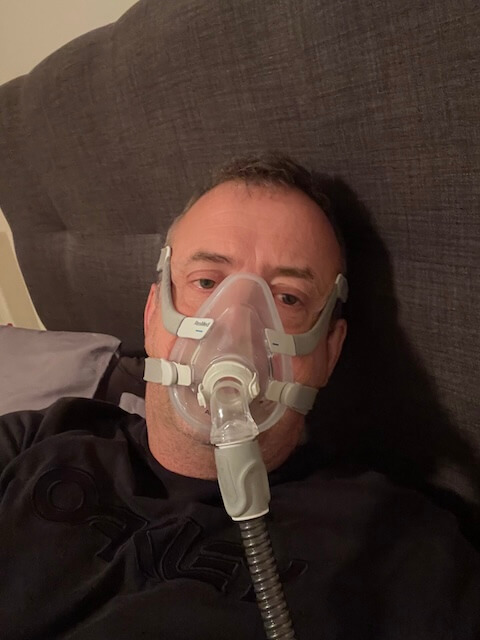
I need to be upfront about something before we get into the recommendations: I am not a stomach sleeper. I have used the ResMed AirFit F20 full face mask every night for more than a decade, and sleeping face down with that mask would be like trying to nap on a dinner plate. It is simply not built for it.
So why am I writing this guide? Because after more than a decade of nightly CPAP therapy for severe obstructive sleep apnea, I understand the thing that makes or breaks treatment for every sleep position: the seal. I know what a leak sounds like at two in the morning. I know how a mask that fights your sleep style slowly convinces you to quit therapy altogether. And I know how to read mask engineering well enough to explain why most masks fail stomach sleepers and why a small handful succeed.
This is a research-based guide, not a personal review. I have not slept in these masks myself, and I will not pretend otherwise. What follows comes from studying how these masks are engineered, what the manufacturers actually claim, and what the published research says about sleep position and CPAP therapy. Where my own experience is relevant, I will tell you. Where it is not, I will say so.
If you sleep on your stomach, you are working with the least common sleep position and the one that is hardest to pair with CPAP equipment. The good news is that mask design has come a long way, and there are now several masks built specifically to survive a night of face-down sleeping.
The 4 Best CPAP Masks for Stomach Sleepers
These four masks share one critical design feature: the hose connects at the crown of the head instead of the front of the face. That single change is what makes stomach sleeping with CPAP possible. Here is how they rank and who each one suits.
1. ResMed AirFit P30i – Best Overall for Stomach Sleepers
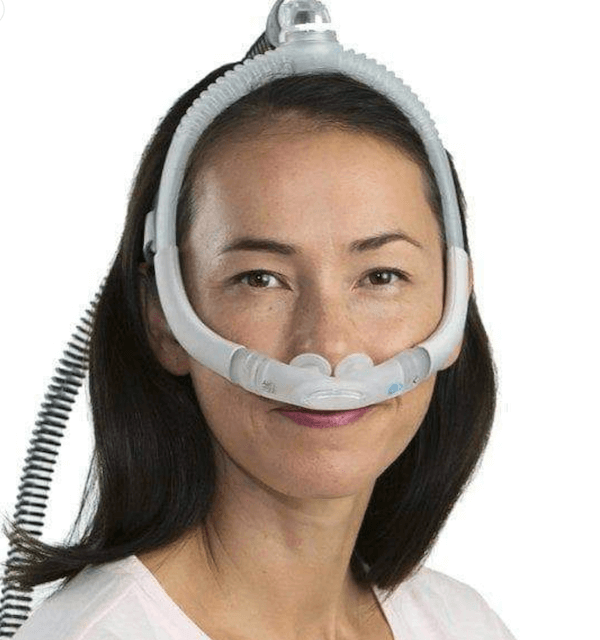
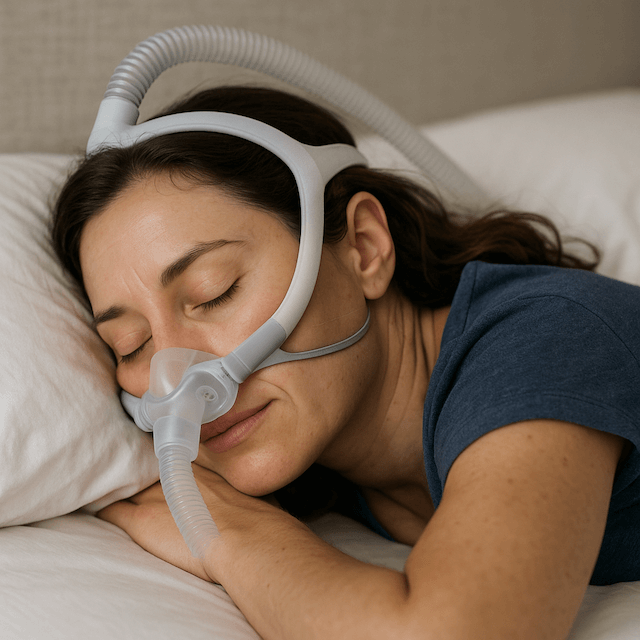
The AirFit P30i solves the fundamental problem of stomach sleeping with its overhead hose connection. The tube rises from the crown of your head, which means pillow contact does not create tension on the mask seal. When you turn your head during the night, nothing pulls on your face.
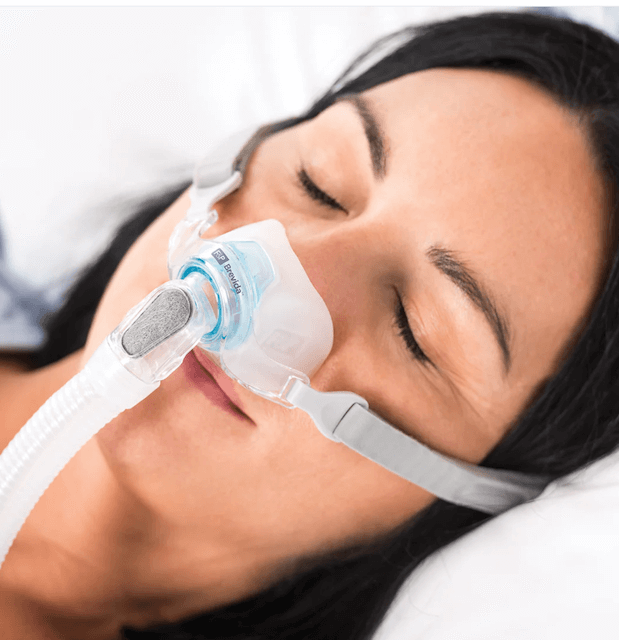
The mask itself is a nasal pillow design, which means the only facial contact is two small cushions that sit at the entrance of your nostrils. There is no cushion spanning your cheeks, no frame across your forehead, and almost nothing between your face and the pillow. For a stomach sleeper, less mask means fewer things for the pillow to push out of place.
The SpringFit frame is the other half of the story. Rather than holding a rigid shape, the frame flexes and adapts as you move, so positional changes during the night are absorbed by the frame instead of being transferred to the seal. ResMed pairs this with QuietAir venting, which diffuses your exhaled air rather than blasting it in a single stream. That matters more than you might expect when your face is inches from a pillow, because a concentrated vent stream bouncing off fabric is loud enough to wake a partner.
Key details:
- Nasal pillow mask with multiple cushion sizes in the box
- Hose connection at the top of the head with a swivel that rotates freely
- QuietAir diffused venting for quieter exhalation
- Compatible with standard CPAP and BiPAP tubing
- One of the lightest and most minimal masks ResMed makes
Best for: stomach sleepers who breathe through their nose. If your nose stays clear at night, start here.
Limitations: this is not a mask for mouth breathers unless you add a chin strap, and like most nasal pillow designs it can feel less stable at higher pressure settings. If your prescribed pressure is on the high end, talk to your equipment provider about whether a pillow mask will hold its seal for you.
2. ResMed AirTouch N30 – Most Comfortable
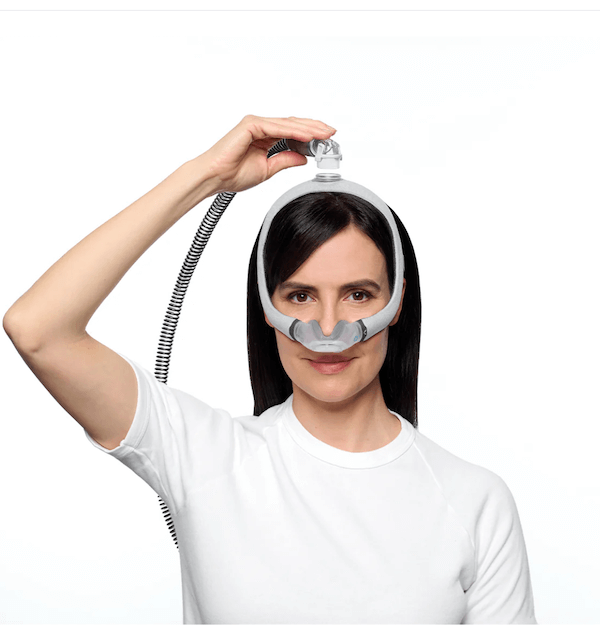
The AirTouch N30 takes the same overhead tube architecture as the P30i and swaps the silicone nasal pillows for a memory foam cradle that rests under the nose. Nothing is inserted into the nostrils. If the idea of pillows sitting in your nose makes you wince, this is your alternative.
The UltraSoft memory foam cushion is the headline feature. Foam conforms to the contours of your face in a way silicone cannot, which makes this one of the gentlest seals on the market. People with sensitive skin or nostril irritation often tolerate foam where silicone failed them, and the broader contact area of a cradle design distributes pressure more evenly than two concentrated pillow points. If you have struggled with soreness at the nostrils, or you are shopping around a deviated septum, the under nose cradle approach is worth understanding before you commit to pillows.
The frame behaves the same way as the P30i in practice: hose at the crown, free swivel, and a low profile that leaves your field of vision clear and your cheeks untouched.
Key details:
- Nasal cradle design that sits under the nose with no nostril inserts
- UltraSoft memory foam cushion that molds to facial contours
- Hose connection at the top of the head
- Multiple cushion sizes available
- Frame and headgear are washable; the foam cushion is replaced rather than washed
Best for: sensitive skin, nostril irritation, or anyone who wants the overhead tube layout without anything inserted in the nose.
Limitations: the memory foam cushion cannot be washed and is designed to be replaced roughly every month per ResMed’s guidance, which raises the ongoing cost compared with silicone. Foam also compresses gradually with use, so expect the seal to soften toward the end of each cushion’s life. Factor that into your replacement schedule.
3. Philips Respironics DreamWear Nasal CPAP Mask – Best Alternative to ResMed
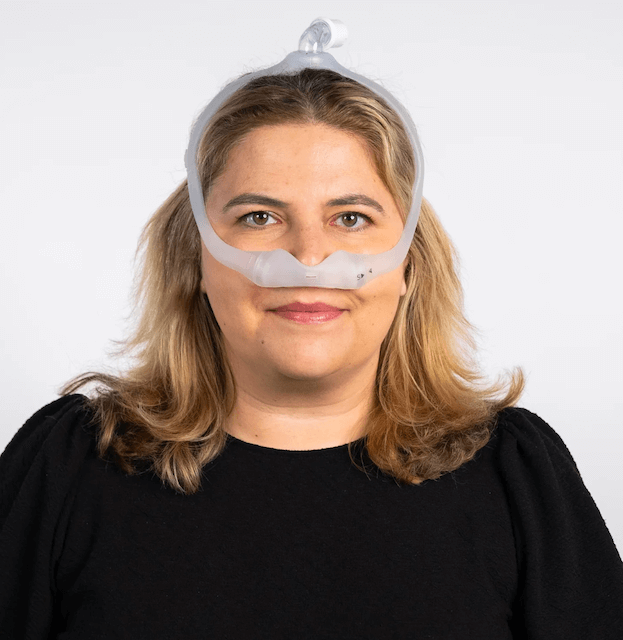
If ResMed masks do not suit your face, the DreamWear is the next stop. Philips pioneered the in frame airflow concept that this whole category is built on, and the DreamWear remains an excellent stomach sleeping option in its own right.
The design is clever. The frame itself is hollow, and air flows through it from the connection point at the crown of your head down to a soft cushion that sits under your nose. There is no tube hanging in front of your face at all, and the frame channels that run along your cheeks are soft enough to compress against a pillow without digging in.
The other thing the DreamWear does well is modularity. The same frame accepts different cushion types, so if you start with the nasal cushion and later decide you need different coverage, you can often change the cushion rather than the entire mask. That flexibility is genuinely useful when you are still figuring out what works for your sleep style.
Key details:
- Under-nose nasal cushion with no nostril inserts
- Hollow frame that carries airflow, eliminating front tubing entirely
- Swivel connection at the top of the head
- Modular design that accepts different cushion styles on the same frame
- Works with standard CPAP tubing
Best for: people whose facial structure does not match ResMed’s cushion shapes, anyone already in the Philips equipment ecosystem, and sleepers who want the option to change cushion styles without buying a whole new mask.
Limitations: the frame is slightly bulkier than the P30i’s minimal design, and some users report the under-nose cushion needs careful sizing to seal reliably at higher pressures. As with any mask, correct pressure settings and correct cushion size matter more than brand loyalty.
4. ResMed AirFit F30i – Best for Mouth-Breathing Stomach Sleepers
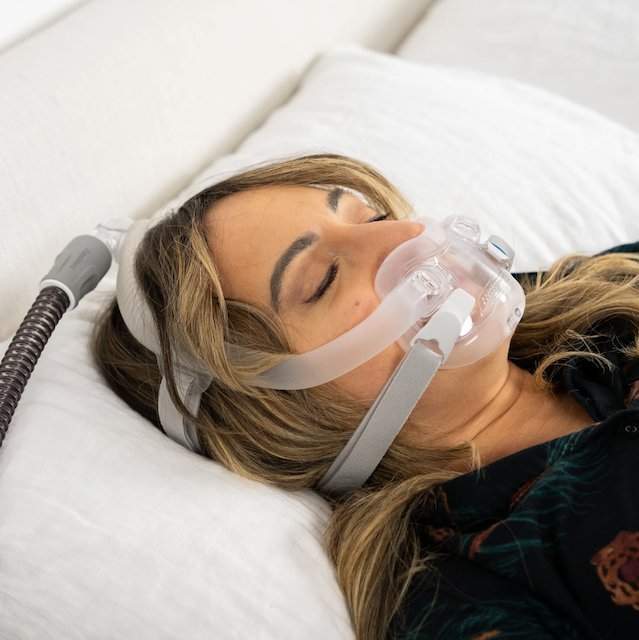
This is the answer to the hardest question in this category: what do you do if you sleep on your stomach and you breathe through your mouth? As a lifelong mouth breather myself, this is the one I find most interesting, because it solves a problem I know intimately from the other side.
Traditional full face masks are a disaster for stomach sleeping. My F20 covers the nose and mouth with a large cushion and connects to the hose right at the front of the face. Press that into a pillow and you get leaks, pressure marks, and a mask shoved sideways by morning. The F30i rethinks the whole layout. The cushion sits under the nose and over the mouth, so there is nothing on the bridge of your nose and far less mask between your face and the pillow. The hose connects at the crown of the head, same as the other masks on this list, so pillow contact does not drag the seal out of position.
The result is the only full face design I would point a stomach sleeper toward. It still covers the mouth, so mouth breathers get the full therapy circuit without a chin strap, but it carries a fraction of the bulk of a traditional full face mask.
Key details:
- Full face coverage with an under-nose cushion, leaving the nasal bridge free
- Hose connection at the top of the head
- Magnetic headgear clips for easy on and off
- Compact cushion that minimizes total facial coverage
- Multiple cushion sizes available
Best for: mouth breathers, people with chronic nasal congestion or nasal obstruction, and stomach sleepers who need the stability of full face coverage at higher pressures.
Limitations: it is still bulkier than any nasal option on this list, and most people need an adjustment period of several nights before it feels normal. One safety note worth knowing: masks with magnetic clips carry manufacturer warnings for people with pacemakers, implanted defibrillators, and certain other medical implants. If that applies to you or your bed partner, raise it with your doctor before choosing a magnetic mask.
Why Stomach Sleeping Makes CPAP So Difficult
It helps to understand exactly what you are up against, because once you see the mechanics, the mask recommendations above stop looking arbitrary.
The Physics of Face Down Sleep
When you sleep on your stomach, your face presses into the pillow. That creates three mechanical problems that back and side sleepers never deal with.
The first is direct pillow pressure on the mask. A pillow pushes against the cushion from angles the mask was never designed to resist, and the seal breaks. This is not a small effect. The Sleep Foundation notes that stomach sleeping can push a CPAP mask out of place, leading to air leaks, dry mouth, and reduced therapy effectiveness. Every leak is pressurized air that never reaches your airway, which means your machine is running but your therapy is not fully happening.
The second is forced neck rotation. Nobody sleeps with their face planted straight down into a pillow, so stomach sleeping means turning your head to one side. That rotation pulls on headgear straps and shifts the mask across your face over the course of the night. A mask that was sealed at lights out can be leaking by midnight purely because your head turned forty five degrees.
The third is tubing entanglement. A hose connected at the front of the face becomes an anchor point when you are face down. You roll, the hose catches, the mask shifts, and air starts hissing across your cheek. This is the specific problem that overhead tube connections were invented to solve, and it is why every mask on this list shares that design.
What the Position Does to Your Apnea
Sleep position interacts with sleep apnea itself, not just with the equipment. For the most common form, obstructive sleep apnea, back sleeping is the worst position because gravity pulls the tongue and soft tissue toward the back of the throat. Stomach sleeping actually works in the opposite direction, letting gravity pull tissue forward and away from the airway, and some limited research suggests it can reduce breathing pauses for certain people.
But there is a catch, and it is a big one. Whatever theoretical airway benefit stomach sleeping offers gets wiped out if the position makes your CPAP leak all night. Effective therapy with a sealed mask beats positional benefit with a leaking one, every time. There is also the orthopedic cost: stomach sleeping strains the neck and spine through that constant head rotation, which is one reason sleep specialists rarely recommend it even when it helps the airway. If you want the deeper comparison of positions, I cover it in my guide to the best sleeping position for sleep apnea.
The Compliance Problem
Here is the part I care about most, because I have lived the early months where therapy hangs in the balance. Mask discomfort is one of the most common reasons people abandon CPAP, and stomach sleepers face more discomfort and more leaks than anyone else. A bad mask match does not just cost you comfort. It quietly erodes your willingness to put the mask on at all, and abandoned therapy means untreated sleep apnea, with everything that carries for your heart, your metabolism, and your brain.
I almost lost my own therapy in the first months, and I sleep in friendly positions. I wrote about that period in my piece on overcoming CPAP anxiety. If a mask mismatch had been stacked on top of that adjustment struggle, I am honestly not sure I would have made it to night ninety. That is why I take this category seriously even though I am not a stomach sleeper. Getting the mask right is not a comfort upgrade. It is the difference between treated and untreated apnea.
What Makes a Mask Work for Stomach Sleepers
These are the design features to evaluate on any mask, including new models that come out after this guide. Learn the features and you can judge equipment for yourself.
A Hose Connection at the Crown of the Head
This is the single most important feature, full stop. A front connected hose becomes a lever when your face hits the pillow, and every bit of pressure on the tube transfers straight to the seal. Moving the connection to the top of the head takes the hose out of the pillow zone entirely. All four masks above share this layout, and I would not consider any front connected mask for regular stomach sleeping.
Minimal Facial Contact
The less mask touching your face, the fewer pressure points when you are face down. Nasal pillows win this category outright, with under nose cradles close behind. Nasal masks with larger cushions can work for some stomach sleepers if the cushion compresses gracefully, but traditional full face masks carry too much structure to survive pillow contact, which is exactly why the F30i’s compact under nose layout exists.
A Frame That Flexes
Rigid frames hold their shape while your face moves, and something has to give. Usually it is the seal. Flexible frames like the P30i’s SpringFit design and the DreamWear’s soft hollow frame absorb movement instead of transferring it. When you read mask descriptions, look for language about the frame adapting or flexing. For stomach sleepers it is not marketing fluff, it is load bearing.
Diffused, Quiet Venting
Every CPAP mask vents your exhaled air, and where that air goes matters when your face is buried in a pillow. A focused vent stream hitting fabric a few inches away is noisy and can even disturb the seal. Diffused vent systems like ResMed’s QuietAir spread the exhalation out so it disperses quietly. Your bed partner will notice the difference before you do.
A Free Spinning Swivel
The hose connection should rotate without resistance. A swivel that spins freely means the tube can wrap and unwrap around your movements all night without ever applying torque to the mask. All the masks above include one, but it is worth checking on anything else you consider.
Beyond the Mask: The Rest of Your Stomach Sleeping Setup
The mask is the centerpiece, but stomach sleepers need the whole setup working together. This is where small purchases and small habits pay off disproportionately.
A CPAP Pillow Is Not a Gimmick
A standard pillow forces your mask to compress against a flat surface. A CPAP pillow is cut with recesses that give the mask somewhere to exist while your head rests normally. For stomach sleepers who rotate their head to one side, the side cutouts on these pillows are exactly where your mask ends up. Of everything in this section, this is the purchase I would make on the same day as the mask. I keep a full roundup of the options in my CPAP pillow guide.
Manage the Hose
With an overhead tube connection, hose pull is already greatly reduced, but slack management still helps. A hose holder suspends the tube above your head so the weight of the hose never hangs off your mask, and so a roll to the left does not pull a tube that is trapped under your right side. A headboard mounted lift or even a simple clip arrangement is enough. The goal is freedom of movement without tension.
Get Humidity Right
Humidification keeps your airway comfortable, but it interacts with mask seal in a way stomach sleepers should understand. Run the humidifier too warm for your room temperature and you get rainout, which is condensation forming inside the tube and pooling where the tube meets the mask. Water at the seal line of an under nose cushion is a leak waiting to happen. Start at a moderate humidity setting, adjust gradually, and consider heated tubing if condensation keeps showing up. Heated tube plus sensible humidity has been the most reliable combination in my own setup for years.
Wash Your Face, Then Your Mask
This sounds trivial and it is not. Skin oil is the enemy of a good seal, and stomach sleepers have no margin for a compromised cushion. Washing your face before bed removes the oil layer that makes silicone slide instead of grip. The same logic applies to the cushion itself. I wash my mask cushion every morning and do a deeper clean weekly, and after more than a decade I can tell you the difference between a clean cushion and a three day old one shows up directly in the seal. My full routine is in my guide to cleaning your CPAP equipment.
Should You Just Change How You Sleep?
I want to be honest about the elephant in the room: some sleep specialists would tell a struggling stomach sleeper to retrain their position rather than chase equipment.
There is a fair case for it. Side sleeping pairs beautifully with CPAP, keeps the airway in a favorable position, and opens up your mask options to almost everything on the market. Positional retraining is also more achievable than people assume. The old tennis ball trick, a ball in the back pocket of a backward shirt to make back sleeping uncomfortable, has a modern equivalent in positional therapy devices that vibrate gently when you drift into an unwanted position. People do successfully retrain over a period of weeks.
But I am not going to pretend everyone can or should. Some people have spent fifty years falling asleep face down and their nervous system simply will not cooperate any other way. Chronic pain, old injuries, and plain ingrained habit are all real. If stomach sleeping is how you actually sleep, then forcing a position change can cost you more sleep than the apnea was costing you, and the right answer is to build a setup that works with your body instead of against it. That is what this guide is for.
Troubleshooting Common Stomach Sleeper Problems
Even with the right mask, expect some tuning. These are the issues that come up most and how to approach them.
The Mask Still Leaks Face Down
Check cushion size first, because the wrong size will defeat every other fix. Most masks ship with several sizes in the box, so experiment. Next, check headgear tension. The instinct when fighting leaks is to crank the straps tighter, and it is almost always wrong. An overtightened cushion distorts and leaks more, not less. The straps should be snug enough that the mask does not slide, and no tighter. If leaks persist, mask liners can improve the seal against skin, and make sure your pillow is giving the mask clearance rather than fighting it. If you have done all of that and the mask still will not hold, the cushion geometry may simply not match your face. Move to the next design on the list rather than forcing it.
Neck or Shoulder Pain
Stomach sleeping loads the cervical spine through that sustained head rotation, and CPAP gear can make a marginal pillow situation worse. A thinner pillow reduces the angle your neck has to hold, and a CPAP pillow keeps the mask from adding pressure on top of the rotation. If pain persists despite a sensible setup, that is a conversation for a physical therapist or your doctor, because the position itself may be the problem rather than the equipment.
Dry Mouth Despite a Nasal Mask
Dry mouth with a nasal mask usually means your mouth is opening during sleep, and pressurized air is escaping through it instead of holding your airway open. I am a chronic mouth breather, so this failure mode is the reason I have worn a full face mask from my very first night. You have three escalating options: a chin strap to hold the jaw closed, more humidity to ease the dryness while you work on it, and if neither solves it, a move to the F30i or another full face design. CPAP dry mouth is manageable, but only if you address the air escape rather than just the symptom.
Strap Marks and Skin Irritation
Pillow pressure pushes headgear into your skin harder than other positions do. Strap covers and mask liners add a soft barrier, and double checking that you have not overtightened the headgear solves more irritation cases than any product does. Persistent redness or rash that does not track with strap pressure can be contact irritation from mask materials, which is worth showing to your doctor rather than pushing through.
You Cannot Fall Asleep With the Mask On
This one is less about the pillow and more about the brain, and I know it firsthand. Stomach sleepers often describe feeling trapped, with the mask pinned between face and pillow. The desensitization playbook works: wear the mask during the day while reading or watching television so your nervous system stops flagging it as a threat, use your machine’s ramp feature so pressure starts low, and put the mask on with the lights already out. I wrote a full guide on getting used to CPAP therapy and another on CPAP anxiety from my own rocky first months. Give a new mask a few weeks of honest effort before you conclude it is the wrong one.
Compliance, Insurance, and Why Mask Fit Has Paperwork Consequences
If your insurance covers your equipment, there is a practical wrinkle to all of this: most insurers require documented compliance to keep covering supplies, typically a minimum number of hours per night across a measurement period. A leaking, miserable mask does not just hurt your sleep. It drags down your recorded usage, which can jeopardize coverage for replacement supplies, which makes everything harder still.
If a mask mismatch is threatening your compliance numbers, act early rather than waiting out the measurement window. Many suppliers and insurance plans allow mask exchanges within an initial trial window, so use it. Document what you have tried and what failed, loop in your sleep medicine provider, and if leaks are bad enough to compromise therapy data, ask whether a follow up assessment makes sense. Some people also choose to buy a trial mask out of pocket rather than fight a coverage battle. The goal is always effective therapy, not just a usage number, but the usage number follows naturally once the equipment stops fighting you.
What Is Actually at Stake
I want to zoom out from cushions and swivels for a moment, because it is easy to lose the plot in equipment details.
Sleep apnea left untreated is not a snoring problem or a tiredness problem. It is a cardiovascular stressor, a metabolic disruptor, and a cognitive drain, night after night. The links between untreated apnea and heart disease, stroke risk, insulin resistance, brain fog, and mental health struggles are well established in the medical literature, and consistent CPAP use is the most effective tool we have against all of it. Used properly, CPAP therapy is associated with meaningful gains in health and longevity.
I can speak to the other side of that ledger personally. My AHI was 51 when I was diagnosed, which put me deep into severe territory, and treatment resolved morning headaches and migraines I had assumed were just part of who I was. None of that happens without a mask I could actually sleep in. For me that mask was easy to find because I sleep in CPAP-friendly positions. For you it takes more deliberate equipment choices, and that extra effort is worth making, because the mask that stays sealed is the mask that delivers the therapy.
Special Situations for Stomach Sleepers
Traveling With Your Setup
Travel is the one part of this guide where I can speak from direct experience, because I travel internationally with my therapy. I use a ResMed AirMini as my travel machine, and the thing I learned quickly is that the mask question and the machine question are connected. The AirMini uses waterless humidification cartridges that are specific to the mask you pair it with, so your mask choice at home follows you onto the plane.
For stomach sleepers, travel adds the hotel pillow problem. You cannot count on a mask friendly pillow away from home, so the minimal designs earn their keep on the road. A nasal pillow mask like the P30i tolerates an unfamiliar pillow far better than anything bulkier, and packing a spare cushion takes almost no space. If you cannot bring your CPAP pillow, a rolled towel under the edge of the hotel pillow can create enough clearance to get through the night.
Beards
Facial hair interferes with any seal that relies on skin contact, and stomach sleeping makes it worse by grinding the beard into the cushion all night. The practical answer is the same one I give in my guide to CPAP masks for beards: nasal pillows seal at the nostrils rather than on the skin, bypassing the beard entirely. A bearded stomach sleeper should look at the P30i first and treat everything else as a fallback.
Fit for Women
Mask sizing has historically been built around average male facial dimensions, and masks sized for women or simply offered in smaller cushion sizes often fit narrower nose bridges and smaller features better. Every mask on this list comes in multiple cushion sizes, including small options, so the recommendation here is less about a different product and more about insisting on a proper sizing rather than accepting whatever default your supplier hands over.
Children
Sleep apnea in children is its own subject, and kids are frequent stomach sleepers with faces that change shape as they grow. Minimal contact designs tend to suit them, but pediatric fitting belongs entirely with a pediatric sleep specialist, and masks for children should be selected and refitted under that supervision rather than from a blog, mine included.
If No Mask Works: The Alternatives
A small number of stomach sleepers exhaust every mask design and still cannot maintain a workable seal. If that is where you land after honest effort, alternatives exist, and they are worth discussing with your sleep specialist rather than abandoning treatment.
Oral appliances, sometimes called sleep apnea mouth guards, reposition the lower jaw to keep the airway open and have no external hardware at all, which makes them naturally compatible with face down sleeping. They are generally less effective than CPAP for moderate to severe apnea, but for milder cases or as a fallback after genuine CPAP failure they have a legitimate place.
Surgical options range from tissue procedures like UPPP to hypoglossal nerve stimulation, which is an implanted system with no mask at all. Surgery removes the equipment problem entirely, but outcomes vary by procedure and patient, and recovery is not trivial, so this is a path you walk with a specialist, not a product you order.
It is also worth knowing that BiPAP machines and ASV devices deliver pressure differently than standard CPAP but use the same masks, so they change the breathing experience without changing the stomach sleeping equation. They solve a different problem.
For the broader landscape beyond machines entirely, I keep a guide to alternative treatments for sleep apnea.
Final Thoughts: Your Path Forward
I will not pretend stomach sleeping with CPAP is easy, and I will not pretend I have lived it. What I can tell you, from more than a decade of nights on this therapy, is that the people who succeed long term are the ones whose equipment stopped being a nightly fight. Here is the path I would lay out if we were talking in person.
Start with the ResMed AirFit P30i if you breathe through your nose. It is the most purpose built mask in this category, and its overhead tube and minimal footprint address the two biggest stomach sleeping failures directly. If nostril inserts bother you, the AirTouch N30i gives you the same architecture with a gentler foam touch. If ResMed’s shapes do not fit your face, the DreamWear is a genuinely excellent third option rather than a consolation prize. And if you are a mouth breather like me, skip straight to the F30i, because no chin strap workaround beats a mask designed for the job.
Buy a CPAP pillow at the same time as the mask, not as a later upgrade. Give any new mask a few weeks of honest adjustment before you judge it. Keep an eye on your leak rate and AHI in your machine’s app, because the numbers will tell you whether the seal is holding before your body does. And keep the cushion clean, because stomach sleepers need every bit of grip a clean cushion provides.
The hours you are awake run on the hours you sleep. You should not have to choose between the position your body wants and the therapy your body needs, and with the right equipment, you do not have to.
Frequently Asked Questions
Can I sleep on my stomach with a full face CPAP mask?
With a traditional full face mask, realistically no. The bulk and the front mounted hose make sustained face down sleeping a leak factory. The exception is the ResMed AirFit F30i, which was designed around this exact problem with an under nose cushion and an overhead hose connection. It is still more challenging than a nasal option, but it makes full face stomach sleeping genuinely workable.
Why does my mask leak more on my stomach?
Pillow pressure pushes the cushion from angles it was not designed to resist, and head rotation drags the headgear across the night. Masks with crown of head hose connections and minimal facial contact reduce both problems dramatically, which is why every recommendation in this guide shares that design.
Will insurance cover trying multiple masks?
Many plans and suppliers allow mask exchanges within an initial trial window after purchase, precisely because fit is so personal. Check the durable medical equipment terms of your specific plan, and start any exchange process early rather than waiting until the window closes.
Can I switch between masks depending on position?
You can, and some people keep two masks for different situations. My suggestion is to aim for one mask that handles all your positions, because consistency helps both comfort and compliance, but a second mask is a reasonable tool if your sleep genuinely varies.
My study says I am a side sleeper but I wake up on my stomach. Which mask do I pick?
Choose for where you end up, not where you start. Waking face down means you are spending real time there, and a mask that survives stomach sleeping will handle side sleeping easily. The reverse is not true.
For authoritative medical guidance on sleep apnea treatment, consult the American Academy of Sleep Medicine at aasm.org or your healthcare provider.
⚠️ MEDICAL DISCLAIMER This blog provides general information only and is not a substitute for professional medical advice, diagnosis, or treatment. Sleep apnea is a serious condition, and CPAP equipment should be used under proper medical supervision. Always consult your doctor or sleep specialist before starting, stopping, or changing any therapy. I share personal experiences as a CPAP user, not as a medical professional. Individual results vary. For medical guidance, please consult a qualified clinician or the American Academy of Sleep Medicine (aasm.org).