Do You Need a Prescription for CPAP Machine?


If you have just been diagnosed with sleep apnea, here is something most new patients do not see coming: you cannot walk into a store and buy a CPAP machine the way you would buy a humidifier or a blood pressure cuff. In the United States, CPAP equipment sits behind the same prescription gate that medications do. The reasons are partly regulatory and partly clinical, and once you understand them, the process turns out to be a lot less daunting than it first looks.
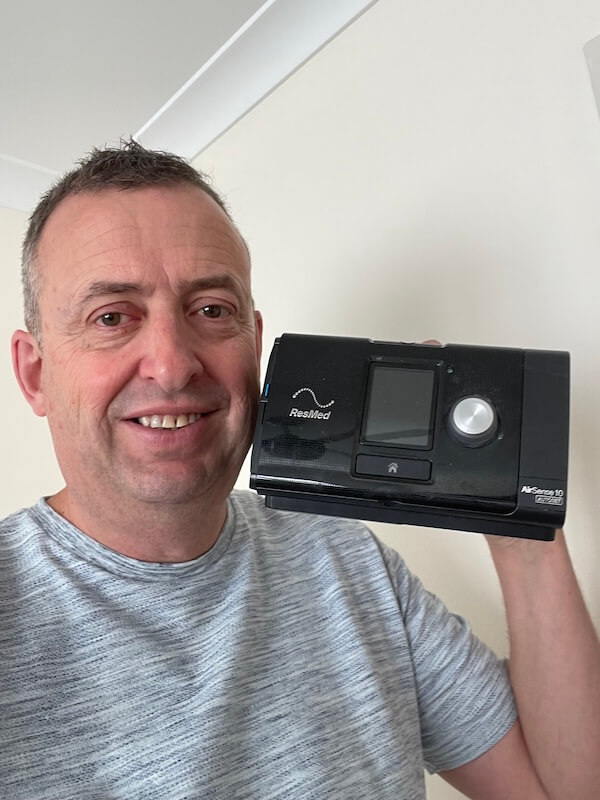
This guide is written for US readers navigating that gate, whether you are about to start therapy for the first time or you are coming up on a renewal. I write about CPAP from the patient side. I have used a ResMed AirSense 10 for the better part of a decade for severe obstructive sleep apnea (my AHI at diagnosis was 51). I am not a clinician, and nothing here is a substitute for guidance from your physician or sleep specialist. The regulatory specifics below come from the FDA, the American Academy of Sleep Medicine, Medicare, and the Centers for Medicare and Medicaid Services.
Why CPAP requires a prescription in the first place
In October 2018, the FDA reclassified positive airway pressure delivery systems from Class III to Class II medical devices. As reported by the American Academy of Sleep Medicine, the reclassification reduced some manufacturer burden while keeping the prescription requirement in place. The FDA’s Federal Register notice states plainly that positive airway pressure delivery systems are for prescription use only and are exempt from the requirement to provide adequate directions for use by a layperson.
Why the gate? A few reasons hold up well.
The first is pressure personalization. CPAP only works when the pressure delivered to your airway is high enough to keep it open during the night but not so high that it triggers leaks, swallowing air, or repeated awakenings. According to the AASM clinical guidelines on manual titration, that ideal pressure is determined during a sleep study, where the technician raises pressure step by step until apneas, hypopneas, respiratory effort related arousals, and snoring are all eliminated. There is no shortcut to that number. It is not the same for every patient with the same body type, and it cannot be guessed from a symptom checklist.
The second is matching the device to the diagnosis. Sleep apnea is not one condition. It includes obstructive sleep apnea, central sleep apnea, and complex or mixed forms. Each can call for a different treatment approach, and the AASM treatment guidelines describe several device categories: standard CPAP at one fixed pressure, auto adjusting CPAP that responds to your airway in real time, BiPAP with separate inhale and exhale pressures, and adaptive servo ventilation for certain central or complex patterns. A prescription is the mechanism that puts you on the right one.
The third reason is ongoing oversight. Sleep apnea is not a problem you solve once and then forget. Weight changes, aging, new medications, surgical history, and other medical events can shift your pressure needs over time. The AASM systematic review recommends that PAP therapy be paired with clinical follow up, not handed out and forgotten. The prescription requirement keeps you tied to a clinician who can adjust your treatment when life changes.
The fourth is insurance. According to Medicare.gov, Medicare Part B covers CPAP under the durable medical equipment benefit only when medical necessity has been documented and the equipment was prescribed. Private insurers operate the same way. Without a valid prescription and the right documentation, you are paying out of pocket and losing access to the supply coverage that makes years of therapy affordable.
What a CPAP prescription actually contains
A valid CPAP prescription is short, but every line on it is doing real work, both for your DME supplier and for your insurer.
You will see your full legal name, sometimes accompanied by date of birth or address. You will see the prescriber’s name, credentials, license number, contact information, and signature, whether handwritten or electronic. You will see the diagnosis, almost always the ICD-10 code G47.33 for obstructive sleep apnea, sometimes paired with your AHI or sleep study date. And you will see a date the prescription was written.
The device portion is where it gets specific. According to Medicare guidelines and standard supplier practice in the US:
For a fixed pressure CPAP, the prescription names CPAP or “Continuous Positive Airway Pressure” along with an exact pressure setting, such as “CPAP at 10 cm H2O.”
For an auto-adjusting machine (APAP), it uses one of the recognized terms: APAP, AutoPAP, AutoSet, Auto CPAP, Auto Adjusting CPAP, or Self Adjusting CPAP. A pressure range typically accompanies it, such as “APAP 5 to 15 cm H2O.”
For BiPAP or VPAP, it names the device type along with separate IPAP (inhale) and EPAP (exhale) pressures, for example, “BiPAP IPAP 15 EPAP 11.”
For masks and humidifiers, the prescription usually just references “CPAP mask,” “CPAP supplies,” or “CPAP humidifier” and may reference the machine type. Specific pressure settings are not required on the mask line.
That is essentially the whole document. The reason it can be that compact is that the heavy clinical reasoning lives in the sleep study report, not on the prescription itself.
Getting a prescription: the traditional pathway
The conventional route, still the most common in the United States, takes you from symptoms through a sleep study to a written prescription.
It usually starts with the classic sleep apnea symptoms: heavy and persistent snoring, witnessed breathing pauses, gasping or choking awakenings, daytime sleepiness that resists caffeine, morning headaches, mood changes, and concentration difficulties. A partner is often the one who first raises the alarm. Mine certainly was.
The next step is a visit to a primary care physician. They take a history, look at risk factors such as BMI, neck circumference, and blood pressure, and decide whether to order a sleep study directly or to refer you to a sleep specialist. In many cases, your primary care doctor can also handle prescription renewals later, as long as your sleep study is on file. You do not always need a specialist for ongoing care.
The sleep study itself comes in two main forms, both supported by AASM clinical practice guidelines:
An in lab polysomnography (PSG) is the more comprehensive option. You spend a night in a sleep lab while technicians record brain waves, heart rate, breathing, oxygen saturation, body movement, and sleep stages. The advantage is depth of data and the ability to detect other sleep disorders alongside apnea. Some labs also handle CPAP titration in the same study or in a follow up night. The disadvantages are cost, the difficulty of sleeping in an unfamiliar environment, and wait times that can stretch for weeks or months depending on your area.
A home sleep test (HST) is the lighter option. A portable device is shipped to you, you wear it for a night or two in your own bed, and the data is returned for a sleep physician to read. It is faster to schedule and more comfortable for many patients. The trade off is that it gathers less information, cannot diagnose other sleep disorders, and in inconclusive cases an in lab study may still be required afterward.
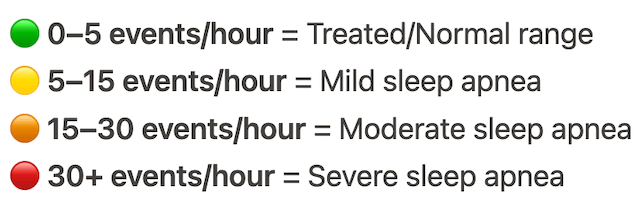
Once your results are in, a sleep physician or your primary care doctor reviews your AHI, your oxygen desaturation profile, your sleep architecture, and your body position during events. The AASM severity classification is straightforward: mild is 5 to 14 events per hour, moderate is 15 to 29, and severe is 30 or above. My own AHI of 51 put me well into the severe range. Moderate or severe sleep apnea typically leads directly to a CPAP prescription. Mild cases may also be prescribed therapy when they come with significant symptoms or comorbid conditions, as outlined in the AASM treatment guidelines.
From there, the prescription is written, you are referred to a DME supplier, and your equipment is delivered or fitted in person. From first symptom report to first night on therapy, the traditional pathway commonly takes one to three months.
Getting a prescription through telehealth
Over the past several years, telehealth has opened a faster route through the same regulatory framework. It does not change the underlying requirements (you still need a diagnosis and a clinician signature), but it compresses the timeline and removes much of the friction.
For new patients, the typical telehealth pathway runs in three stages. A short video consultation establishes that home testing is appropriate. A portable sleep study device is shipped to your home, you wear it for one night, and the data is uploaded or returned for a sleep physician to interpret. A follow-up consultation walks you through results and, if indicated, generates the prescription.
For existing CPAP users who need a renewal, the process is shorter. A brief video appointment with a licensed sleep physician reviews your current therapy, confirms that your numbers are reasonable, and the new prescription can be sent the same day or within a day or two.
A few things to look for when evaluating any telehealth service for CPAP. The prescribing clinician should be a licensed physician, and licensed in your state. The service should have a real consultation step rather than a form fill. Any sleep test interpretation should be performed by a sleep specialist. Avoid any service that promises a prescription without an actual clinical evaluation. CPAP prescriptions are nationwide once issued, but the prescriber needs to be authorized in your jurisdiction.
A note on insurance: most telehealth CPAP services are out of pocket for the consultation itself, but the prescription they produce works the same as any other for filling through your insurer or your DME supplier.
Who can write a CPAP prescription?
You do not need a sleep specialist for every prescription. Several types of US-licensed clinicians can write one, depending on state regulations.
Sleep medicine specialists are the most experienced for complex cases and titration. Pulmonologists frequently treat sleep apnea given the respiratory overlap. Primary care physicians can prescribe CPAP, particularly for straightforward cases and renewals, as long as they have access to your sleep study results. Ear, nose, and throat specialists may also prescribe, especially when anatomical contributors to apnea are part of the picture, and neurologists may be involved with central sleep apnea cases. Nurse practitioners and physician assistants can prescribe in many states, often inside a sleep medicine practice or under physician supervision.
The common thread is licensure and authority to prescribe medical devices in your state. The specialty matters less than the documentation and the clinical relationship.
How long is a CPAP prescription valid
Unlike most medication prescriptions, CPAP prescriptions are often written without an annual expiration. Many are essentially lifetime, valid for as long as you stay on therapy and your condition has not materially changed. Some prescribers use codes like “99 months” or “PRN” to convey the same intent. Others set explicit one-year, three-year, or five-year durations.
There are still situations where you will need a new prescription even with a lifetime one on file.
If your device type changes (moving from CPAP to BiPAP, or to ASV therapy, or from fixed to auto-adjusting), the AASM guidelines treat that as a clinical decision requiring evaluation.
If your pressure requirements change substantially, often after meaningful weight change, surgical intervention, or evolution of your condition, your prescriber will want a fresh look.
If your insurance requires periodic updates, Medicare and some private insurers do, especially around the rental to ownership transition.
If the original document is lost, the prescriber’s practice has closed, or the prescription had a specific expiration that has passed.
If you are not sure where you stand, your DME supplier will have a copy of your active prescription on file, and so will your prescriber’s office.
What requires a prescription, and what doesn’t
In the US, the prescription requirement applies to the therapeutic core of CPAP, not to the surrounding accessories.
Equipment that requires a prescription includes the machine itself, regardless of whether it is CPAP, APAP, BiPAP, or ASV. It also includes CPAP masks of all types (nasal, full face, and nasal pillow) and the heated humidifier when it is purchased with the machine. These are the components that deliver the actual therapy.
Items that do not require a prescription include almost everything else you will buy after the initial setup: hoses and tubing, heated tubing, filters, water chambers, CPAP pillows, mask liners, chin straps, hose covers, travel bags, cleaning supplies, and replacement mask cushions or headgear. These are accessories rather than therapeutic devices.
Replacement masks sit in a gray area in practice. Some suppliers and insurers want a current prescription on file for any full mask order, while others treat cushion swaps as routine supply replenishment. The safest move is to keep a current prescription handy regardless. Most suppliers want it for their records and for insurance billing.
Insurance, Medicare, and the compliance question
Insurance is where the prescription does most of its bureaucratic work. The rules below are US specific.
Medicare coverage
Medicare Part B covers CPAP under the DME benefit when several conditions are met.
You have been diagnosed with obstructive sleep apnea by a Medicare enrolled physician. Your sleep test meets the Medicare coverage thresholds: an AHI or RDI of 15 or more events per hour with at least 30 events recorded, or 5 to 14 events per hour with at least 10 events recorded and documented comorbidities such as daytime sleepiness, hypertension, stroke, heart disease, mood disorders, insomnia, or impaired cognition. Your equipment comes from a Medicare enrolled DME supplier. And you meet compliance requirements during the initial trial period.
Compliance is the part that catches many new patients off guard. According to CMS, Medicare requires CPAP use for at least four hours per night on at least 70 percent of nights (in practice, 21 of any 30 consecutive nights) during the initial 90 day trial. The usage data is read directly from the machine. Medicare does not accept self reported numbers.
The financial side is structured as a 13 month rental that converts to ownership. Medicare pays 80 percent after the Part B deductible, and the machine becomes yours after 13 months of documented compliance. If you stop using the device during the rental period, Medicare stops paying, and you are responsible for returning the equipment or covering the balance.
The CMS compliance materials also report that, during the 2024 reporting period, insufficient documentation accounted for 71.2 percent of improper Medicare CPAP payments. The practical implication for patients is simple: make sure your sleep test results, your prescriber’s notes, and your equipment paperwork all line up. Most denied claims are not denied because the patient did not need therapy. They are denied because the file did not say so clearly enough.
Private insurance
Most US private insurers follow Medicare’s general framework with their own variations. A valid prescription from an in network provider is required, a sleep study has to document medical necessity, AHI thresholds typically begin around 5, and compliance monitoring usually mirrors Medicare’s four-hour and 70 percent rule. Mask replacements are typically covered every three to six months. Premium machine upgrades, multiple backup masks, and travel-specific equipment like a travel CPAP are often only partially covered, or not covered at all.
Out of pocket
For patients paying without insurance, costs vary widely depending on device type, supplier, region, and whether the equipment is new or refurbished. Standard fixed pressure CPAP machines sit at the lower end of the range, auto adjusting machines are in the middle, and BiPAP devices are at the higher end. Masks and ongoing supplies represent a meaningful annual line item on top of the machine itself.
Money saving options worth knowing about include comparing prices across multiple Medicare enrolled DME suppliers, looking at certified refurbished machines, buying compatible supplies in bulk, and using HSA or FSA funds where eligible.
Common prescription situations
A few scenarios come up often enough to be worth covering directly.
If you have lost your prescription, your DME supplier almost certainly has a copy on file. Your prescriber’s office can also produce one quickly, and many practices now keep records accessible through patient portals.
If your prescribing physician has retired or moved, you have several options. You can transfer your records to a new clinician, you can ask your primary care doctor to take over prescriptions (especially if your sleep study is on file), or you can use a telehealth service for a quick renewal.
If you want to switch mask types, you usually do not need a new prescription as long as your current one references “CPAP mask” or “CPAP supplies.” Some insurers may want updated documentation if you are moving from a nasal mask to a full face mask or vice versa, so it is worth asking before ordering.
If your prescription shows pressure settings that do not match what you remember from titration, raise it with the prescribing office before you fill the order. Errors do happen, and they should be corrected at the source rather than worked around at the supplier.
Importing equipment from outside the US to avoid the prescription requirement is technically possible, but it is a bad idea. You lose insurance coverage, you lose US warranty support, you have no clinical oversight, and the device settings may not match what you actually need.
Practical tips for keeping the paperwork from owning you
A few simple habits make prescription life much easier over the years.
Keep a digital copy. Scan or photograph your prescription, store it in cloud storage, and email a copy to yourself. Future you will thank present you.
Know your settings. Your pressure setting or range, your machine type, and your mask type and size. If a supplier or new clinician asks, you can answer in seconds.
Stay on top of your CPAP data. The myAir, DreamMapper, or OSCAR reports your machine generates are the single best evidence of compliance and therapy quality. They protect your insurance coverage and give your clinician something concrete to work with.
Build a relationship with one DME supplier rather than rotating between several. Your equipment history, your insurance file, and your renewal habits all sit more cleanly in one place.
Plan ahead for renewals. Do not wait for equipment to fail or for a prescription to expire. The process is much easier when there is no time pressure.
Final thoughts
The prescription requirement for CPAP feels like a wall when you are first diagnosed. After more than a decade in the system, my honest view is that it is mostly a useful wall. It pushes you toward the right clinician, the right device type, and the right pressure for your specific anatomy. It also keeps insurance coverage in play, which matters a lot over a decade or two of supplies and replacements.
The path through it has also gotten much shorter and more flexible than it used to be. Between primary care prescribing, telehealth renewals, and home sleep tests, most patients no longer need months and multiple in person specialist visits to start therapy. The regulatory bar is intact. The friction around it has come down.
If you are newly diagnosed, the right next step is not to argue with the prescription requirement. It is to find a clinician (your primary care doctor is often a fine starting point), get the sleep study done, and let the documentation chain do its job. The benefits of treating sleep apnea, both for daily function and for long term health, are well worth the modest administrative friction at the front end.
Frequently Asked Questions
Can I buy a CPAP machine without a prescription in the US?
No. According to FDA regulations, CPAP, APAP, BiPAP, and ASV machines are Class II medical devices restricted to prescription use only. Reputable US suppliers will not sell a machine without a valid prescription.
How long does it take to get a CPAP prescription?
Through the traditional pathway with in person doctor visits and in lab sleep testing, the process typically takes one to three months. Through telehealth with a home sleep test, new diagnoses can move in one to two weeks. Renewals for existing CPAP users can be turned around in 24 to 48 hours.
Can my primary care doctor prescribe CPAP?
Yes. Once your sleep study is on file, your primary care physician can usually prescribe and renew. A sleep specialist is not required for every prescription, especially for routine renewals or straightforward cases.
Do I need a new prescription for a different CPAP mask?
Usually no, as long as your current prescription references “CPAP mask” or “CPAP supplies.” Some insurers and suppliers may want updated documentation when you switch between mask categories, for example from nasal to full face, so it is worth checking before ordering.
Is my CPAP prescription valid in other states?
Yes. CPAP prescriptions are recognized nationwide by DME suppliers as long as the prescribing clinician is licensed in your state of residence.
Do CPAP supplies need a prescription?
No. Tubing, filters, water chambers, cleaning supplies, mask liners, and similar accessories can be purchased without one. Only the machine, the mask, and the humidifier (when sold together with the machine) require a prescription.
What if my CPAP prescription has expired?
Contact the original prescriber for renewal, see your primary care doctor (especially if your sleep study is on file), or use a telehealth service for a quick renewal. For established CPAP users with usage data showing effective therapy, this is usually one of the lower-friction parts of the whole process.
What if I lost my CPAP prescription?
Contact your DME supplier first. They almost always have a copy on file. Your prescribing physician’s office can also produce one, and your patient portal may have it stored.
References
FDA Federal Register, October 19, 2018. Classification of positive airway pressure delivery systems as Class II medical devices.
Medicare.gov. Continuous Positive Airway Pressure (CPAP) Therapy coverage.
Centers for Medicare and Medicaid Services. CPAP Devices and Accessories provider compliance tips, including 2024 improper payment data.
American Academy of Sleep Medicine. Clinical guidelines for manual titration of positive airway pressure in patients with obstructive sleep apnea, Journal of Clinical Sleep Medicine.
American Academy of Sleep Medicine. Clinical practice guideline for treatment of adult obstructive sleep apnea with positive airway pressure.
American Academy of Sleep Medicine. Full systematic review of adult OSA treatment with positive airway pressure.
American Academy of Sleep Medicine. FDA reclassification of positive airway pressure devices, 2018.
⚠️ MEDICAL DISCLAIMER This blog provides general information only and is not a substitute for professional medical advice, diagnosis, or treatment. Sleep apnea is a serious condition, and CPAP equipment should be used under proper medical supervision. Always consult your doctor or sleep specialist before starting, stopping, or changing any therapy. I share personal experiences as a CPAP user, not as a medical professional. Individual results vary. For medical guidance, please consult a qualified clinician or the American Academy of Sleep Medicine (aasm.org).