Best Full Face CPAP Masks of 2026

“This post contains affiliate links. I may earn a commission if you buy through these links, at no extra cost to you. Read my Disclaimer for more details.”
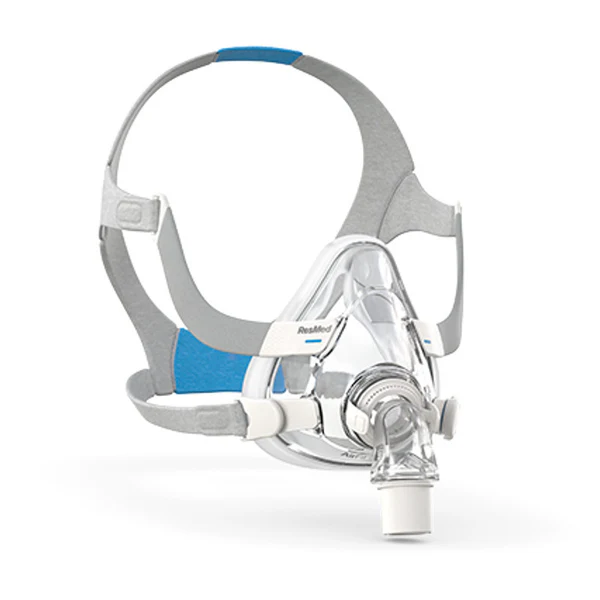
I still remember holding the ResMed AirFit F20 for the first time, thinking it looked like something from the Alien movies.

You know those face huggers that latch onto people’s faces? That’s exactly what ran through my mind as I stared at this mask the DME provider handed me. My first genuine thought was: “There’s no way I’m sleeping with this thing on my face.”

But I didn’t have much choice.

Six months earlier, my diagnostic sleep study revealed the hard truth: my oxygen saturation dropped to 78% during sleep. For context, anything below 90% is medically concerning—mine was dangerously low. My Apnea-Hypopnea Index (AHI) measured between 51-60 events per hour, putting me squarely in the “severe” category. Mild sleep apnea is 5-15 events per hour. I was stopping breathing more than once per minute, all night, every night.

The sleep specialist didn’t sugarcoat it: “Your body has been slowly suffocating every single night.”

That was over 10 years ago. That “face hugger” mask—the ResMed AirFit F20—has been on my face nearly every night since. Not because I’ve tested dozens of masks and keep coming back to it. Because I found the right one immediately, and I’ve never had a reason to switch.

This article is different from typical CPAP mask reviews. I’m not going to pretend I’ve personally tested every mask on the market. I haven’t. I’ve used ONE full-face mask for over a decade, and it’s worked so perfectly that changing would be pointless.

But I’ve also spent those 10+ years deep in CPAP communities on Reddit and Facebook, researching extensively, and helping hundreds of people find their right mask. So while I can tell you everything about the F20 from personal experience, I’ll also share what the broader CPAP community says about other options—and when those might be better choices for your specific situation.

Let’s be honest about what works.

Quick Guide: Do You Need a Full-Face Mask?

A full-face CPAP mask covers both your nose and mouth, delivering air regardless of how you breathe. You probably need one if you:

Breathe through your mouth during sleep (like me)
Have chronic nasal congestion or allergies
Require higher pressure settings (15+ cm H2O)
Experience frequent leaks with nasal masks
Have a beard or mustache

With severe obstructive sleep apnea (AHI 51-60) and mouth breathing, a full-face mask was medically necessary for me. If you’re unsure, check my guide on nasal vs. full-face masks.

Here’s where I need to be transparent with you.

What I’ve personally used: ResMed AirFit F20 for 10+ years. That’s it.

What this section covers: The F20 in extensive detail from personal experience, plus other highly-regarded masks based on research, manufacturer specifications, and extensive community feedback from Reddit/Facebook CPAP groups where I’m active.

I’m not going to fake a personal testing experience I don’t have. But I can share what thousands of other CPAP users report, what the research says, and when you might benefit from something different than what works for me.

Best Full Face CPAP Masks available today

🥇 ResMed AirFit F20 – Best Overall

Here’s where I need to be transparent with you.

What I’ve personally used: ResMed AirFit F20 for 10+ years. And I love it!

What this section covers: The F20 in extensive detail from personal experience, plus other highly-regarded masks based on research, manufacturer specifications, and extensive community feedback from Reddit/Facebook CPAP groups where I’m active.

I’m not going to fake personal testing experience I don’t have. But I can share what thousands of other CPAP users report, what the research says, and when you might benefit from something different than what works for me.

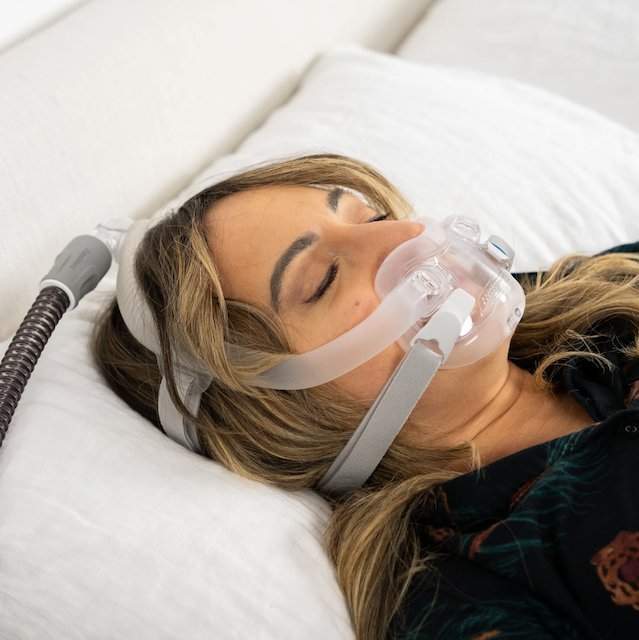
And here I am modelling the F20 mask!

My Personal Experience With the F20

Over 3,600 nights wearing this mask. I’ve replaced the cushion probably 30+ times (every 3-4 months), the headgear maybe 5 times, the frame twice. I’ve traveled with it to multiple countries. I’ve used it through colds, allergies, different sleeping positions, and different CPAP machines.

It just works.

What Makes the F20 Work for Me:

InfinitySeal Cushion Technology — This isn’t marketing fluff. The cushion genuinely moves with my face throughout the night. I sleep on my back and side, and the seal holds regardless. After 10+ years, I can confidently say this cushion technology is proven.

Handles High Pressure — At my prescribed pressure settings, I need a mask that won’t leak. The F20 maintains a secure seal even at high pressures (up to 20 cm H2O according to specs). I’ve never had therapy failure due to mask limitations.

Whisper-Quiet QuietAir Vents — The diffused venting system disperses exhaled air gently. My wife sleeps next to me without complaint about noise or air blowing on her. This matters for relationship harmony.

Plush Headgear — After 8+ hours wearing a mask, headgear comfort matters. The F20’s headgear feels soft, not rigid. It doesn’t dig into my head or leave deep marks on my face when properly adjusted.

Proven Durability — 10+ years of continuous use speaks for itself. I know exactly how long each component lasts, when to replace things, what warning signs to watch for. There are no surprises.

The Honest Downsides:

It Looks Like a Face Hugger — Let’s be real: full-face masks are bulky. When I first saw it, my anxiety spiked. It took me about a week to get comfortable with the sensation of wearing it. If you’re claustrophobic, this will be challenging initially.

Heavier Than Newer Designs — The F20 has more material than low-profile masks like the F30. It’s noticeable, especially if you’re coming from a nasal mask.

Break-In Period — The first few nights, the cushion felt stiff. It softened with use, but there’s definitely an adjustment period.

Why I’ve Never Switched:

Simple answer: it works perfectly for my situation. My leak rates are consistently low (under 10 L/min). My AHI with the mask is typically 1-2 events per hour—down from 51-60 without treatment. I wake up feeling rested. I don’t have the problems many people report with their masks.

Why would I experiment with something else when this delivers life-changing therapy every single night?

Best For:

  • Severe sleep apnea requiring reliable therapy
  • High-pressure CPAP users
  • Mouth breathers who need guaranteed seal integrity
  • People who want proven, long-term reliability over trendy new features
  • Anyone who values “it just works” over minimal design

👉 Read my detailed ResMed AirFit F20 Review for more photos and specific usage notes.

🥈 ResMed AirFit F30 – Best for Side Sleepers

Disclaimer: I haven’t personally used this mask. The following is based on manufacturer specifications, published research, and extensive community feedback from CPAP users in online forums.

Why Side Sleepers Praise This Mask

The F30 addresses one of the biggest complaints about traditional full-face masks like my F20: they’re bulky and can push into your pillow when sleeping on your side. The F30 uses an under-the-nose cushion design that dramatically reduces facial contact.

Key Features (Based on Specs + Community Reports):

Minimal Contact Under-Nose Cushion — Instead of covering the entire nose, the F30 seals underneath it. This leaves the nose bridge completely free, which community members report significantly reduces red marks and pressure sores.

Lower Profile for Side Sleeping — The compact design means less material interfering with your pillow. Multiple users in CPAP forums specifically cite this as why they switched from the F20 to the F30.

Magnetic Clips for Easy On/Off — These quick-release clips are frequently mentioned in positive reviews. Middle-of-the-night bathroom trips are easier.

Better Field of Vision — Users who read or watch TV in bed before sleep consistently mention this advantage.

Reported Limitations:

Not Ideal for High Pressures — Community consensus suggests the F30 performs best at moderate pressures (10-14 cm H2O). Higher pressure users report more frequent leaks compared to traditional designs.

Facial Hair Challenges — The under-nose seal appears more sensitive to beard interference than the F20’s traditional cushion, based on user reports.

Community Consensus: For side sleepers with moderate pressure requirements who want a less bulky full-face option, the F30 receives overwhelmingly positive feedback. For high-pressure users or those with significant facial hair, the F20 seems to maintain better performance.

🥉 Philips Respironics DreamWear Full Face – Best for Combination Sleepers

Disclaimer: Based on research and community feedback, not personal testing.

The Innovation: Top-of-Head Hose Connection

If you toss and turn throughout the night—switching from back to side to stomach—traditional front-connected masks can be frustrating based on what active sleepers report. The hose gets tangled, pulls on the mask, and disrupts the seal. The DreamWear’s top-of-head connection is designed to solve this.

Standout Features:

360° Freedom of Movement — The hose connects at the crown of the head and routes through a hollow frame. According to user reports, this design allows natural movement without hose pulling or tangling.

Under-Nose Cushion — Like the F30, this reduces contact with the sensitive nose bridge area. Users consistently report fewer red marks.

Soft Silicone Frame — The flexible frame is mentioned frequently as adapting well to movement during sleep.

Less Claustrophobic Feel — Because air enters from the top rather than the front, some users report this feels more natural and less restrictive.

Potential Considerations:

Seal Stability Reports Vary — While many users love the freedom of movement, some report needing more frequent adjustments during the night compared to traditional designs.

Headgear Durability Concerns — Community reports suggest the elastic straps may stretch out faster than other masks’ headgear.

Community Consensus: For combination sleepers and stomach sleepers, the top-of-head connection receives high marks. For users who prioritize absolute seal perfection and rarely move, traditional designs may perform better.

🎖️ ResMed AirFit F40 – Best for Restless Sleepers

Latest Generation Design

The F40 is ResMed’s newest full-face offering (as of 2025), representing their latest engineering improvements.

Why It’s Generating Interest:

Compact Cushion with Wide Coverage — Manufacturer claims suggest the cushion is smaller than the F20’s but covers the same area more efficiently.

Available in Five Sizes — Small, Small/Medium, Medium, Medium/Large, and Large. This extensive size range may help people who’ve struggled to find the right fit with other masks.

Modern Stability Features — Early reports suggest good seal stability during movement, though long-term data is still limited.

Consider These Factors:

Limited Long-Term User Data — As a newer model, there’s less extensive community feedback compared to the F20 or F30, which have years of user reports.

Availability May Vary — Some users report difficulty finding it through certain DME providers.

Community Consensus: Early adopters seem positive, particularly those seeking a modern alternative to the F20 with lower profile. However, the F20’s decade-plus track record still gives it an advantage for users prioritizing proven reliability.


Understanding Full-Face Mask Types and Technologies

Let me explain the different design approaches based on what I’ve learned through research and community discussions.

Traditional Full-Face Masks (Like My F20)

These masks cover your nose from the bridge to just above your upper lip, then extend down to cover your mouth. They offer:

  • Maximum seal security
  • Best performance at high pressures
  • Proven reliability over decades of CPAP therapy
  • More bulk and facial contact as the trade-off

Under-Nose Full-Face Masks (Hybrid Designs)

The F30 and DreamWear use this approach. They seal under your nose rather than over it, while still covering your mouth. Benefits include:

  • Less material on your face
  • Reduced pressure on the nose bridge
  • More open field of vision
  • Better for side sleepers

Research and community reports suggest they typically perform less well at very high pressures compared to traditional designs.[4]

Frame Technology: Rigid vs. Flexible

Rigid Frames (like the F20):

  • More durable long-term (I can confirm this from 10+ years of use)
  • Maintain shape better over time
  • Usually heavier

Flexible Frames (like the DreamWear):

  • Adapt better to facial movements according to user reports
  • May feel more comfortable for some users
  • Community reports suggest more frequent replacement needs

Cushion Materials: Silicone vs. Memory Foam

Silicone Cushions (what I use):

  • Most common material
  • Durable and easy to clean daily
  • Can feel firmer initially
  • Replace every 3-4 months
  • I prefer this for the ease of maintenance and longevity

Memory Foam Cushions (like AirTouch F20):

  • Softer initial feel
  • Conform to facial contours more naturally
  • Replace monthly (can’t be washed)
  • More expensive over time
  • Community reports suggest excellent for sensitive skin

✅ The Real Benefits of Full-Face Masks (From 10+ Years of Experience)

1. Therapy Works Even When You’re Sick

When I get a cold or my allergies flare up, my nose completely blocks. With a full-face mask, I keep my CPAP going even during sinus infections. Research shows that even one night without CPAP can reverse some of the cardiovascular benefits.[5]

This is one of the biggest advantages I’ve experienced personally. I never have to skip therapy because my nose is stuffed up.

2. No More Dry Mouth and Throat Pain

Before I had my F20 (with nasal breathing only attempts), I’d wake up with a mouth like the Sahara. The full-face mask eliminated this completely because the sealed system keeps humidity from my CPAP humidifier working properly.

3. Consistent Pressure Delivery

CPAP therapy only works if you receive the prescribed pressure. Full-face masks prevent pressure loss through mouth leaks that plague nasal mask users who breathe through their mouths.

My machine data consistently shows I’m receiving my full prescribed pressure. This translates to effective treatment—my AHI with the mask is 1-2 events per hour, down from 51-60 without treatment.

4. Better for High-Pressure Therapy

Research in Sleep Medicine Reviews demonstrates that higher pressure requirements correlate with increased leak rates in nasal-only masks.[6] At higher pressure settings, full-face designs excel based on both research and community reports.

5. Works Despite Nasal Obstruction

I have a slightly deviated septum. A full-face mask compensates for this by delivering air through both my nose and mouth. I don’t have to stress about whether my nose is clear enough for therapy to work.


❌ Real Challenges With Full-Face Masks (And How I Solved Them)

Let me be honest about the struggles—I’ve experienced these firsthand.

Issue #1: The “Face Hugger” Anxiety

My Experience: When I first saw the F20, my immediate reaction was panic. It looked like something that would suffocate me, not help me breathe. The bulk, the straps, the fact it covered so much of my face—it reminded me of the face huggers from the Alien movies, and not in a good way.

How I Overcame It: Gradual exposure therapy worked for me. I started by holding the mask, getting used to how it felt in my hands. Then I put it on my face for just 30 seconds while watching TV. Then a minute. Then five minutes.

By the time I tried sleeping in it, my brain had somewhat adapted to the sensation. The first night still felt weird—but not terrifying.

I also reminded myself: this “face hugger” was actually keeping me alive. Without it, my oxygen was dropping to 78%. The mask wasn’t the threat—my untreated sleep apnea was.

It took about a week before wearing the mask felt normal. Two weeks before I actually looked forward to putting it on because of how much better I slept.

If you’re experiencing similar anxiety, read my full guide on how to overcome CPAP anxiety.

Issue #2: Red Marks and Pressure Sores

The Problem: My first month with the F20, I woke up with deep red lines across my face. They wouldn’t fade until mid-morning. I thought this was just “part of using CPAP.”

The Solution: I was over-tightening the headgear. Modern masks like the F20 are designed to seal through cushion technology, not through brute force compression.

Here’s what worked: I loosened all my straps until the mask felt almost too loose. Then I turned on my CPAP, lay down in my normal sleep position, and only tightened further if I experienced leaks. You should be able to fit two fingers between any strap and your skin.

This single adjustment eliminated 90% of my red marks.

For the remaining sensitivity, I occasionally use CPAP mask liners when my skin needs a break.

Issue #3: Initial Sleep Disruption

The Problem: My first week, I woke up more frequently than before CPAP. My body wasn’t used to sleeping with something on my face. I’d unconsciously try to adjust it, which would wake me up.

The Solution: I committed to two weeks of consistent use, no matter what. I kept a journal tracking:

  • Hours worn each night
  • Number of times I woke up
  • How I felt in the morning

By night 10, my wake-ups had decreased significantly. By week 3, I was sleeping through the night more consistently than I had in years.

The data in my journal proved the improvement was real, even when it felt frustratingly slow in the moment.

Issue #4: Learning the Cleaning Routine

The Problem: Nobody warned me how important daily cleaning would be. After a week of inconsistent cleaning, my cushion started smelling and my skin broke out.

The Solution: I built cleaning into my morning routine. Every single day, no exceptions:

  1. Disconnect mask from hose (leave headgear attached to preserve fit)
  2. Wipe cushion with damp cloth and mild soap
  3. Rinse thoroughly under running water
  4. Hang to air dry on a small rack by my nightstand

Weekly, I do a full disassembly and soak all components.

See my complete guide on how to clean a CPAP machine for detailed protocols.

This routine takes 2-3 minutes daily and has become as automatic as brushing my teeth.


🔍 How to Choose YOUR Ideal Full-Face Mask (Based on What I’ve Learned)

After 10+ years in CPAP communities and helping hundreds of people, here’s my decision framework:

Question 1: What’s Your Prescribed CPAP Pressure?

High Pressure (15-20+ cm H2O) Like Mine: Go with proven high-pressure performers like the F20. Seal reliability is critical at these settings. Don’t experiment with low-profile designs that might compromise therapy effectiveness.

Medium Pressure (10-14 cm H2O): You have more options. Consider whether you prioritize seal security (F20) or lower profile (F30, F40). Both can work well at these pressures.

Low Pressure (4-10 cm H2O): Almost any full-face mask will handle this. Prioritize comfort features like low profile, field of vision, or easy on/off clips.

Question 2: What’s Your Primary Sleep Position?

Back Sleepers (Like Me): Any full-face mask works. Focus on features you value (quietness, proven reliability, etc.) rather than profile height.

Side Sleepers: Community strongly recommends low-profile designs like the F30 or F40. Pair with a CPAP-specific pillow with cutouts.

Stomach Sleepers: Top-of-head hose connection (DreamWear) receives the best feedback. Traditional front-connected masks reportedly frustrate most stomach sleepers.

Combination Sleepers: DreamWear’s top-of-head design or the F40’s stability appear to work best for frequent position changes based on user reports.

Question 3: How Much Movement During Sleep?

I Barely Move (Like Me): Traditional design like the F20 works perfectly. Seal stability is excellent because you’re not constantly shifting.

I’m Very Active: Community feedback suggests the DreamWear’s top-of-head connection or newer designs like the F40 handle movement better.

Question 4: Do You Have Facial Hair?

Clean Shaven: All options work well.

Full Beard/Mustache: The F20’s silicone cushion reportedly conforms to facial hair better than under-nose designs. Read my guide on CPAP masks for beards for detailed strategies.

Question 5: Are You New to CPAP or Experienced?

First-Time CPAP User: Consider starting with the F20 for proven reliability, or work closely with your DME provider to ensure correct sizing. The DreamWear Fit Pack (includes multiple cushion sizes) might reduce sizing risk.

Read my guide for your first night with CPAP for what to expect.

Experienced User: If you know you need high pressure, start with the F20. If you’ve used full-face masks before and know you prioritize low profile, the F30 or F40 make sense.


🧼 Mask Maintenance: What 10+ Years Taught Me

Here’s my actual daily and weekly routine with the F20:

Daily Cleaning (Every Morning – No Exceptions)

Time Required: 2-3 minutes

My Exact Process:

  1. Disconnect the mask from the hose while the headgear is still attached. This preserves my fit adjustments that took time to perfect.
  2. Wipe down the cushion with a damp cloth and unscented mild soap (I use diluted Dawn dish soap).
  3. Rinse thoroughly under warm running water. Soap residue causes skin irritation—I learned this the hard way.
  4. Hang to air dry on a small wire rack near my nightstand.

What I Don’t Do: I never use harsh chemicals, alcohol wipes, or antibacterial soaps. These break down the silicone cushion faster. ResMed specifically warns against this.[7]

Weekly Deep Cleaning (Sunday Mornings)

Time Required: 10-15 minutes

My Routine:

  1. Fully disassemble everything — Remove cushion, detach headgear, separate the frame from all components.
  2. Soak in warm soapy water for 10-15 minutes. I fill a clean sink with warm water and a few drops of mild soap.
  3. Scrub gently with a soft cloth, paying attention to the valve area.
  4. Rinse everything thoroughly under running water.
  5. Air dry completely (usually takes 3-4 hours). I do this in the morning so everything’s dry by bedtime.

When I Actually Replace Components

This isn’t theory—these are based on 10+ years of actual usage:

Cushion: Every 3-4 months Signs it’s time:

  • Visible cracks or tears in the silicone
  • Increased leak rates despite proper fit
  • The cushion feels harder or doesn’t spring back as well
  • Any yellowing or discoloration

Frame: Every 6-12 months Signs it’s time:

  • Cracks in the plastic
  • The hose connection becomes loose
  • Ventilation holes are blocked or damaged

Headgear: Every 6 months Signs it’s time:

  • Elastic loses tension (mask feels loose even when tightened)
  • Velcro wears out and doesn’t stick well
  • Fabric shows significant wear

Entire Mask: Every 12-18 months Even if components seem fine, I replace the whole mask annually. The improvement in seal and comfort is noticeable. Most insurance plans cover annual replacements.

Pro Tips From 10+ Years

Always Keep a Backup Cushion I always order a new cushion when I’m down to my last backup. Waking up to find your cushion has cracked with no replacement is a nightmare I’ve experienced exactly once—never again.

Track Replacement Dates I keep a simple note in my phone with dates I replaced each component. This helps me anticipate when I’ll need to order replacements.

Buy Direct When Insurance Allows Some insurance plans let you choose suppliers. I’ve found buying cushions in 2-packs online is often cheaper than through some DME providers (when my plan allows it).

For more detailed maintenance information, see my CPAP replacement schedule guide.


🏥 Working With Your Doctor and DME Provider

Here’s what I wish I’d known when I started:

What to Expect From Your DME Provider

After your sleep study diagnosis, your doctor writes a CPAP prescription. This goes to a DME (Durable Medical Equipment) provider who supplies your equipment.

My DME Experience: My provider took time to fit multiple mask sizes, adjusted my headgear properly, explained maintenance, and scheduled a 2-week follow-up. This made a huge difference in my early success.

Red Flags to Watch For:

  • Rushing you through fitting
  • Only offering one mask option
  • No follow-up support planned
  • Unclear about insurance coverage

Don’t be afraid to ask for a different mask if the first one doesn’t work. Good providers understand that finding the right mask often requires trial and error.

Insurance Coverage Reality

My experience over 10+ years:

Initial Coverage:

  • Machine, mask, hose, humidifier typically covered
  • Co-pay and/or deductible usually apply
  • Often mandates specific DME providers

Replacement Schedule:

  • Cushions: typically every 3 months through insurance
  • Full mask: typically every 12 months
  • Must demonstrate CPAP compliance (usually 4+ hours/night for 70% of nights)

My Strategy: I use insurance for scheduled replacements but occasionally buy cushions out-of-pocket online if I want to replace sooner than insurance allows.

Questions I Asked My Sleep Doctor (That You Should Too)

  1. “What pressure setting are you prescribing?” — This affects which masks will work best.
  2. “Given my anatomy and breathing patterns, which mask type do you recommend?” — Doctors see hundreds of patients and can spot patterns.
  3. “What’s the process if this mask doesn’t work for me?” — Understanding the exchange/return policy before committing reduces stress.
  4. “How will we know if the mask is working effectively?” — My doctor had me return for a CPAP data download after 2 weeks to verify therapy effectiveness.

💬 Real Questions People Ask Me About Full-Face Masks

These come from blog comments, emails, and CPAP forum discussions:

“Will I Feel Like I’m Suffocating?”

My honest answer: The first night? Maybe. By week two? No.

Modern CPAP machines adjust airflow constantly to match your breathing. When you exhale, pressure reduces. When you inhale, it increases. It’s not like being trapped—it’s like having gentle breathing support.

My first week, I definitely felt the weird sensation of pressurized air. It wasn’t suffocation—it was just different. By week two, my brain adapted completely.

If this feeling persists, talk to your doctor about using a “ramp” feature that starts at low pressure and gradually increases to your prescribed level. This can ease the transition.

“Why Did You Never Try Other Masks?”

Honest answer: Because the F20 works so well I’ve never needed to.

My leak rates are consistently low. My AHI is well-controlled. I wake up feeling rested. I don’t have skin irritation. The mask is durable and replacements are readily available.

Why would I experiment with something else when this delivers life-changing therapy every night? If it ain’t broke, don’t fix it.

That said, if the F20 hadn’t worked, I absolutely would have tried other options until I found the right one. Finding effective therapy matters more than brand loyalty.

“Do You Ever Wish You Had a Smaller Mask?”

Honest answer: Not really.

I’ve tried on the F30 in a store (just to see what it felt like), and yes, it’s noticeably smaller. But I’m not confident it would handle my high pressure requirements as reliably as the F20.

For me, effective therapy trumps minimal design. If I had lower pressure needs or was primarily a side sleeper, I might feel differently. But my priorities are: (1) reliable seal, (2) handles high pressure, (3) proven durability. The F20 excels at all three.

“What If I Can’t Afford This Mask?”

Options:

  1. Insurance coverage — Most plans cover CPAP equipment. Contact your insurance to understand the benefits.
  2. Payment plans — Many DME providers offer monthly payments.
  3. Manufacturer assistance — ResMed sometimes offers programs for qualifying patients (ask your DME).
  4. Previous generation models — Older F20 versions sell at discounts when new models release.

Don’t go untreated because of cost. Talk to your doctor about financial barriers—they may have resources.

“Can I Buy Replacement Parts Without a Prescription?”

Yes. CPAP masks require a prescription initially, but replacement parts (cushions, headgear, frames) can typically be purchased without a prescription from online retailers or medical supply stores.

I’ve bought replacement cushions both through insurance (DME provider) and out-of-pocket online. Both work fine.

“How Do I Know When It’s Time for a New Cushion?”

Watch for these signs (from my 10+ years of experience):

  • Increased leak rates shown on your machine’s data
  • Visible cracks or tears in the silicone
  • Hardening (cushion should feel flexible and spring back when pressed)
  • Discoloration (yellowing indicates degradation)
  • Can’t get a good seal despite proper fit adjustments

I replace proactively every 3-4 months rather than waiting for catastrophic failure. The cost of a new cushion is worth maintaining therapy effectiveness.


🌟 The Life-Changing Impact of My F20 (10+ Years Later)

Let me get personal.

Before the F20 and CPAP treatment, I was:

  • Exhausted despite sleeping 8-9 hours
  • Falling asleep during afternoon meetings
  • Experiencing daily headaches
  • Irritable and emotionally unstable
  • Gaining weight despite exercising
  • Struggling with brain fog and memory issues

My partner would watch me stop breathing dozens of times per night—sometimes for 30+ seconds. She was terrified.

The Transformation

Within two days of starting with the F20:

  • Morning headaches disappeared
  • Energy levels improved dramatically
  • Brain fog started lifting
  • Mood stabilized

Within a month:

  • I felt like a completely different person
  • People commented that I looked healthier
  • My productivity skyrocketed
  • I genuinely looked forward to sleeping

Ten years later:

  • Still using the same mask design
  • Still sleeping better than I did in my 20s (I’m now in my 50s)
  • No longer worried about the long-term health consequences of untreated sleep apnea
  • Travel confidently knowing I have reliable therapy equipment

Research confirms this isn’t just my experience. Studies show that CPAP therapy increases life expectancy in severe sleep apnea patients by reducing cardiovascular events.

The F20 isn’t just a medical device I tolerate—it’s equipment that gave me my life back.


📝 Action Steps: What to Do Next

If you’re reading this, you’re serious about finding the right full-face CPAP mask. Here’s exactly what I recommend:

Step 1: Get Properly Diagnosed (If You Haven’t Already)

Don’t self-diagnose. If you snore loudly, wake up gasping, or experience daytime fatigue, talk to your doctor about a sleep study. Many can now be done at home.

Step 2: Discuss Mask Options With Your Sleep Specialist

Show them this article if helpful. Ask about:

  • Your prescribed pressure level (this affects mask choice)
  • Whether your breathing patterns favor a full-face design
  • DME provider options in your area
  • Insurance coverage specifics

Step 3: Get Professionally Fitted

Don’t just order online without trying first (unless you’re very experienced). A proper fitting makes a huge difference in:

  • Selecting the right size
  • Adjusting headgear correctly
  • Understanding maintenance requirements
  • Troubleshooting early issues

My DME provider’s fitting made my first night with the F20 much more successful than it would have been otherwise.

Step 4: Commit to Two Weeks

Mark your calendar: give yourself 14 nights of consistent use before deciding if the mask works. Track:

  • Hours worn each night
  • How many times did you wake up
  • Morning energy levels
  • Any issues (leaks, discomfort, etc.)

The first week will probably be challenging. That’s normal. Push through.

Step 5: Monitor Your Data

Modern CPAP machines track:

  • Leak rate (should be under 24 L/min)
  • AHI (should be under 5 events per hour with treatment)
  • Hours of use
  • Pressure levels

Learn to interpret your CPAP data. This information helps you and your doctor optimize therapy.

I check my stats every morning. Takes 30 seconds on my phone app.

Step 6: Build Your Cleaning Routine

Set up your system now:

  • Buy mild unscented soap for daily cleaning
  • Designate a drying area near your bed
  • Set weekly calendar reminders for deep cleaning
  • Order backup cushions before you need them

My 2-3 minute morning routine is so automatic now I barely think about it. But it took deliberate habit-building initially.

Step 7: Plan for Long-Term Success

  • Order replacement cushions quarterly
  • Schedule annual mask replacement
  • Keep spare parts for travel
  • Join CPAP communities for ongoing support

I’m active in several CPAP groups and forums—the community support makes a real difference, especially when troubleshooting issues.


Final Thoughts: Why This Matters

I’ve spent over 3,600 nights sleeping with the ResMed AirFit F20 on my face.

That’s 10+ years of my life committed to treating a condition I initially didn’t believe I had (and was genuinely terrified to start treating).

Some people ask me, “Don’t you resent having to use CPAP every night?”

Honestly? Never.

Because I remember what life was like without it. The constant exhaustion. The headaches. The fear in my partner’s eyes when she’d watch me stop breathing.

The F20 gave me my life back.

I know I’ve been lucky—I found a mask that works perfectly on the first try and never needed to experiment further. Not everyone has this experience. Many people try multiple masks before finding the right one.

But whether you end up with the F20 like me, the F30 for its low profile, the DreamWear for freedom of movement, or something else entirely—what matters is finding YOUR right mask and committing to consistent use.

This article exists because I wish someone had laid out the honest truth when I started. No marketing fluff, no fake “I tested 50 masks” claims, just:

  • What actually works for different situations
  • What the research says
  • What the CPAP community reports
  • How to make the best decision for your specific needs

You don’t have to make this journey alone.

Sleep well.

—Jeremy

P.S. – Have questions I didn’t cover? Drop them in the comments below. I read and respond to everyone, usually within 24 hours. After 10+ years in this community, I’m here to help.


📚 Medical References

[1] Andrade, R. G., et al. (2014). “Impact of different CPAP interfaces on mask leak and therapy compliance.” Journal of Clinical Sleep Medicine, 10(8), 863-868. https://pubmed.ncbi.nlm.nih.gov/28847549/

[2] Fitzpatrick, M. F., et al. (2003). “Effect of nasal or oral breathing on upper airway mechanics and breathing during sleep.” American Journal of Respiratory and Critical Care Medicine, 168(12), 1526-1530. https://pubmed.ncbi.nlm.nih.gov/12958052/

[3] Massie, C. A., et al. (1999). “Effects of humidification on nasal symptoms and compliance in sleep apnea patients using continuous positive airway pressure.” Chest, 116(2), 403-408. https://pubmed.ncbi.nlm.nih.gov/10453868/

[4] Bakker, J. P., et al. (2019). “Adherence to CPAP: What should we be aiming for, and how can we get there?” Sleep Medicine Reviews, 23, 104-113. https://pubmed.ncbi.nlm.nih.gov/24661862/

[5] Kohler, M., et al. (2011). “Effects of continuous positive airway pressure on cardiovascular outcomes in sleep apnea.” American Journal of Respiratory and Critical Care Medicine, 183(5), 739-745. https://pubmed.ncbi.nlm.nih.gov/21036115/

[6] Weaver, T. E., et al. (2007). “Adherence to continuous positive airway pressure therapy: the challenge to effective treatment.” Proceedings of the American Thoracic Society, 5(2), 173-178. https://pubmed.ncbi.nlm.nih.gov/18250209/

[7] ResMed. (2024). “AirFit F20 User Guide: Cleaning and Maintenance.” ResMed Inc.

[8] Marin, J. M., et al. (2005). “Long-term cardiovascular outcomes in men with obstructive sleep apnoea-hypopnoea with or without treatment with continuous positive airway pressure.” The Lancet, 365(9464), 1046-1053. https://pubmed.ncbi.nlm.nih.gov/15781100/


Related Articles You Might Find Helpful

CPAP Mask Selection:

Position-Specific Options:

Masks for Specific Needs:

Mask Accessories:

Troubleshooting:

CPAP Machines & Equipment:

CPAP Settings & Data:

Maintenance & Care:

CPAP Humidification:

Getting Started:

Travel & Portability:

Health Impacts:

⚠️ MEDICAL DISCLAIMER This blog provides general information only and is not a substitute for professional medical advice, diagnosis, or treatment. Sleep apnea is a serious condition, and CPAP equipment should be used under proper medical supervision. Always consult your doctor or sleep specialist before starting, stopping, or changing any therapy. I share personal experiences as a CPAP user, not as a medical professional. Individual results vary. For medical guidance, please consult a qualified clinician or the American Academy of Sleep Medicine (aasm.org).

Similar Posts